
A viral YouTube video isn't lucky. A foundational study of YouTube traffic found that about 25% of daily views came from person-to-person sharing, while social sources accounted for 34% of views on the first day after upload and 16% by the third month. The same research found a 0.69 correlation between views and shares, and defined a viral video as one with a share-through rate above 1%. The study's findings point to a practical conclusion: sharing, especially early sharing, can move a video far beyond passive discovery.
What makes YouTube videos go viral is a stack of decisions. The topic must matter to a particular audience, the title and thumbnail must earn the click, the opening must justify the viewer's choice, and the experience must give people a reason to keep watching or send the video to someone else. The recommendation system influences reach, but it doesn't replace audience appeal or production craft.
Table of Contents
- What Drives a YouTube Video to Spread
- The Three Forces Behind Every Viral Video
- The Psychology That Makes People Click and Share
- How the YouTube Algorithm Amplifies or Buries You
- Production Choices That Lift Retention and Reach
- Shorts vs Long-Form and What Changes by Format
- Three Real Viral Videos and What Made Them Spread
- Your 30-Day Virality Action Plan
<a id="what-drives-a-youtube-video-to-spread"></a>
What Drives a YouTube Video to Spread
A viral video is built through a sequence, not defined by a view count alone. A viewer notices the package, clicks, stays, reacts, and sometimes shares. Each step gives YouTube more evidence about whether the video deserves additional exposure.
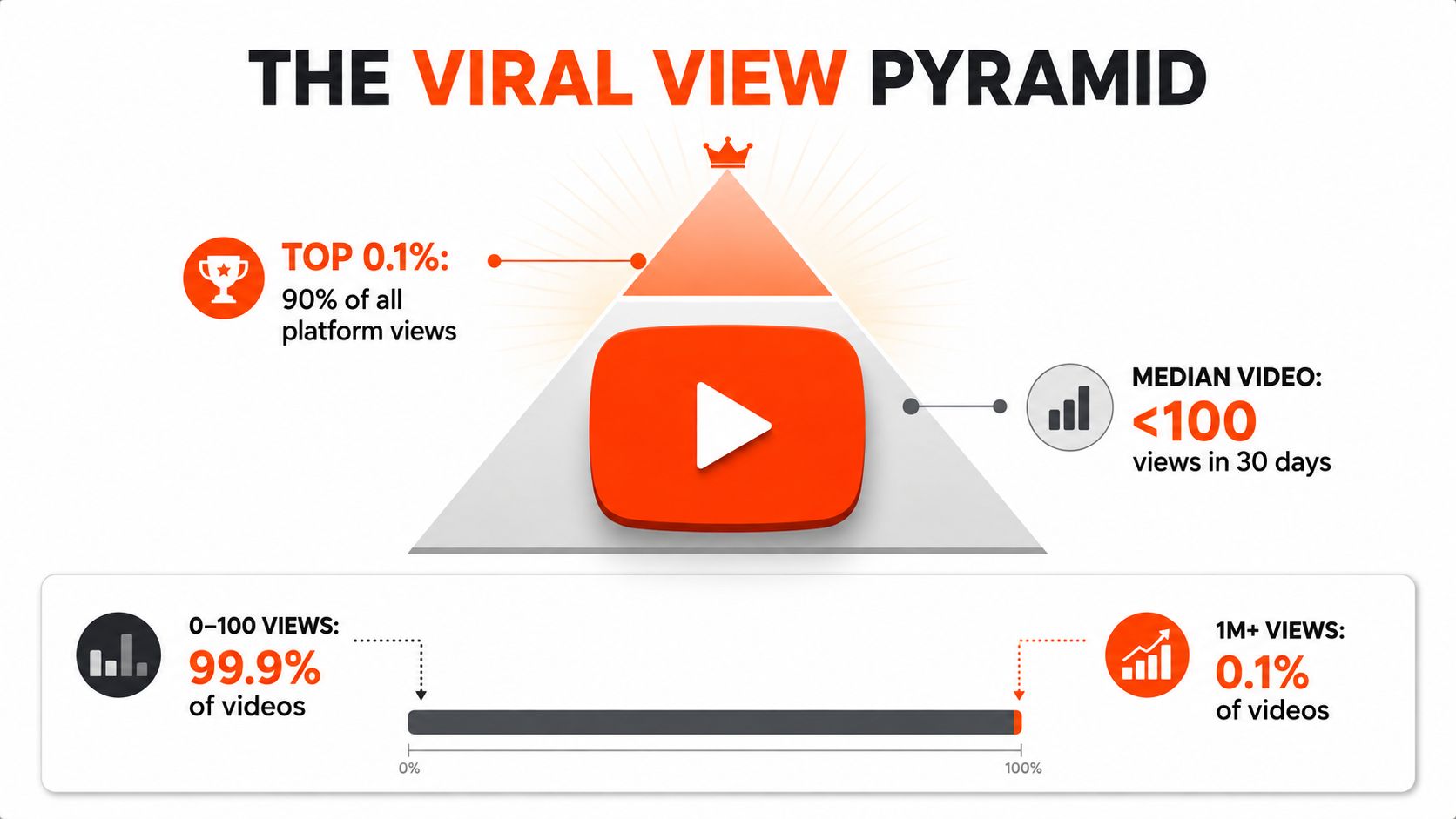
The chain starts with a clear audience promise. A relevant, surprising, emotional, useful, or socially meaningful idea can earn attention. The title and thumbnail turn that idea into a click decision, while the opening must confirm that the viewer made the right choice. Structure, editing rhythm, captions, sound, and format then determine how easily the video holds attention.
The signals do not carry equal weight in every format. Shorts can be judged heavily through rapid viewing behavior, replays, and completion patterns, while long-form videos give more room for sustained watch time and session value. A high click-through rate can bring viewers in, yet weak retention suggests that the package promised more than the video delivered. Strong retention with a weak click-through rate points to a different problem: the content works for those who enter, but its packaging does not earn enough impressions.
Sharing adds another layer. Viewers pass along videos that help them express identity, begin a conversation, solve a problem, or give someone else a memorable experience. A polished upload may satisfy its audience without spreading if it offers no clear reason to send it onward.
Practical rule: Design one connected path from impression to share. Treat the package, opening, viewing experience, and response as parts of the same product.
The algorithm amplifies viewer behavior, but its role remains contested because distribution is shaped by context, competition, and changing recommendation systems. Creators can improve the chain without assuming that any single metric guarantees reach. Ask where the last upload lost momentum: at the impression, the click, the opening, the payoff, the reaction, or the share.
<a id="the-three-forces-behind-every-viral-video"></a>
The Three Forces Behind Every Viral Video
Virality looks mysterious when creators examine only the final result. The process becomes easier to read when you separate the forces that create it.
Psychology creates the initial desire. Viewers don't click because a creator worked hard. They click because the idea appears to solve a problem, reveal something unknown, produce an emotion, or help them participate in a social moment. A title such as “I Tested the Cheapest Camera Setup” creates a concrete question. A vague title such as “My New Video Setup” gives the audience little tension to resolve.
Algorithmic signals determine whether the initial response earns more distribution. Click-through rate tells YouTube whether the package attracts viewers from an impression. Retention and watch behavior show whether the content fulfills enough of the promise to hold attention. Likes, comments, shares, subscriptions, and other actions add context about the strength of the response. Independent engagement research found that likes had the strongest positive association with several downstream behaviors, including viewing, sharing, commenting, subscribing, playlist additions, longer viewing, and full-video completion. The peer-reviewed engagement analysis also describes a recommendation feedback loop in which stronger engagement can accompany greater recommendation exposure.
Production craft converts the idea into evidence. A strong hook makes the promise understandable quickly. A deliberate thumbnail reduces confusion. A changing visual rhythm prevents the video from feeling static. A payoff structure gives the viewer a reason to continue rather than merely confirming that the premise exists.
These forces can compensate for one another, but only temporarily. A highly emotional concept may overcome average editing. A powerful creator relationship may overcome an ordinary thumbnail. A technically polished video may earn trust without producing broad sharing. Breakout videos usually align all three: a compelling reason to care, measurable viewer response, and an experience that delivers quickly.
Before changing your strategy, audit recent uploads through this lens. Write down the promise, the first meaningful payoff, the likely reason to share, and the point where a viewer could leave. That audit often reveals a fix more useful than another generic instruction to “post consistently.”
<a id="the-psychology-that-makes-people-click-and-share"></a>
The Psychology That Makes People Click and Share
A viewer's decision begins before playback. The title and thumbnail create a mental question, emotional reaction, or perceived benefit. If that reaction is strong enough, the viewer invests attention to resolve it.
<a id="curiosity-needs-a-clear-object"></a>
Curiosity needs a clear object
Curiosity works when the audience can identify what it wants to learn. A challenge-style title can combine scale, stakes, and novelty. MrBeast's familiar challenge framing works because the audience can immediately understand the contest while still wondering who will win, what will happen, and how far the premise will go.
High-stakes reveals use a similar structure. The creator withholds the outcome but shows enough evidence that the outcome matters. This creates an open loop. The viewer doesn't need every detail upfront, but they do need a specific question that the video promises to answer.
Vague mystery is weaker than concrete uncertainty. “You Won't Believe What Happened” hides the subject, the stakes, and the reason to care. “I Used a Budget Microphone for a Professional Voiceover” gives the viewer a defined comparison and a possible result.

<a id="emotion-gives-sharing-a-purpose"></a>
Emotion gives sharing a purpose
People share videos that help them communicate. A funny clip lets someone entertain a friend. A surprising explanation lets someone appear informed. A moving story lets someone express empathy. A controversial argument lets someone signal agreement, criticism, or group identity.
High-arousal emotions often create stronger action than mild approval, but emotional intensity alone isn't enough. The feeling needs a specific trigger, such as an unexpected transformation, an impossible constraint, a satisfying solution, or a conflict with a visible outcome.
Audience question: If a viewer shares this video, what are they saying about themselves or the person receiving it?
Social proof adds another layer. Comments, visible reactions, recurring formats, and familiar creators can reduce uncertainty about whether a video deserves attention. Pattern interrupts then create the first moment of attention through motion, contrast, a direct statement, or an unusual visual.
Turn the psychology into controllable choices. Put the open loop in the title, show the stakes in the thumbnail, make the first scene prove that the premise is real, and structure the payoff so the viewer feels rewarded rather than manipulated. A share happens when the video becomes useful as communication, not merely enjoyable in private.
<a id="how-the-youtube-algorithm-amplifies-or-buries-you"></a>
How the YouTube Algorithm Amplifies or Buries You
YouTube's recommendation system is easier to understand as a sequence of decisions rather than a hidden switch that labels a video viral.
<a id="start-with-the-impression"></a>
Start with the impression
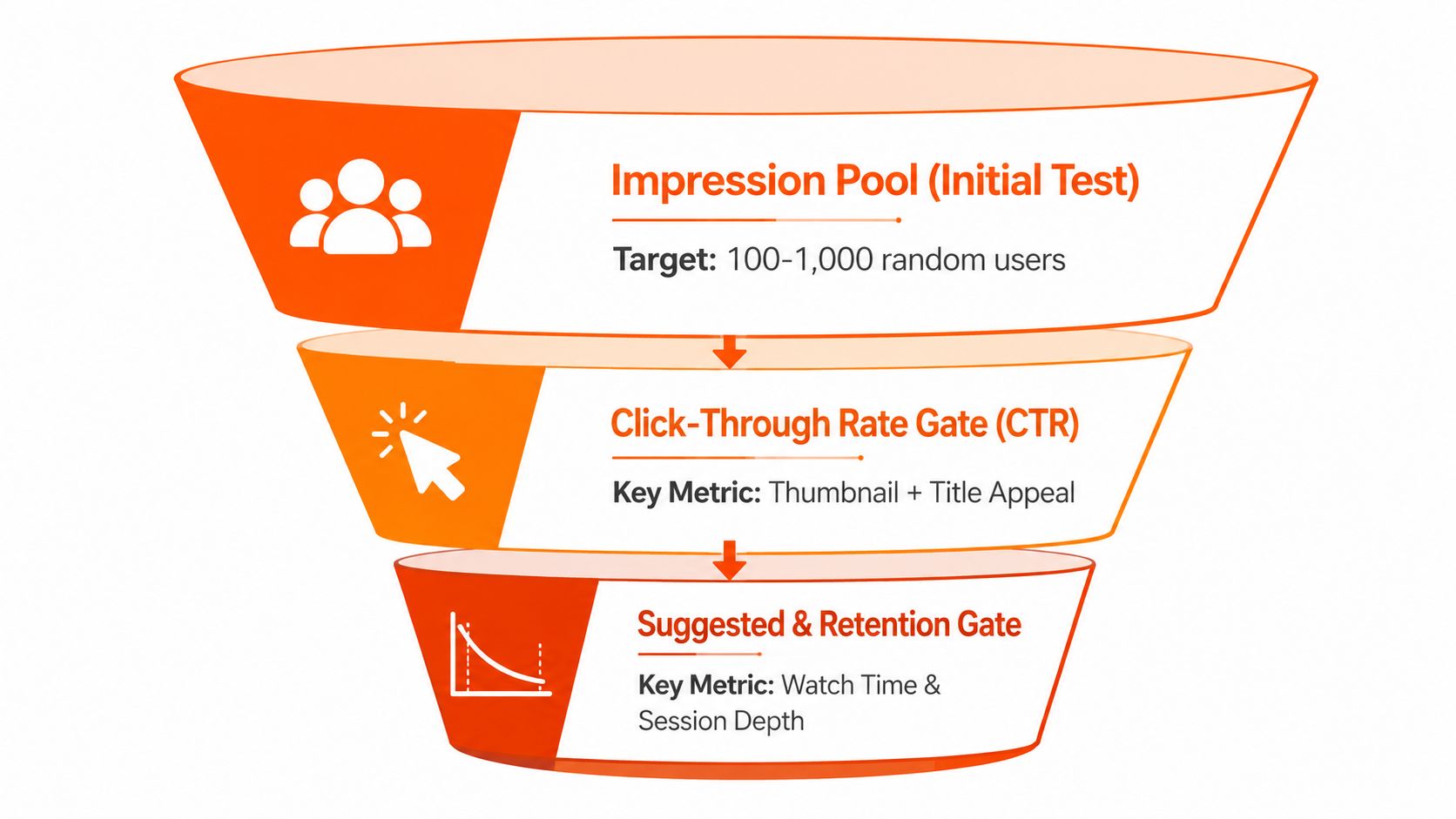
A video first reaches an audience that may include subscribers, viewers from browse features, suggested placements, search results, or other surfaces. The system watches how those viewers respond. The initial audience isn't necessarily random in the everyday sense, but creators should treat it as a test of whether the package makes sense to people who encounter it in context.
The first filter is the title-thumbnail package. A peer-reviewed analysis of newly released YouTube videos found that higher click-through rate was significantly associated with more views, while audience retention and average watch time per view showed little or no predictive power for views in that particular dataset. The study record and analysis support a useful caution: a video can't benefit from strong viewing behavior if its package doesn't generate enough initial clicks.
<a id="defend-the-click-with-the-experience"></a>
Defend the click with the experience
After the click, the opening has to confirm the promise. YouTube exposes audience-retention data to creators as a core engagement metric, making the retention graph one of the clearest places to diagnose a weak opening, an unclear transition, or an overlong explanation. Research on viral YouTube videos also found that days-to-peak and overall viral lifespan have decreased over time, which is consistent with a faster cycle of acceleration and decline. The retention research supports faster testing, sharper openings, and less dependence on a video slowly finding its audience.
Don't treat a single metric as a universal ranking rule. CTR can bring viewers in, but the video still has to earn continued attention. Likes, comments, shares, and other responses help reveal whether viewers found the content meaningful enough to act on.
A practical operating model looks like this:
- Package for recognition: Make the subject and tension clear at a glance.
- Open with proof: Show the problem, test, conflict, or result before delivering background.
- Create forward motion: Every segment should answer a question, introduce a complication, or deliver a useful development.
- Invite relevant response: Ask for an opinion that naturally follows from the video instead of adding a generic engagement request.
For creators who want a broader workflow around optimize content and retention, the important principle is diagnosis. Don't blame “the algorithm” until you've checked whether viewers clicked, stayed, and responded.
Recommendation systems matter, but they don't make virality a lottery. A 2025 PubMed-indexed study using counterfactual bots found that exclusive reliance on YouTube recommendations produced less partisan consumption on average, and that sidebar recommendations could forget a partisan preference within roughly 30 videos when users shifted toward moderate content. The PubMed-indexed research complicates the idea that extreme content automatically receives unstoppable amplification. Packaging and viewer preference still matter.
<iframe width="100%" style="aspect-ratio: 16 / 9;" src="https://www.youtube.com/embed/SIp7MeYbz8U" frameborder="0" allow="autoplay; encrypted-media" allowfullscreen></iframe><a id="production-choices-that-lift-retention-and-reach"></a>
Production Choices That Lift Retention and Reach
Production decisions become visible in the retention graph. The opening, edit rhythm, visual clarity, and payoff placement determine whether the viewer experiences progress or friction.
<a id="build-the-opening-in-layers"></a>
Build the opening in layers
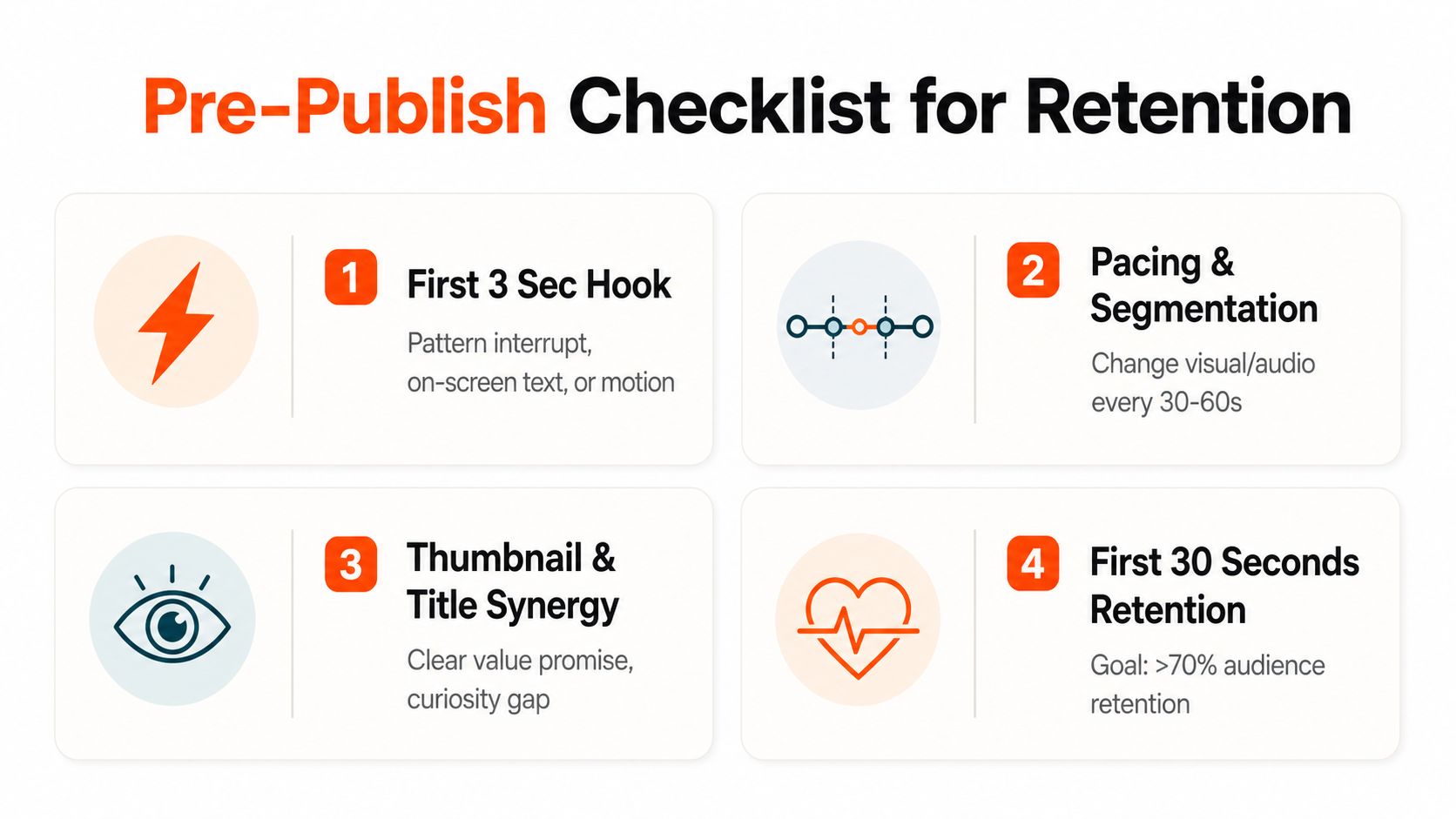
The first few seconds need an interruption. Use motion, a striking image, on-screen text, a direct result, or an immediate problem. The interruption doesn't need to be loud or sensational. It needs to make the viewer understand why this moment deserves attention.
The first half-minute then expands the promise. Show what will be tested, compared, built, revealed, or solved. Avoid spending the opening on greetings, long logos, or context that the viewer can't yet value.
A useful structure is:
- First moment: Establish the visual or verbal disruption.
- Opening beat: State the specific problem or challenge.
- Early development: Show proof that the premise is underway.
- First payoff: Deliver a result or reveal before the viewer has to wait too long.
<a id="make-the-package-readable-on-a-phone"></a>
Make the package readable on a phone
A thumbnail should communicate one dominant idea. Use a clear subject, strong contrast, a face with an understandable emotion when a face belongs in the story, and limited text that remains legible at a small size. The title should add information rather than repeat the thumbnail.
Don't treat title length as a magic formula. Treat every word as a decision about clarity, tension, and audience fit. A thumbnail showing a damaged laptop paired with “Can This Still Run a Full Edit?” creates a different expectation from a thumbnail showing a finished project paired with “I Edited It on the Cheapest Laptop.”
Creators should review package variations before publishing, not after a weak launch. A testing workflow may compare different subject emphasis, promise wording, or emotional framing while keeping the underlying video unchanged. For broader guidance on Surnex's video SEO guide, focus on the connection between discoverability, metadata, and the viewer's first decision.
<a id="edit-for-forward-movement"></a>
Edit for forward movement
Cut dead space, but don't remove every pause. A pause can create emphasis when the viewer understands why it exists. Change the visual, audio, example, or question when the current beat has delivered its value. Chapters can help viewers find their way around long-form content, while mid-video questions create a reason to continue.
Shorts need a different edit. A successful long-form excerpt often requires a new vertical composition, a faster setup, and a hook that appears immediately. Use subtitles when adding captions to your video so the idea remains understandable when viewers watch without sound.
<a id="shorts-vs-long-form-and-what-changes-by-format"></a>
Shorts vs Long-Form and What Changes by Format
Shorts and long-form videos shouldn't share one universal viral formula. A 2026 comparative analysis of recommendation behavior across the formats, together with an independent analysis of more than 300,000 high-performing videos and 62.6 billion views, points to meaningful differences in how format, emotion, title length, thumbnail text, and duration interact. The comparative research is best read as a warning against applying one format's signals to another.
| Signal or Tactic | Shorts under 60s | Long-Form 8+ min |
|---|---|---|
| First decision | Swipe or continue | Click from browse, search, or suggested |
| Opening | Immediate visual or verbal hook | Title-thumbnail promise confirmed quickly |
| Viewing pattern | Completion, replay, and fast interaction | Sustained viewing and movement through the session |
| Structure | One idea, escalating beat, clean loop | Multiple developments, examples, and payoff points |
| Visual design | Vertical framing and readable captions | Thumbnail composition plus wider scene design |
| Best use case | A compact idea with instant recognition | A topic requiring context, proof, or detailed instruction |
Shorts should make the central action visible immediately. A recipe, transformation, reaction, or visual trick can begin at the moment of change, then provide just enough context to make the result satisfying. Loop-friendly endings can encourage another viewing, but the loop should feel natural rather than mechanically repeated.
Long-form gives the creator more room to establish authority and complexity. That room creates a risk. If the video delays the first useful development, viewers may leave before the structure has earned their patience. Use chapter-like progression, visible stakes, and intermediate payoffs so the audience can feel movement through the topic.
Choose the format based on audience intent. Use Shorts when the idea can be understood and felt quickly. Use long-form when the viewer needs comparison, explanation, demonstration, or a complete process. A creator can extract both formats from one subject, but shouldn't just crop the long-form edit and expect the same response.
For creators managing publishing across channels, schedule videos with Donivo can help organize format-specific planning. When building supporting visuals from still assets, turn a picture into a video with an appropriate motion concept, then judge the result by the format's viewing behavior rather than by production effort alone.
<a id="three-real-viral-videos-and-what-made-them-spread"></a>
Three Real Viral Videos and What Made Them Spread
Named viral examples are useful only when you analyze the mechanism rather than copy the surface. MrBeast-style challenge videos, emotional Shorts, and niche explainers can all spread, but they earn attention in different ways.
| Video Type | Primary Pillar | Key Trigger | Share Driver |
|---|---|---|---|
| High-stakes challenge | Psychology | Clear rules, visible stakes, escalating outcomes | Viewers send it to people who enjoy spectacle or competition |
| Emotional Short | Production craft | Immediate expression, tight loop, fast payoff | Rewatching and emotional identification |
| Niche explainer | Audience trust | Specific problem, walkthrough, credible detail | Viewers share it as a useful answer inside a community |
A high-stakes challenge carries its own narrative engine. The audience understands the rules, sees the consequences, and waits for the next escalation. The creator doesn't need to explain every reason to watch because the structure produces a sequence of questions. Social sharing extends the experience beyond the existing audience because viewers can invite others into the challenge.
An emotional Short depends more heavily on the first visual beat. The expression, gesture, or unexpected turn must arrive before the viewer has time to question the premise. A clean loop can make the ending feed the beginning, while a caption can invite interpretation without manufacturing an empty argument.
An unexpected long-form explainer spreads through usefulness and authority. It might answer a narrow technical question, walk through a difficult process, or expose a common mistake. Cross-community sharing can introduce the video to viewers who weren't searching for the channel but immediately recognize the problem.
The pattern is more valuable than the celebrity. Ask which pillar carried your own idea. Psychology creates the invitation, algorithmic response expands the test, and production craft makes the promise worth passing on. A smaller creator can use the same logic with a narrower topic, clearer stakes, and a more specific audience.
<a id="your-30-day-virality-action-plan"></a>
Your 30-Day Virality Action Plan
A month of structured testing is more valuable than repeatedly publishing without a diagnosis. Keep the plan narrow enough that you can identify which change affected the response.
<a id="week-one-focuses-on-observation"></a>
Week one focuses on observation
Study five strong videos in your niche. Record the title promise, thumbnail subject, first meaningful payoff, recurring visual pattern, emotional trigger, and likely reason viewers share them. Compare those observations with your own retention graphs and comments. Look for a repeated audience problem rather than copying a competitor's wording.
<a id="week-two-tests-packaging"></a>
Week two tests packaging
Create multiple thumbnail concepts and title variations before the upload is scheduled. Change one meaningful variable at a time, such as the subject, promise, contrast, or question. Track click-through behavior alongside the audience context, because a package can appeal to one viewer group while confusing another.
Use this week to write several opening lines for the same idea. Choose the version that communicates the stakes fastest without making a promise the video can't fulfill.
<a id="week-three-improves-the-viewing-experience"></a>
Week three improves the viewing experience
Re-edit the opening for immediate proof. Remove unnecessary setup, add a visual development, and place a useful or emotional payoff earlier. Create a Short from the strongest moment, but rebuild it for vertical viewing rather than treating it as a simple excerpt.
If a multi-tool workflow slows experimentation, automate video editing with ClipNova's workflow as one option for assembling scripts, voiceover, visuals, captions, music, and alternate aspect ratios. Use the saved time to review the actual viewer response, not to produce more versions without a hypothesis.
<a id="week-four-accelerates-relevant-distribution"></a>
Week four accelerates relevant distribution
Publish a community post that frames a real question from the video. Send the upload to people who have previously responded to similar topics, and place it inside a relevant end-screen path or playlist. Cross-platform sharing should give each audience a reason to watch, rather than repeating the same generic announcement everywhere.
Run this pre-publish audit:
- Promise: Can a viewer explain the video's value from the title and thumbnail?
- Opening: Does the first scene prove the premise quickly?
- Retention: Does each segment add a question, development, example, or payoff?
- Format: Was the edit designed for Shorts or long-form behavior?
- Sharing: Can you name the person or group most likely to send it onward?
Repeat the audit for every upload. Virality isn't a guarantee you can manufacture, but it is a system you can improve by testing the path from click to continued attention to meaningful sharing.
ClipNova helps creators turn prompts, links, or topics into publish-ready videos with scripting, voiceover, visuals, captions, music, multilingual voiceover, and exports for vertical, square, and widescreen formats. Visit ClipNova to create packaging variants and format-specific videos faster, then use your audience data to decide which ideas deserve another test.
Ready to ship your own?
Start creating viral videos with AI in under twenty minutes, no credit card required.