
UGC marketing is using content made by customers and other unpaid users, such as reviews, photos, videos and testimonials, in a brand's marketing because shoppers trust peer experience.
You might already have a customer photo in your inbox and a product review that explains your offer better than your latest ad. The practical question is how to use that material responsibly, and how to distinguish it from paid creator videos or AI-made ads that merely look like customer content.
Table of Contents
- What UGC Marketing Means in Plain Terms
- Why Shoppers Trust Content From Other People
- UGC Formats and Where Each One Fits
- How UGC Ads Work and What to Measure
- Where Authentic UGC Turns Into a Misleading Ad
- How to Launch Your First UGC Ad Test
- Start Your First UGC Ad Test This Week
<a id="what-ugc-marketing-means-in-plain-terms"></a>
What UGC Marketing Means in Plain Terms
Say a friend recommends a coffee grinder. They explain that it fits under their kitchen cabinet and show you how easily the grounds container comes out. That's more useful than a brand calling its grinder convenient.
Now suppose the grinder company gets permission to reuse that recommendation on its product page. The customer's experience becomes part of the company's marketing. That's user-generated content, or UGC, put to work.
The foundation is peer credibility, not a particular camera angle or editing style. In Nielsen's 2012 Global Trust in Advertising study, 92% of respondents trusted earned media, including recommendations from friends and family, more than other advertising formats, while 70% trusted online consumer reviews.
<a id="what-counts-as-customer-content"></a>
What counts as customer content
Useful material can come from several places:
- Reviews and ratings capture a customer's assessment.
- Customer photos show ownership and everyday context.
- Unboxing clips reveal packaging and initial setup.
- Testimonials explain an actual experience.
- Social posts show how people incorporate a product into their lives.
A person appearing on camera doesn't automatically make a video UGC. The distinction is who created the message and whether it reflects real experience.
If you need commissioned material instead, Sup's resource for finding UGC creators can help you explore that route. Treat a hired creator's work as paid creator content, even when the industry calls it UGC.
Practical rule: If a real user made it and the brand reuses it with permission, it's UGC. If the brand hired someone to deliver the message, it's paid creator content.
<a id="why-shoppers-trust-content-from-other-people"></a>
Why Shoppers Trust Content From Other People
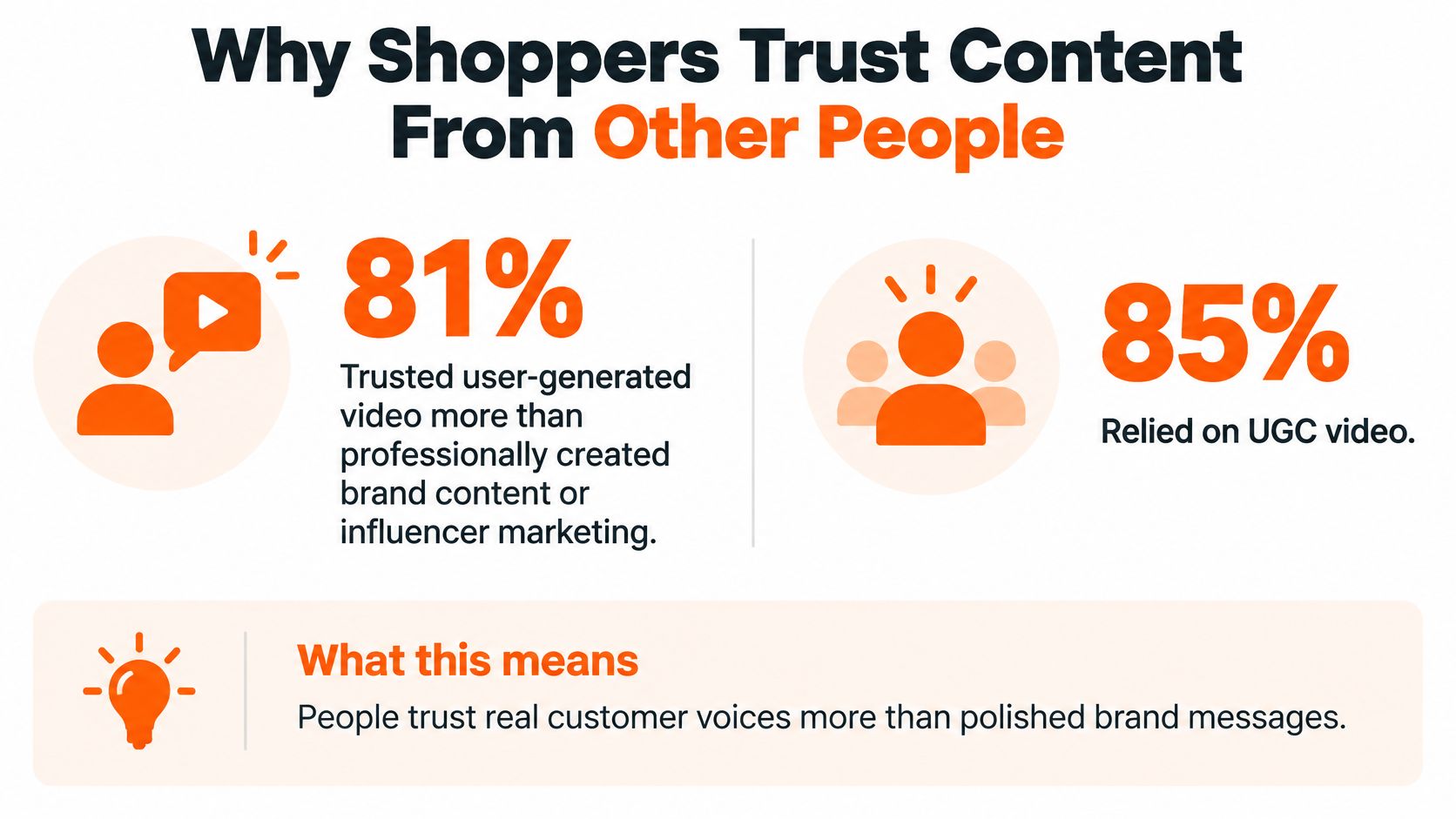
In 2024, 81% of consumers said they trusted user-generated video more than professionally created brand content or influencer marketing, while 85% relied on UGC video before making a purchase, according to MASV and Dynata.
These findings describe trust and reported reliance, not guaranteed sales. They help explain why a useful customer video can deserve a place beside professionally produced product information.
<a id="credibility-comes-from-recognizable-context"></a>
Credibility comes from recognizable context
A shopper knows a company has a reason to praise its product. A customer's account offers another perspective, particularly when it includes specific details rather than broad compliments.
For example, a skincare customer's bathroom photo of an opened jar can help another shopper understand the cream's texture. A studio photograph might show the packaging beautifully without answering that question.
Believable context matters more than deliberate roughness. You don't need shaky footage or bad lighting. You need a clear view of something a prospective buyer wants to evaluate.
<a id="useful-evidence-reduces-uncertainty"></a>
Useful evidence reduces uncertainty
Customer material can answer questions about fit, storage, setup, appearance or ease of use. It also gives a brand reusable assets for product pages, email and social posts, provided the permissions cover those placements.
But a customer photo can't repair an unsuitable product. Nor does someone's positive experience establish that everyone will get the same result.
Before collecting content, make a short checklist:
- Buyer doubt: What do people ask support before ordering?
- Visible answer: Would a photo, demonstration or detailed review resolve it?
- Missing context: Does the viewer need dimensions, usage conditions or limitations?
The content that answers those questions is the first UGC you need. Start with buyer uncertainty, not a demand for more videos.
<a id="ugc-formats-and-where-each-one-fits"></a>
UGC Formats and Where Each One Fits
The 2024 Bazaarvoice Shopper Experience Index, summarized by Revid, reported that 65% of global shoppers relied on UGC, including ratings, reviews, photos and videos, in buying decisions.
UGC isn't a single video format. This comparison separates customer evidence from the paid and synthetic formats often sold under the same label.
<a id="ugc-formats-who-makes-them-and-where-they-fit"></a>
UGC formats, who makes them and where they fit
| Format | Who makes it | Best placement | Effort for the brand |
|---|---|---|---|
| Star ratings and written reviews | Verified customers | Product pages and category pages | Low, collected through a review tool |
| Customer photos | Customers who bought the product | Product pages, email and organic social | Low to medium, needs usage permission |
| Unboxing and demo clips | Customers or small creators | Paid social and organic short video | Medium, needs a clear brief and a release |
| Testimonial videos | Real customers, filmed with a release | Landing pages and paid ads | Medium to high, needs scheduling and editing |
| Creator-style UGC ads | Paid creators under contract | Paid social ads | Medium to high, includes creator fees and disclosure |
| AI-made UGC-style ads | The brand, using a saved character and original scenes | Paid social tests and variant testing | Low per variant, disclosure required where applicable |
Reviews and ratings help shoppers compare experiences. Put them where people evaluate the product, rather than hiding them on a separate testimonials page.
Customer photos add visual context. Unboxing and demonstration clips serve a different purpose: they show the steps between receiving a product and getting value from it.
Testimonials need enough room for the customer's circumstances and outcome. Paid creator ads can follow a tighter sales structure, while AI-made versions are advertising assets, not independent customer evidence. When planning narration for those versions, compare AI voiceover tools for clarity and pronunciation, not just vocal style.
Store the permission record beside the asset, not in someone's inbox.
Collect usage rights during submission, specify intended placements, and tag files by product and buyer question. A kitchen-counter photo tagged for storage size is easier to reuse than a file called customer-final-new.
The right format follows the buying situation. A shopper comparing specifications needs different evidence from someone encountering a product for the first time in a feed.
<a id="how-ugc-ads-work-and-what-to-measure"></a>
How UGC Ads Work and What to Measure
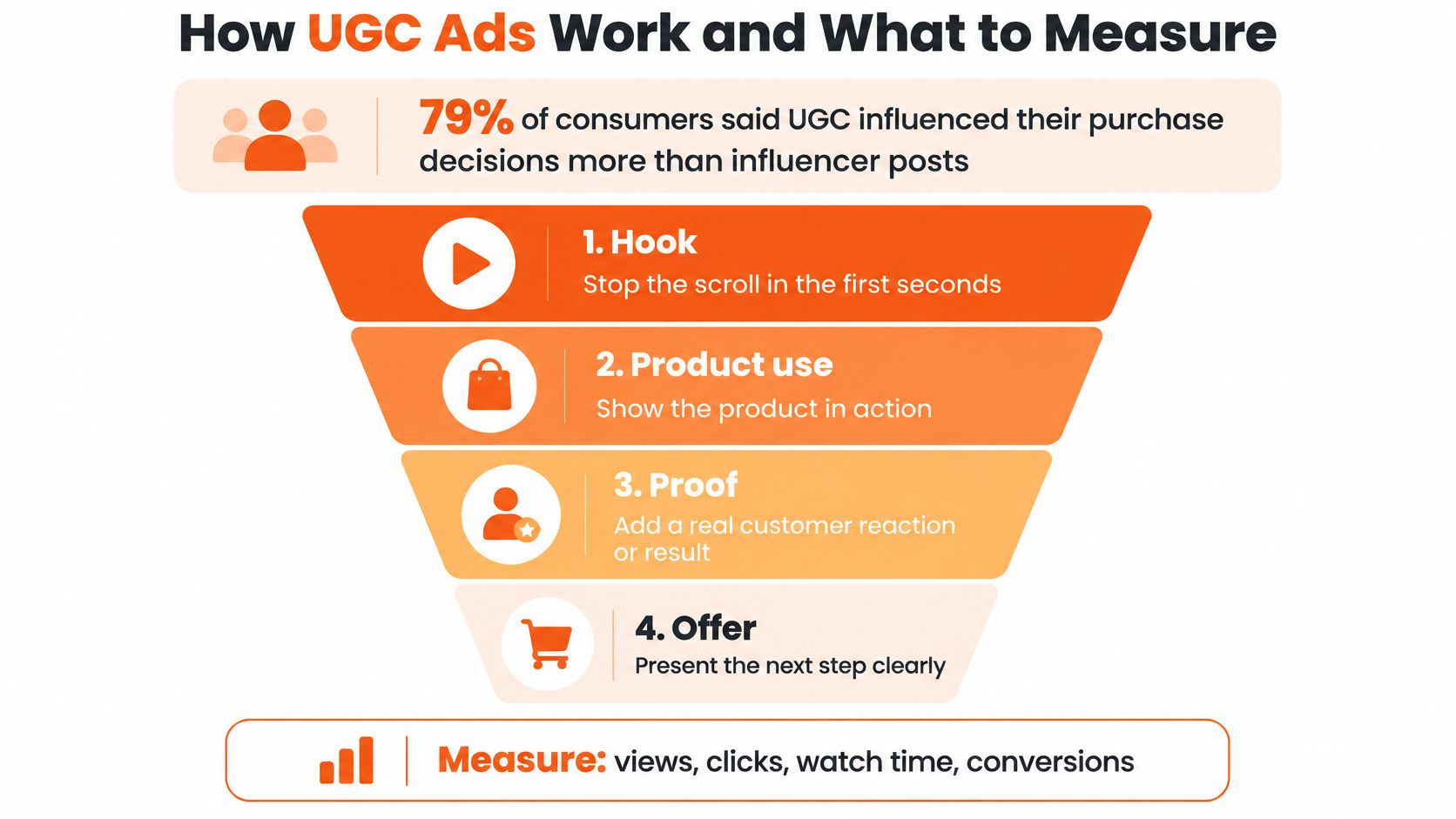
In 2024, 79% of consumers said UGC influenced purchasing decisions more than influencer posts, according to a creator-economy report covered by NetInfluencer.
Build the ad around a clear sequence:
- Hook: Name a problem the viewer recognizes in the first three seconds.
- Speaker: Use a natural setting appropriate to the product.
- Product use: Show the feature clearly, rather than only holding the packaging.
- Proof: Include a sourced review, accurate demonstration or substantiated result.
- Action: Give the viewer a single next step.
Readable captions help viewers follow the message. A caption generator for video can assist production, but check product names and proof statements manually.
<a id="ugc-ad-metrics-by-funnel-stage"></a>
UGC ad metrics by funnel stage
| Metric | What it tells you | Funnel stage |
|---|---|---|
| Three-second hook retention | Whether the opening stops the scroll | Attention |
| Watch-through rate | Whether the message holds the viewer to the end | Attention to interest |
| Click-through rate | Whether the offer earns a visit to the product page | Consideration |
| Conversion rate | Whether visitors buy | Purchase |
| Cost per acquisition | Whether each sale costs less than its margin | Purchase |
| Refund or complaint rate | Whether the claims matched the product | Quality check |
Read performance at the weakest stage. Strong viewing with weak clicks suggests a different problem from strong clicks with weak purchases.
For connecting campaign costs to business outcomes, Cometly offers a framework for measuring marketing ROI. Views alone don't establish that an ad sells profitably, so keep the test conditions stable.
<a id="where-authentic-ugc-turns-into-a-misleading-ad"></a>
Where Authentic UGC Turns Into a Misleading Ad
Looking authentic isn't the same as being authentic. Viewers may interpret a face, voice or first-person story as evidence that someone used the product.
Keep these categories separate:
- Customer-originated UGC: An unpaid user's account of their experience.
- Paid creator content: Commissioned material with a commercial relationship.
- Licensed-likeness ads: Creator-style advertising made using authorized identity assets.
- Fictional or AI-generated testimonials: Synthetic statements that can falsely imply personal experience.
<a id="a-convincing-demonstration-isnt-proof-of-use"></a>
A convincing demonstration isn't proof of use
The U.S. Federal Trade Commission's consumer-reviews and testimonials guidance explains that material connections must be disclosed clearly and that testimonials can create liability when they misrepresent someone's experience or imply use that didn't happen. The FTC doesn't impose a blanket ban on AI avatars, but required disclosures must be clear and conspicuous, and advertising claims still need substantiation.
For customer content, preserve what the person meant. For paid creators, make the relationship understandable and don't script experiences they haven't had.
With licensed likenesses or synthetic characters, authorization to use a face doesn't establish that the person used or endorsed a product. For campaign planning, Rapid Ads' explanation of substantiation rules for Meta campaigns is a useful supplementary resource.
An AI presenter accurately explaining a real product feature, labeled where required, is an advertisement. An invented testimonial claiming that a user lost weight within a month misrepresents an experience. Adding an AI label doesn't make an unsupported health claim acceptable.
Before publishing, ask:
- Real use: Did the person whose experience is described use this?
- Commercial context: Will viewers understand that it's paid?
- Evidence: Can every factual claim be backed?
- Identity: Could viewers misunderstand who is speaking?
A synthetic presenter can explain evidence. It can't become the evidence by appearing believable.
<a id="how-to-launch-your-first-ugc-ad-test"></a>
How to Launch Your First UGC Ad Test
Start with a narrow buying question, not a broad request for authentic content. You want to learn which explanation helps the right shopper move toward a purchase.
The workflow is straightforward when you keep collection, production and evaluation separate.
<a id="build-a-comparison-you-can-interpret"></a>
Build a comparison you can interpret
-
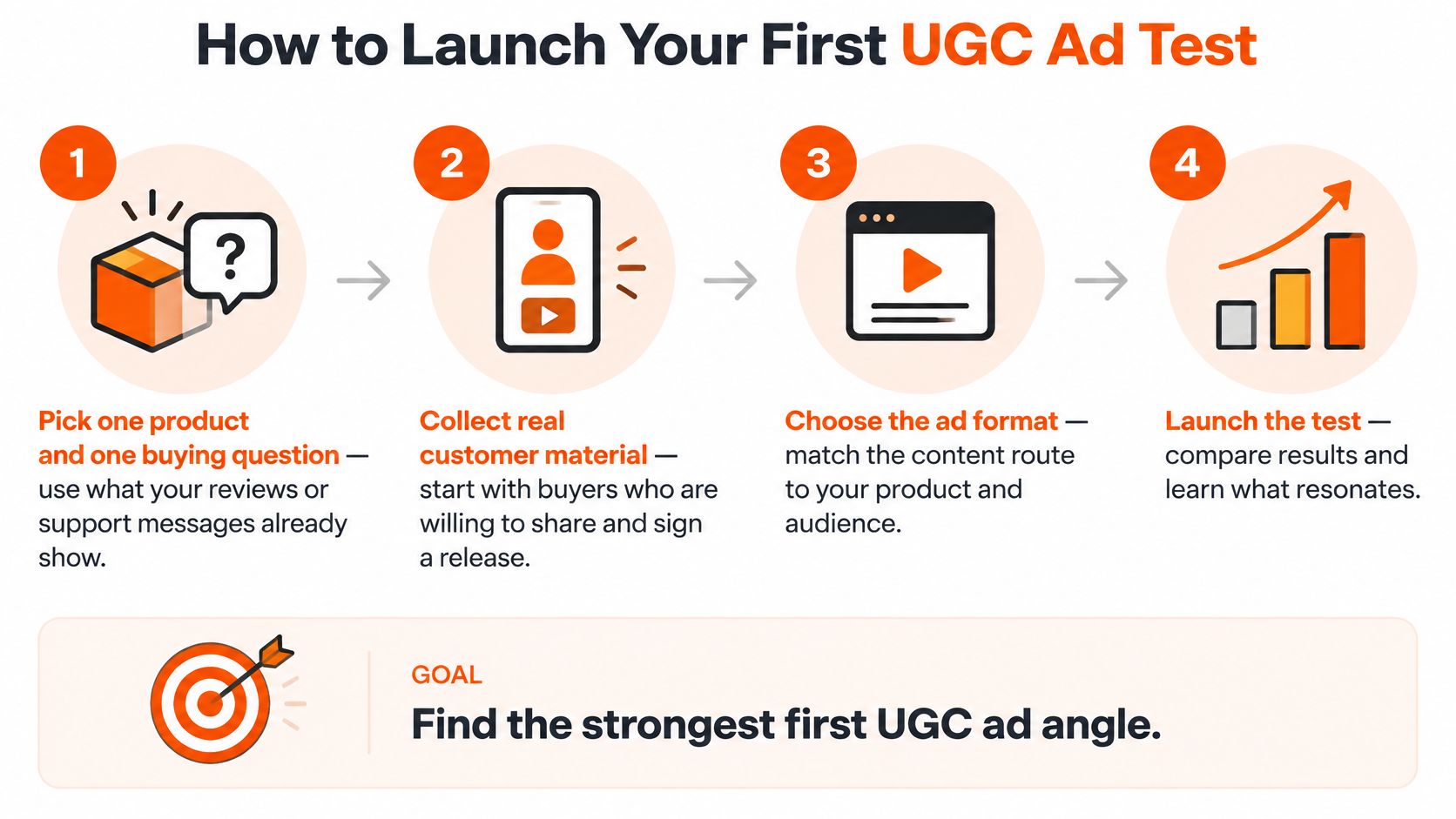
Choose a product and a buying question. Read reviews and support messages for recurring hesitation. For a coffee grinder, the question might be whether cleanup is awkward, rather than whether the product is good.
-
Collect customer material first. Ask recent buyers for photos, short videos and permission covering your intended use. Keep each release beside its file so your editor doesn't have to guess what can run in advertising.
-
Write three problem-led hooks. As a hypothetical exercise, try cleanup frustration, limited counter space and confusing setup. Each opening should lead naturally into evidence that answers that particular concern.
-
Build controlled variants. Hold the product, offer, landing page, audience and spend allocation steady, changing a single creative element at a time. If you use AI-made creator-style content, record the disclosure and verify the spoken claims and visual representation before uploading.
-
Set a budget and test window in advance. For example, you might plan a seven-day test, but that's a scheduling choice, not a guarantee of sufficient evidence. Don't declare a winner when a variant has barely received delivery or generated too few purchases to judge.
-
Read results in sequence. Check hook retention, click-through rate, conversion rate, cost per acquisition and refunds. A clip that attracts curious viewers but produces disappointed buyers isn't a useful winner.
-
Keep what worked and document why. Record the buying question, proof line and result before creating the next round. Retire weak variants, but avoid treating a small difference as a settled finding.
When you automate video editing, use consistent file names and a variant log. Record exactly what changed so production speed doesn't erase the comparison you're trying to make.
<a id="avoid-breaking-your-own-test"></a>
Avoid breaking your own test
Changing the landing page mid-test makes interpretation harder. If the page must change, document the change and separate the results rather than attributing everything to the creative.
Choosing by views alone favors watchability without proving commercial value. A funny opening can draw attention from people who will never need the product.
Keep a decision log containing the variant, spend, purchases and complaints. That gives the next test a concrete starting point instead of another round of guesses.
<a id="start-your-first-ugc-ad-test-this-week"></a>
Start Your First UGC Ad Test This Week
Choose your content route first. Use customer material when buyers can share relevant experiences, hire a creator when you need a contracted performance, or make AI-style variants when you need repeatable production without presenting them as customer testimony.
Plan the content and evidence together before production.

ClipNova AI makes finished videos up to 5 minutes at up to 1080p, including script, original scenes, voiceover, captions and background music in one pass. Saved characters retain the same face and outfit; Series supports a cast of up to 8 characters across episodes with story memory, and characters can speak with lip sync.
We offer narration in 18 languages, exports in 9:16, 16:9 or 1:1, and plans from $19 per month with commercial rights. Our AI Product Video Generator, AI Ads Generator, AI Video Ad Generator and AI UGC Video Generator serve creators, marketers, agencies and businesses making ads, explainers, short-form videos and faceless content without filming or editing.
Unlike shot generators such as Runway, Kling, Veo and Hailuo, ClipNova produces the whole story. It makes original character scenes rather than the stock-footage templates associated with InVideo and Pictory, extends beyond shorts-focused Revid, StoryShort and Zebracat, and tells stories rather than only making presenters like HeyGen and Synthesia.
Watch the video before planning your production workflow.
<iframe width="100%" style="aspect-ratio: 16 / 9;" src="https://www.youtube.com/embed/6zuLlF9yZ8o" frameborder="0" allow="autoplay; encrypted-media" allowfullscreen></iframe>The tool makes the video; it can't prove the claim. Your proof must still come from a real review, verified feature or substantiated result. Make your first video with that evidence ready.
ClipNova AI turns an idea into a finished video with consistent characters, narration and captions. Bring a product, a buyer question and an accurate proof point, then build a clearly presented UGC-style ad you can test.
Ready to ship your own?
Start creating viral videos with AI in under twenty minutes, no credit card required.