
Most advice about a softbox for video light gets this backward. People shop for the biggest modifier they can hang, then wonder why their desk setup feels cramped, their key light floods the room, and their camera still sees hard edges where they wanted softness.
Buy the box that fits your distance, room, and subject size. That's the whole game. A softbox isn't a trophy, it's a coverage tool, and the right one gives you the look you want without forcing your light stand, ceiling height, or wattage budget to do stupid things.
| Softbox Type | Beam Character | Best For | Watch Out For |
|---|---|---|---|
| Rectangular | Window-like, directional | Talking heads, interviews, product flats | Can look plain if pushed too far off axis |
| Octagonal | Rounder wrap, nicer catchlights | Beauty, podcast, portrait-style video | Can be overkill in tight rooms |
| Strip | Narrow and controlled | Rim light, hair light, edge accents | Too skinny for a primary key in most setups |
| Lantern | Soft, wide, ambient fill | Run-and-gun rooms, overhead fill | Spill control is weak unless the room is already tidy |
| Parabolic | Focused wrap with more punch | Narrative, fashion, controlled beauty work | Costs more and demands careful placement |
Table of Contents
- Why Softbox Size Is Not a Simple Upgrade
- What a Softbox Actually Does to Your Light
- Softbox Shapes Compared
- Matching Softbox Size to Room and Subject
- Single vs Double Diffusion
- Mounting Systems and Modifier Compatibility
- Recommended Softbox Setups by Use Case
- Buyer Checklist and Common Questions
<a id="why-softbox-size-is-not-a-simple-upgrade"></a>
Why Softbox Size Is Not a Simple Upgrade
Bigger isn't better, it's just bigger. That sounds obvious until someone puts a huge octa in a small office and discovers the box lights half the room, hits the monitor, and still doesn't solve the exposure problem because the light is too far away to stay soft.
The right way to shop is to treat size as a coverage-and-distance matching problem. The question isn't “What's the largest softbox I can buy?” It's “How far will the light sit from the subject, and how wide is the frame I need to cover?”
If you want a practical visual reference for how creators think through framing and production choices, the guide on making your own movies is a good adjacent read. It won't pick your light for you, but it reinforces the same principle, tools only work when they match the shot you're making.
<a id="size-follows-the-room-not-ego"></a>
Size follows the room, not ego
A softbox works by creating a larger apparent source. Push a big modifier back, and it starts acting smaller relative to the subject. That's why a giant box at distance can look surprisingly ordinary, while a moderate box placed close can look beautifully soft.
For desk work, oversizing is usually the wrong move. You end up fighting spill on walls, screens, and reflective furniture, and the extra fabric and frame just make the stand more annoying to position.
Practical rule: buy the smallest softbox that still covers your frame at your normal shooting distance, then stop there.
For home studio work, the room shape matters as much as the subject. If the light has to sit farther back for framing or clearance, size becomes a necessity, not a luxury.
<a id="what-a-softbox-actually-does-to-your-light"></a>
What a Softbox Actually Does to Your Light
A softbox doesn't create softness out of nowhere. It enlarges the apparent source size of your LED or flash, which makes shadow edges less severe and specular highlights less aggressive on skin, glass, and product surfaces.
That means the modifier and the distance work together. If you move the light farther away, it becomes effectively smaller, so the image gets harder unless you compensate with a bigger modifier or different placement.
<a id="source-size-throw-distance-and-stop-loss"></a>
Source size, throw distance, and stop loss
Think in three terms. Source size is the physical modifier, throw distance is how far the light travels, and stop loss is the exposure you give up to diffusion and distance. Once you understand those three, softbox shopping gets a lot less mystical.
Every extra layer of diffusion costs output. That's not a theory, it's the trade you're making every time you chase a smoother wrap. The point is to spend that output only when the shot benefits from it.
If your light already sits close and you just need flattering skin, keep the setup simple. If your light has to sit back for framing, you need a bigger source, more power, or both.
The inverse-square law is the other half of the decision. As distance increases, intensity drops fast, which is why a softbox that looks perfect at three feet can fall apart at six.
So don't buy based on brand hype. Buy based on how much room you need to cover, how close the light can sit, and how much output your fixture can spare.
<a id="softbox-shapes-compared"></a>
Softbox Shapes Compared
Shape changes the beam just as much as size does. A rectangular box, an octa, and a strip light can all be “soft,” but they won't draw the same catchlights or shape the face the same way.
<a id="match-the-shape-to-the-job"></a>
Match the shape to the job
Rectangular softboxes are the cleanest all-around choice. They mimic window light, they're easy to aim, and they're excellent for interviews, talking heads, and product flats where you want a controlled, familiar look.
Octagonal softboxes are the most forgiving single purchase for most creators. They round the catchlight, wrap the face more naturally, and they look good in beauty, podcast, and portrait-style video.
Strip softboxes are specialists. Use them for rims, hair lights, vertical accents, and anything where you want a narrow beam that stays off the background. If you try to use one as a key light, it usually feels too skinny.
Lantern softboxes spread light in almost every direction. That makes them useful for room fill and run-and-gun work, but they're not the first choice if you need clean spill control.
Parabolic softboxes sit in the sweet spot between wrap and punch. They're the choice when you want more direction than a basic octa and more polish than a generic rectangular box.
| Softbox Shapes at a Glance | |||
|---|---|---|---|
| Shape | Beam Character | Best For | Watch Out For |
| Rectangular | Controlled, familiar | Interviews, product work, talking heads | Can feel flat if placement is lazy |
| Octa | Rounded, flattering wrap | Beauty, podcast, creator portraits | Needs room to breathe |
| Strip | Tight and directional | Rim, hair, edge accents | Too narrow for most key lighting |
| Lantern | Broad, ambient fill | Room lift, casual setups | Spill is hard to tame |
| Parabolic | Focused but soft | Narrative, fashion, premium beauty | More expensive, more finicky |
If you're building a modest kit, I'd buy the octa first. It does the widest range of jobs without making you fight the modifier every time you change format.
<a id="matching-softbox-size-to-room-and-subject"></a>
Matching Softbox Size to Room and Subject
Size only matters after you know the room. A softbox that feels perfect in a small office can be useless in a wider studio, because the same modifier behaves differently as the distance changes.
The safest habit is to match the box to your normal camera-to-subject setup, not to some imaginary future studio. That's also why the people who buy huge modifiers first often end up with the most annoying rigs.
<a id="room-size-decides-the-starting-point"></a>
Room size decides the starting point
In a small home office, a 60×90 cm rectangular softbox is usually the cleanest fit for a desk or talking-head setup. It wraps the face well enough without taking over the whole room, and it's easier to flag than something oversized.
In a larger home studio where the light has to sit farther back, step up to a 90×120 cm box, a 95 cm octa, or a 120 cm parabolic. Those sizes make more sense when the source needs to stay soft at a longer throw.
For full-body frames or two-person interviews, you're often better off adding a second light or moving into a larger modifier with double diffusion. That's not a luxury move, it's how you keep the source large enough relative to the subject.
Here's the hard truth. If the light can't sit where it needs to sit, no softbox will save you. You either increase source size, reduce distance, or accept a harder look.
Buy for the shot you repeat, not the shot you hope to shoot someday.
For creators building around green screen or composited work, background control matters just as much as key softness. A practical reference is background for green screen video, because a bigger softbox can help or hurt depending on how much spill you can manage.
| Softbox Size by Room and Distance | |||
|---|---|---|---|
| Room Type | Subject Distance | Recommended Softbox | Coverage Notes |
| Small home office | Close desk distance | 60×90 cm rectangular | Controlled wrap, easier spill management |
| Compact home studio | Moderate throw | 90×120 cm rectangular or 95 cm octa | Better softness without dominating the room |
| Larger studio | Longer throw | 120 cm parabolic or larger octa | Keeps source large enough at distance |
| Two-person frame | Wider coverage | Large modifier or two-light setup | Single small box usually won't cover evenly |
<a id="single-vs-double-diffusion"></a>
Single vs Double Diffusion
Single diffusion should be your default. It softens the beam enough for most video work, keeps output usable, and doesn't punish lower-power LEDs as badly as a second layer does.
Double diffusion is for when you already have enough light. In a documented test, the first diffusion layer caused only about a 0.2-stop loss, while the second layer pushed the total loss to nearly 0.9 stop overall, which is a real exposure hit on a constant LED source material from the diffusion test.
<a id="when-the-second-layer-earns-its-keep"></a>
When the second layer earns its keep
Use double diffusion when you want creamier skin, softer catchlights, and less edge contrast. It's especially good for beauty, interview, and polished talking-head work where a little extra smoothness improves the frame.
Skip it when the scene already feels dim. If you're near your camera's ISO ceiling, your lens is wide open, or your LED is underpowered, the second layer just steals light you can't spare.
It also changes the look, not just the brightness. Double diffusion lowers contrast enough that product shots can lose shape, which is why it's a better choice for faces than for objects that need edge definition.
Single diffusion gives you the better baseline. Double diffusion is a finishing move, not a default setting.
<a id="mounting-systems-and-modifier-compatibility"></a>
Mounting Systems and Modifier Compatibility
The mount is where a lot of people waste money. They buy a great softbox, then discover it doesn't fit the light they already own, and suddenly the “upgrade” turned into a return, an adapter hunt, or a dead accessory.
Bowens is the safest standard for video creators. It's the most practical choice across a lot of mid-tier LED lights, and it keeps your modifier options wide open.
<a id="standardize-before-you-shop"></a>
Standardize before you shop
If you're buying a new continuous light for video, make Bowens compatibility your first filter. It gives you the broadest access to rod-based softboxes, quick-release options, and future upgrades without locking you into a tiny accessory ecosystem.
Some systems use their own mounts. Profoto, Elinchrom, Broncolor, and Arri all have their own logic, and that's fine if you already live inside that ecosystem. It's a bad idea if you're starting from scratch and want flexibility.
Strip lights and tube fixtures are different again. They often need clip-on fabric modifiers, not a standard rod-built box, so don't assume every softbox works with every light.
Quick-release designs are useful for location work and interview days. They save setup time, but they narrow compatibility, so check the fixture's modifier list before you commit.
If you want one mount to build around, pick Bowens and stop shopping the weird stuff unless you have a specific fixture that demands it.
A softbox for video light should make your workflow easier, not more proprietary. The safer you are on compatibility, the less likely you are to end up with a perfectly good modifier that can't be mounted.
<a id="recommended-softbox-setups-by-use-case"></a>
Recommended Softbox Setups by Use Case
The right buy depends on what you shoot all week, not what looks best on a gear page. That's why I'd make different recommendations for short-form creators, streamers, interview shooters, and product people.
If you're comparing how these kits fit into broader social workflows, Video for blogs is a useful adjacent read because it shows why consistency and speed beat overbuilt lighting in a lot of creator setups.
<a id="buy-for-the-job-you-repeat"></a>
Buy for the job you repeat
For short-form creators and Reels or TikTok shooters, I'd choose a 24-inch rectangular softbox on a single 100W LED, mounted tight to the subject. The look stays consistent, the spill stays manageable, and you're not wasting time chasing a cinematic setup for a frame that only lasts seconds.
For streamers and desktop talking heads, I'd go with a 20-inch or 24-inch octa with double diffusion on a compact Bowens LED, placed camera-left at roughly a 45-degree angle. That gives you a flattering face light without blasting your monitor or reflecting a giant white shape in your glasses.
For interview and podcast work, I'd use a 35-inch octa as key and a 24-inch rectangular softbox as fill, both double-diffused if the lights can handle it. Keep the placement consistent and the distance matched, and the frame looks deliberate instead of improvised.
For product and e-commerce shoots, I'd pair a strip softbox for edges with a medium lantern overhead for overall wrap, or use a parabolic when the product needs premium shaping. Jewelry, glass, and reflective objects need more control than talking heads, so don't use the same logic.
| Softbox Setups by Use Case | ||
|---|---|---|
| Use Case | Setup | Why It Wins |
| Short-form video | 24-inch rectangular on a 100W LED | Fast, tight, reliable |
| Streaming | 20-inch or 24-inch octa with double diffusion | Flattering, screen-friendly |
| Interviews and podcasts | 35-inch octa key plus rectangular fill | Controlled, repeatable, polished |
| Product and e-commerce | Strip plus lantern, or parabolic for jewelry | Better edge control and shape |
For anyone building display or product content, the same framing logic shows up in professional mannequin selection tips. The point isn't mannequins, it's that the subject shape and surface dictate the lighting choice.
<a id="setup-speed-matters-more-than-most-reviews-admit"></a>
Setup speed matters more than most reviews admit
A quick-release softbox can save real time when you're shooting, breaking down, and resetting the same room all day. That matters more than a fancy beam profile if you work alone and need to keep moving.
The newer portable, foldable, and quick-deploy designs are where a lot of the category is heading, especially for creators who care about speed as much as polish market trend overview. The trade-off is simple, faster setup can mean less flexibility or more compatibility headaches.
<a id="buyer-checklist-and-common-questions"></a>
Buyer Checklist and Common Questions
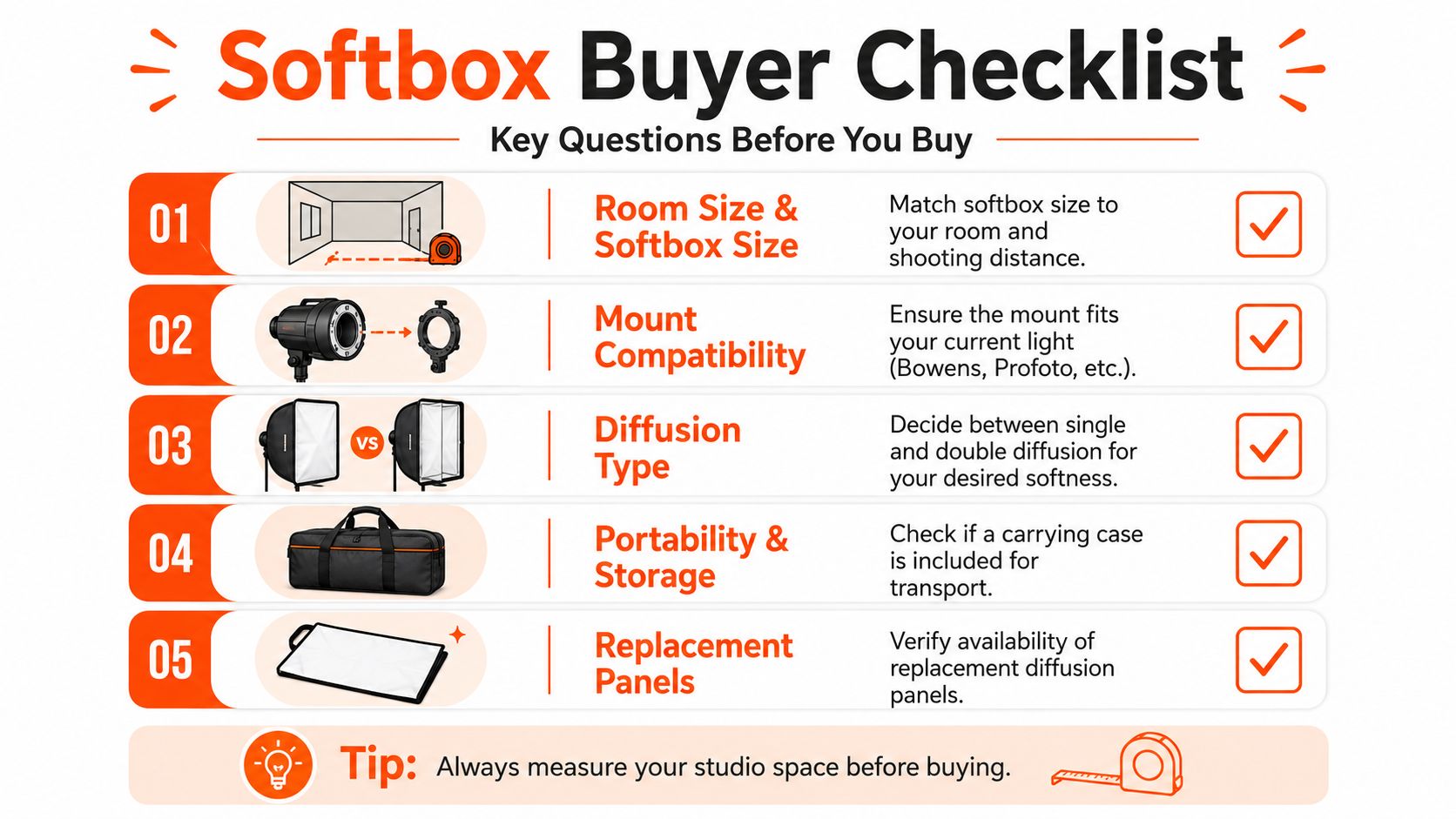
Before you buy, check these five things:
- Room size and distance: Measure where the light will sit, then buy to match that distance.
- Mount compatibility: Confirm the softbox works with your current light, especially if you're choosing between Bowens and a proprietary mount.
- Diffusion choice: Decide upfront whether single diffusion is enough or whether you need the extra softness of two layers.
- Carrying case: If you move between rooms, shoots, or locations, don't ignore storage and transport.
- Replacement panels: Make sure you can replace the diffusion fabric if it gets torn or stretched.
If you want one more practical reference for social-first production planning, Social Media Video Production is a useful way to think about how lighting choices affect fast-turn content.
Here are the questions people keep asking:
How often should you replace diffusion fabric? When it tears, warps, or stops fitting tightly. If the panel is loose or yellowed, replace it, because inconsistent diffusion is visible on camera.
Do LED panels need a softbox at all? Not always, but if you want softer skin and cleaner facial shaping, yes. Bare LEDs are fine for utility, but they're rarely the best look for people.
What size softbox works best for YouTube talking heads? A medium octa or a 60×90 cm rectangular box is the safe default. Go bigger only if your room and power budget can support it.
Can you mix brands with a Bowens mount? Yes, that's the point of Bowens. It's the easiest way to keep future upgrades flexible.
Do softboxes work outdoors in wind? They do, but they're a headache if the modifier is large and the stand isn't weighted. Outdoors, smaller and sturdier usually beats prettier and bigger.
What's the difference between cheap and pro diffusion cloth? Better cloth holds tension more evenly and gives a more consistent beam. Cheap fabric can still work, but it's more likely to sag, wrinkle, or look uneven on camera.
ClipNova is a smart next step if you want to turn a lighting setup into a full content workflow, because the same creator who benefits from a better key light also benefits from faster scripting, voiceover, captions, and export formats. If you're building videos around a softbox for video light, visit ClipNova and see how much of the production stack you can cut down to one place.
Ready to ship your own?
Start creating viral videos with AI in under twenty minutes, no credit card required.