
AI-cloned voice samples were mistaken for genuine human voices in 58% of cases, while fully synthetic voices fooled listeners about 40% of the time, according to a 2024 study summarized in a 2025 publication. That gap changes the search for the most realistic AI voice. You're not choosing the voice that wins a polished demo. You're choosing the voice that stays credible for your listener, in your language, on your script, and under permission you can prove.
A voice can fool people and still be the wrong choice. It may drift over a long read, mispronounce the names your audience knows best, or imitate someone who never agreed to be cloned. Judge realism as a production decision, not a party trick.
Table of Contents
- Which Voice Type Sounds Most Real for Your Goal
- The Criteria That Separate Realistic Voices from Good Demos
- How to Run a Blind Listening Test
- Language Coverage Changes the Ranking
- Consent, Disclosure and Voice Rights
- Use Cases and the Realism That Matters Most
- Choose Your Voice and Run the Test This Week
<a id="which-voice-type-sounds-most-real-for-your-goal"></a>
Which Voice Type Sounds Most Real for Your Goal
No single AI voice wins every test, so the most realistic AI voice is the one that sounds credible to your listener, in your language, and that you're allowed to use. Start with voice type, not brand. The type decides what realism can mean, what can break, and what paperwork you need before you publish.
<a id="ai-voice-types-compared-at-a-glance"></a>
AI voice types compared at a glance
| Voice type | Realism strength | Main risk | Consent needed |
|---|---|---|---|
| Curated library voice | Tuned pacing, breath and emphasis across many scripts | Generic delivery when the genre is unusual | Check the licence terms of the platform |
| Custom cloned voice | Closest match to one real speaker's timbre | Impersonation and consent disputes | Written, dated permission from the speaker |
| Fully synthetic new voice | Designed persona with a stable identity | Can sound uniform over long reads | No real person imitated, but check the terms |
| Human-reviewed hybrid | Neural voice plus native-speaker review of emphasis and culture | Higher time and cost per script | Source voice permission plus reviewer sign-off |
Curated library voices carry the lowest legal and trust risk. They cover most creator, ad and explainer work because the provider has already tuned them across varied scripts. Their weakness shows up when your genre is unusual, such as hushed horror, solemn narration or a very local comedy style, where a safe delivery can sound generic.
Custom cloned voices sit at the opposite end. They can match one real speaker's timbre more closely than any library voice, which is why they suit a founder, host or spokesperson. That closeness is also the hazard. Without written, dated permission, a convincing clone is an impersonation risk, not an asset.
Fully synthetic new voices work best for branded characters where no real person is imitated. You get a stable persona that can return across episodes, but long reads can flatten into uniformity. Human-reviewed hybrids cost more time because a native speaker checks emphasis, names and cultural fit, yet that review catches errors automation routinely misses.
Shortlist one or two voice types for your project before you compare individual tools, because the type sets the rules for testing, consent and disclosure.
Say you're making weekly product explainers. A library voice is probably enough, and your test should focus on consistency. Say you're dubbing a founder into other languages. You're in clone or hybrid territory, and consent plus native review matter as much as timbre. Pick the type first, then make tools compete inside it.
<a id="the-criteria-that-separate-realistic-voices-from-good-demos"></a>
The Criteria That Separate Realistic Voices from Good Demos
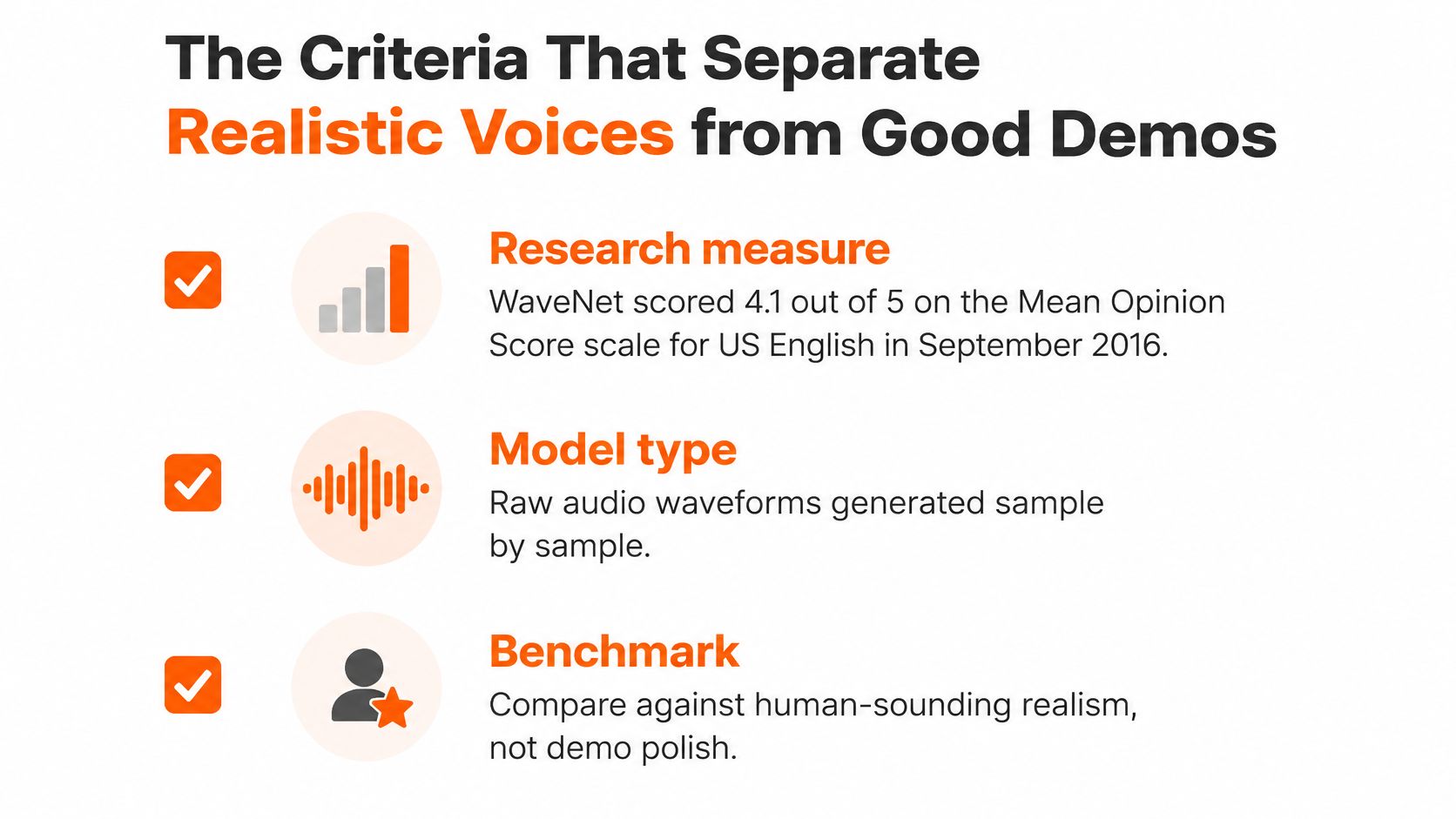
Realism has a research measure, and it's based on listeners, not specifications. In September 2016, DeepMind introduced WaveNet, a neural model capable of generating raw audio waveforms sample by sample, and US English WaveNet voices received an average Mean Opinion Score (MOS) of 4.1 on a 1 to 5 scale in controlled listening tests, according to MIT speech synthesis course notes on WaveNet. Google reported that result was more than 20% better than standard text-to-speech voices and reduced the remaining quality gap with human speech by more than 70%. MOS runs from 1, meaning very poor, to 5, meaning excellent.
That history matters because earlier systems often produced unnatural timing, limited prosody and noticeable joins between sound segments. WaveNet improved pitch movement, rhythm and acoustic detail by modelling the waveform directly. Modern voices inherit that lesson. A larger library doesn't make a voice realistic. Better modelling of prosody, the pattern of stress, rhythm and intonation, does.
<a id="realism-criteria-what-to-listen-for-and-red-flags"></a>
Realism criteria, what to listen for and red flags
| Criterion | What to listen for | Red flag |
|---|---|---|
| Naturalness | Speech sounds like a person reading, not a readout | Flat, evenly weighted sentences |
| Pacing | Pauses fall at phrase and clause boundaries | Pauses mid-clause or rushed endings |
| Breath | Audible breaths before long sentences | No breaths, or breaths placed at random |
| Emphasis | Stress lands on the meaningful word | Stress on the wrong word or the same pitch throughout |
| Prosody across genres | Tone shifts for questions, lists and emotional lines | Same tone for ad copy and a warm story |
| Accent and names | Native rhythm, correct names and numerals | Mispronounced names or foreign-sounding stress |
| Consistency over time | Same timbre and pace across a five-minute read | Drift in timbre or pace late in the file |
Listen for naturalness first, then get specific. Pacing tells you whether the model understands sentence structure. Breath tells you whether it understands the body behind the voice. Emphasis tells you whether it understands meaning, because stressing "only" instead of the product name can change what the listener remembers.
Demos mislead because they're short, pre-selected and often edited. A voice can sound perfect for fifteen seconds and drift over five minutes. It can also handle a vendor's clean script while failing on your prices, abbreviations and local names. That's why comparisons of AI voiceover tools should start with your material, not showcase clips.
Practical rule: Judge each criterion on a sixty-second sample of your own script and note the first red flag you hear, with its timestamp.
Score each criterion separately. A single overall impression hides the exact failure you'll need to fix, and it lets a warm timbre excuse bad emphasis.
<a id="how-to-run-a-blind-listening-test"></a>
How to Run a Blind Listening Test
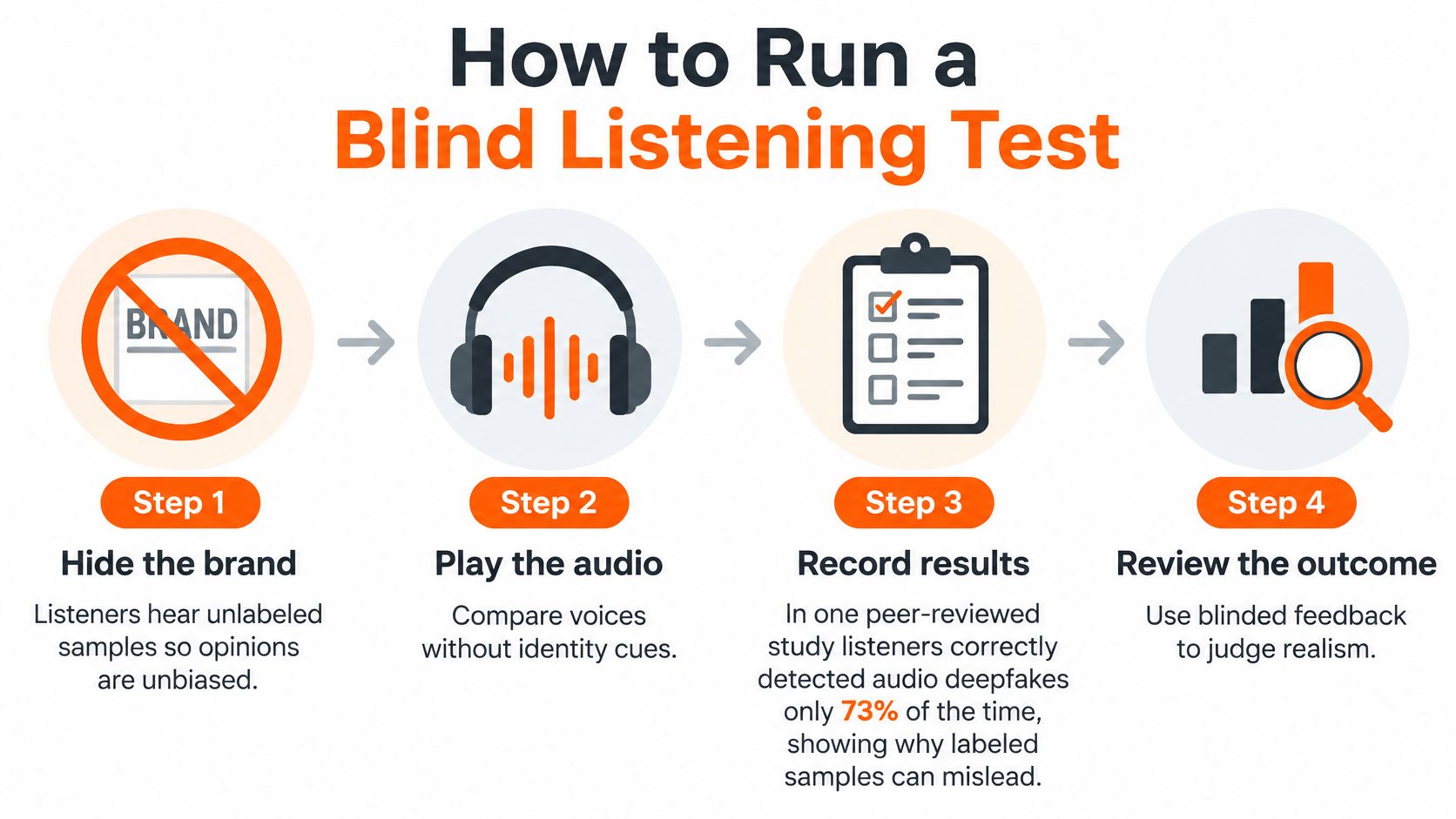
Labelled samples invite brand bias. You listen for what you expect a famous tool to sound like, and you forgive errors you'd catch in an unknown voice. Blind testing removes that shortcut. It also respects how hard detection has become, since participants correctly detected audio deepfakes only 73% of the time in one peer-reviewed study summarized by Audeus on AI voices versus robotic text to speech. Listeners incorrectly accepted or rejected roughly 27% of examples, with no meaningful difference in detectability between the two languages tested.
Don't treat that figure as a universal rate for every model or language. Clean studio samples, short clips, background noise, accents and familiarity with the speaker can all change results. Use it as a warning against casual confidence. If listeners can't reliably spot synthetic speech in a defined experiment, your team shouldn't trust a quick labelled playback in a meeting.
<a id="the-seven-step-procedure"></a>
The seven-step procedure
- Write one neutral script: Make it 60 to 90 seconds and include a question, a list, a number and one emotional line, so every voice faces the same traps.
- Generate identical takes: Run each candidate from the exact same text with no manual edits, because edits hide weaknesses you need to see.
- Remove every label: Rename files A, B and C and strip platform and voice names from folders, file properties and shared links.
- Use outside listeners: Ask three to five people who don't know the brands to rate each clip from 1 to 5 for naturalness and trust.
- Score details separately: Rate pacing, breath and emphasis on their own lines and write the timestamp of every failure.
- Test local accuracy: Check names, numbers and one local term in the target language, since errors there damage credibility fastest.
- Reveal and retest: Average the scores, reveal the labels, then take the top two into a second round using your real audience context.
Keep playback conditions identical. Use the same headphones or speakers, the same volume and the same order randomization for each listener if you can. Don't explain your favourite before people score. A single comment like "this one's the expensive one" can move ratings more than the audio does.
<a id="mistakes-that-ruin-the-test"></a>
Mistakes that ruin the test
The common slip is deciding on the first ten seconds. That hides drift, late-file errors and fatigue, which is when a voice starts rushing endings or losing emotional control. Another slip is testing only calm narration when your channel needs questions, jokes or urgent calls to action.
Don't average away disagreement too quickly. If native speakers score a voice low while non-native colleagues score it high, the native score is the signal. If everyone likes the timbre but timestamps cluster around numbers, you don't have a realism winner. You have a pronunciation problem to fix or a reason to choose another voice.
<a id="language-coverage-changes-the-ranking"></a>
Language Coverage Changes the Ranking
A voice that wins in English may lose badly in your audience's language. Most rankings test English and a small set of major languages, so they rarely examine accent authenticity, code-switching, local names, numerals, speech rhythm or emotional range elsewhere. A multilingual label tells you a language is available. It doesn't tell you native listeners believe it.
The gap can be severe in low-resource languages. Research on African-language speech technology notes that more than 2,300 African languages remain underserved, and a 2025 study created over 2,500 hours of synthetic speech data for eight languages at less than 1% of the cost of real data, but improvements varied by language and evaluation set, according to a 2025 ACL Anthology study on low-resource speech. Scale alone doesn't guarantee equally natural or reliable speech.
<a id="checks-to-run-for-each-language"></a>
Checks to run for each language
- Accent authenticity: Test the regional variety your audience expects, such as Mexican Spanish rather than a generic Spanish label.
- Code-switching: Include a sentence that mixes languages the way local speakers do, especially brand names inside local grammar.
- Names and places: Use real local names, streets and organisations, not translated placeholders.
- Numerals: Test dates, prices, phone-style sequences and large numbers in the local spoken format.
- Rhythm and stress: Ask whether pauses and emphasis follow local speech patterns, not English patterns with foreign words.
- Emotional range: Check warmth, urgency and humour separately, because a neutral read can pass while expressive lines sound translated.
Gather evidence from the market, not the vendor page. Ask native speakers from the target audience to rate blind samples and flag any word they'd never say that way. Run a word-error check on names across a sample of scripts. If you're publishing video, confirm captions match the spoken language and check how to add subtitles to a video before you scale the workflow.
Say a Mexican Spanish audience hears a Castilian-accented narrator with perfect audio quality. Listeners may still judge the voice foreign or robotic because the rhythm and vocabulary don't belong to them. The useful question isn't which voice sounds most human in general. It's which voice sounds credible to the specific audience being addressed.
Demand language-specific evidence. Native-speaker ratings, name accuracy and code-switching performance tell you more than one global star rating ever will.
<a id="consent-disclosure-and-voice-rights"></a>
Consent, Disclosure and Voice Rights
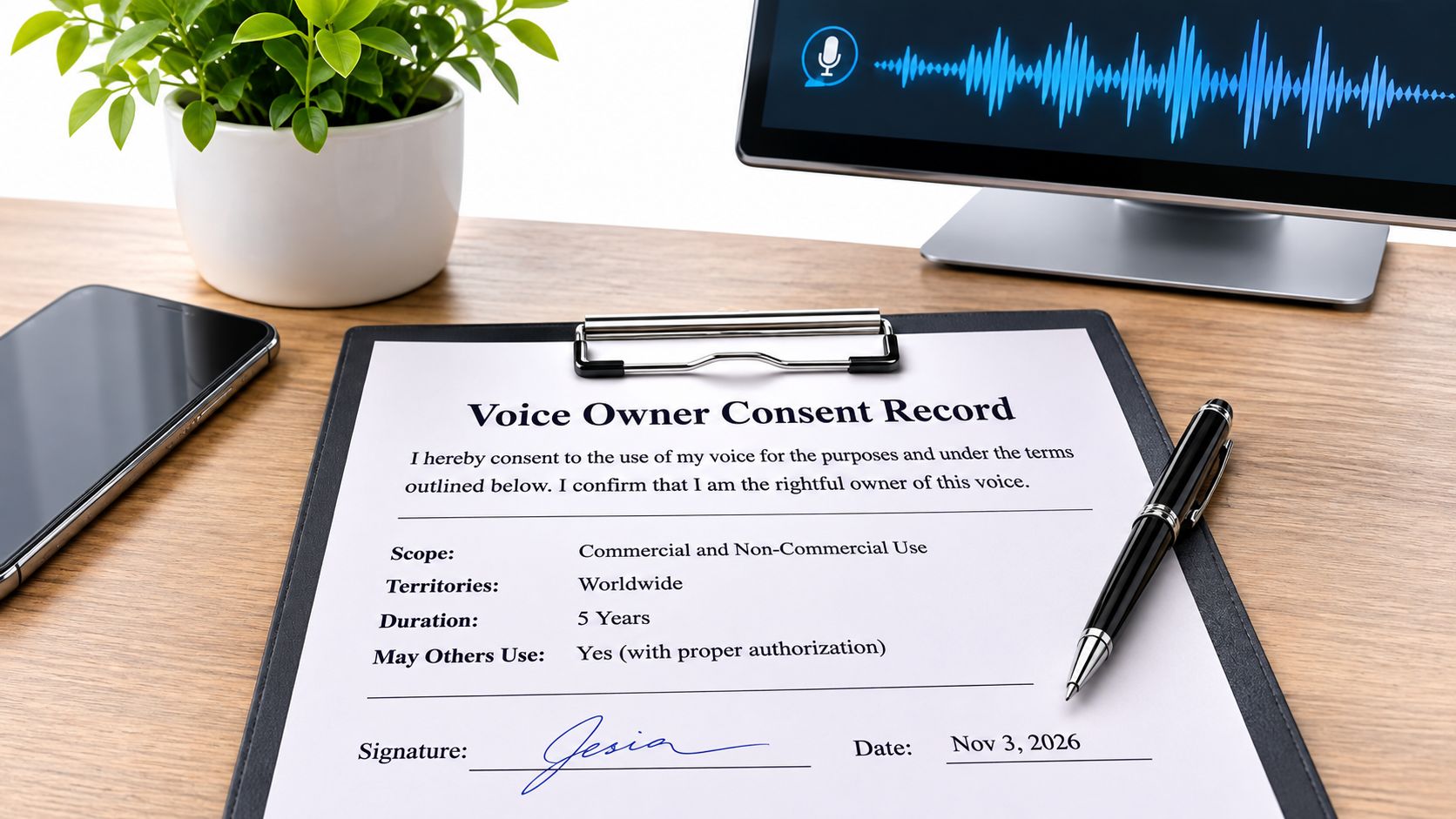
A voice may sound convincing and still be unsafe to use. Before a commercial recording or clone is approved, create a consent record signed and dated by the voice owner. Specify permitted uses, such as advertising, social media or training, along with territories, duration, paid use, sublicensing and whether permission can be withdrawn.
The risk is not only contractual. A European Parliament briefing on AI voice cloning reports that one in four adults had experienced, or knew someone affected by, an AI voice-cloning scam, while 70% were unsure they could distinguish a cloned voice from a real one. In the same source context, a Boston University/Ipsos survey found that 84% of Americans agreed people should be protected from unauthorized AI replicas of their voice or likeness. Those figures point to a practical test of realism: listeners must be able to trust not just what they hear, but how the voice was made and authorized.
<a id="disclosure-and-provenance-in-practice"></a>
Disclosure and provenance in practice
Label synthetic narration where the audience or platform expects it, and keep the label visible rather than burying it in small print. Check whether synthetic-media transparency rules apply in the countries where your audience is located. Ask whether your tool supports watermarking or provenance metadata, and keep a generation log regardless. A polished demo can show that a voice sounds natural; it cannot show that the voice owner authorized its use or that a published asset is traceable.
Keep these records together for each voice:
- Owner and contact: Identify who owns the voice and who approved its use.
- Scope and dates: Record permitted media, territories, start and end dates, and renewal terms.
- Disclosure wording: Save the exact audience-facing label and where it appears.
- Generation log: Record the tool, voice settings, script version and export date for each asset.
The same records matter in regulated outreach, where a voice agent may book calls or qualify leads. Life insurance booking guidance from Voicedial.ai provides context for why consent, disclosure and record keeping belong in the workflow before a synthetic voice contacts anyone.
A believable voice without clear ownership and permission can create a dispute, not credibility. Check facts, then watch the full video or listen to the full audio before publishing. A waveform, transcript snippet or opening seconds cannot reveal every error in a name, date or other detail.
<a id="use-cases-and-the-realism-that-matters-most"></a>
Use Cases and the Realism That Matters Most
These choices now appear in ordinary production work. In 2024, 45% of companies surveyed by Voices.com said they had used an AI voice, up from 38% in 2022, and 64% said they would use an AI voice in the future, according to the Voices.com 2024 client trends report. Adoption doesn't settle quality, though. Each use case fails for a different reason, so test the dominant criterion first.
<a id="realism-priorities-by-use-case"></a>
Realism priorities by use case
| Use case | Criterion that matters most | Language check | Disclosure need |
|---|---|---|---|
| Short social ads | Pacing and emphasis in the first five seconds | Product names and local slang | Follow platform AI-content label rules |
| Long YouTube explainers | Consistency across eight to ten minutes | Names, numerals and technical terms | Follow platform AI-content label rules |
| Audiobooks and long narration | Breath and prosody over long passages | Accent consistency across chapters | Check the platform's labelling requirements |
| Founder or brand spokesperson | Timbre match to the real speaker | Accent of the real speaker | Written consent and a visible disclosure |
| Multilingual localization | Native rhythm in each language | Code-switching and local names | Disclose when the heard voice is not the original speaker |
| Animated characters | Emotional range on cue | Dialect fit for the character | Mark the voice as synthetic in credits |
A fifteen-second social ad fails on pacing and emphasis in its opening seconds, not on breath. If the hook lands late, the viewer scrolls before the voice can prove itself. A ten-minute explainer fails differently. Timbre drift, rushed endings and inconsistent technical terms accumulate until the narration feels unstable.
Audiobooks expose breath and prosody because listeners stay with one voice for long passages. A founder voice exposes identity. Timbre match matters, but consent and visible disclosure decide whether you should publish at all. For host-led formats, compare that need with the workflow behind a talking avatar AI, where face, voice and lip movement must agree.
Localized campaigns should move toward a human-reviewed hybrid when native rhythm, local names or cultural references carry the message. Animated characters need the opposite test. Push emotional range on cue with joy, fear, sarcasm and calm lines, because a character that sounds pleasant but can't act won't hold a scene.
Match the project to its dominant criterion and test that criterion first. You'll eliminate weak candidates faster and spend review time where failure is most expensive.
<a id="choose-your-voice-and-run-the-test-this-week"></a>
Choose Your Voice and Run the Test This Week
Use the verdict that fits your situation. For high-volume English ads and explainers, shortlist curated library voices and run the blind test on your own script. For a founder or brand spokesperson, use a cloned voice only with written consent and a visible disclosure. For multilingual campaigns, choose the voice separately for each language and get a native reviewer's sign-off before launch. For animated or branded characters, choose a designed synthetic voice and test emotional range before you test polish.
<a id="your-action-plan-for-this-week"></a>
Your action plan for this week
- Pick finalists: Choose two or three voices from the type that fits your project, not from every category.
- Run the blind test: Use one shared script, remove labels and score naturalness, trust, pacing, breath and emphasis separately.
- File the evidence: Save scores, timestamps, consent records, disclosure wording and generation settings in one project folder.
- Get specialist approval: Publish only after a native speaker or domain reviewer checks names, facts and cultural fit.
ClipNova's curated voice library is one option to put through the same test. Every voice comes from our curated internal library, tuned for natural pacing, breath and emphasis. You choose who speaks, either a narrator in one of 18 languages or talking characters with lip sync, then pick a caption style and music.
One customer described the result this way:
"One video, twelve languages, native-quality voices. The localization doubled our reach overnight without re-shooting anything."
Treat that as a claim to verify with your own script, not as a substitute for testing. The winner is the voice your target listeners trust, your reviewers approve and your records support. That's a stricter standard than fooling someone for fifteen seconds, and it's the standard that survives publication.
Put your finalists through a blind test with a real script, then compare how ClipNova handles pacing, breath, captions and multilingual narration in one finished video workflow. Visit ClipNova to choose a narrator or talking character, generate your first test asset, and judge the result against the same criteria you'd apply to any other voice.
Ready to ship your own?
Start creating viral videos with AI in under twenty minutes, no credit card required.