
Why do so many video guides ask you to choose between a short clip and a long documentary, when your story needs just a few minutes? A useful explanation, a compact mystery, or a complete cartoon episode can need more room than a hook without needing an extended runtime.
That middle ground deserves its own production method. A 2-5 minute story needs a clear premise, purposeful scenes, and a satisfying ending. Treat it as a complete work, not a stretched short or a compressed documentary.
Table of Contents
- Why Long Form Video Still Matters in 2026
- What Defines a Long Form Video
- Long Form Video Formats and Platform Expectations
- Storytelling Techniques for Keeping Attention
- Production Approaches for Long Form Video
- Why Long Form Video Wins for Loyalty and Monetization
- How to Plan and Publish Your First Long Form Video
- Frequently Asked Questions About Long Form Video
<a id="why-long-form-video-still-matters-in-2026"></a>
Why Long Form Video Still Matters in 2026
You've built a channel around short clips. People recognize your style, but your next idea needs context: a history story with competing explanations, a faith narrative with a consequential choice, or a product demonstration that shows more than the result.
Cutting everything into fragments would make publishing easier. It might also remove the reason someone would care.
The distinction is discovery versus value. In the 2025 State of Create survey, fans reported seeing nearly twice as much short-form content, yet favored long-form when judging value and were much more likely to pay for it. That's directional evidence from a creator-economy survey, not a universal forecast of audience spending.
<a id="give-each-format-a-different-job"></a>
Give each format a different job
A short clip can introduce an intriguing question. A complete video can explain why the answer matters, show the evidence, or let a character experience the consequences.
For a faceless educational channel, that might mean separating a surprising fact from its explanation. For a small brand, it could mean using a brief demonstration to introduce a fuller account of how someone uses the product.
- Use a short when the moment is the message. A visual reveal or isolated observation may not need elaboration.
- Use a complete story when context changes meaning. Causes, decisions, procedures, and consequences need room.
- Keep the promise consistent. The discovery clip should introduce the same subject the finished video resolves.
For help organizing those complementary roles, Klap's guide to building a hybrid video strategy is a useful planning resource.
Long form video isn't automatically more worthwhile because it takes longer to watch. Its advantage is the opportunity to deliver something a fragment can't: understanding, emotional resolution, or a useful demonstration.
The practical question isn't whether viewers have abandoned longer videos. It's whether your idea gives them a reason to stay.
<a id="what-defines-a-long-form-video"></a>
What Defines a Long Form Video
Long form video is a sustained viewing experience built around a developed subject or narrative. Duration matters, but so do audience intent, depth, and structure.
A documentary and a compact animated story can both ask viewers to follow a developing argument or sequence of events. They differ in scale, not necessarily in purpose. That's why a multi-minute story can function as a longer-format destination even when someone else would classify it as mid-length.
This concept map illustrates the dimensions involved.
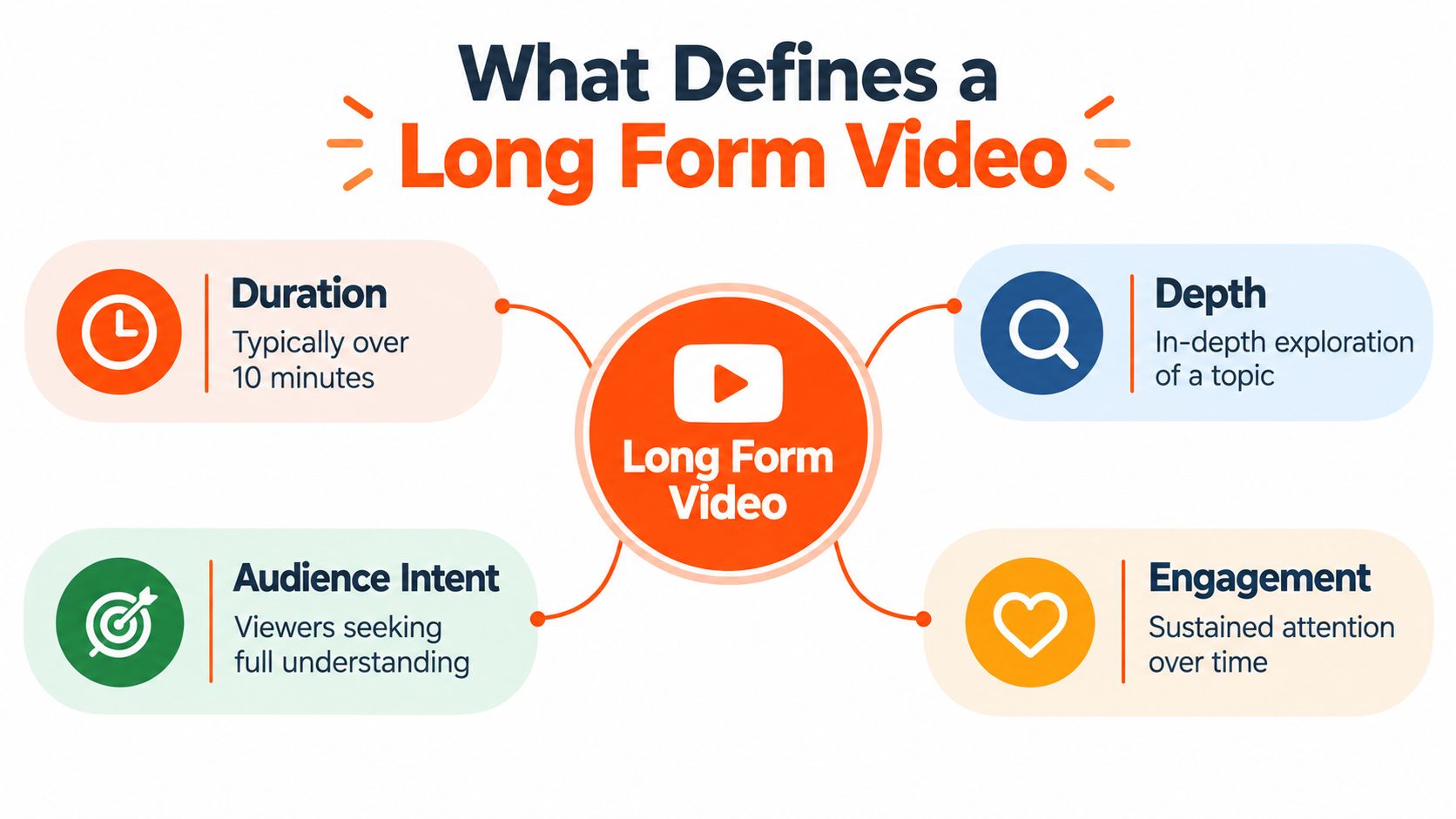
Treat the graphic's duration label as a convention, not a universal eligibility rule. A runtime threshold alone can't tell you whether a video delivers depth.
<a id="from-uploaded-files-to-publishing"></a>
From uploaded files to publishing
YouTube was founded in February 2005, published its first uploaded video, Me at the Zoo, on April 23, 2005, and launched its first public beta in May 2005; by December 2005, it handled more than 2 million video views per day, before introducing its Partner Program in May 2007 and testing pre-roll advertising in August 2007, according to this history of YouTube's development.
Those milestones help explain the shift from uploading a file to publishing an ongoing body of work. Creators could build standalone programs or recurring episodes without first securing broadcast distribution.
Working definition: A longer-format video earns its runtime by developing an idea that would lose meaning if you reduced it to a single moment.
<a id="structure-matters-more-than-the-label"></a>
Structure matters more than the label
Consider a fictional cartoon about a child returning a lost animal. The complete story needs a discovery, a decision, an obstacle, and a resolution. A clip of the animal's arrival might be appealing, but it doesn't perform the same narrative job.
Educational videos follow a similar distinction. Showing a finished craft is different from explaining how to make it and why a particular step matters.
Long form video therefore includes more than documentaries and vlogs. Story videos, practical lessons, narrated history, and episodic fiction belong in the conversation.
Choose the structure first. Then select the shortest runtime that delivers the promised experience without rushing the explanation or skipping the ending.
<a id="long-form-video-formats-and-platform-expectations"></a>
Long Form Video Formats and Platform Expectations
Where might viewers encounter the same story, and what does that setting ask of its format? A person choosing a video from a channel page may be ready for a developed explanation. Someone scrolling a feed may need the premise made clear within the video itself.
Separate platform capacity from audience readiness. An upload option doesn't show how much context viewers will follow. The table gives practical editorial ranges, not technical upload limits or claims about average viewing habits. The 2-5 minute story sits between a quick clip and a long program, so it can develop a complete idea without documentary-length production.
<a id="long-form-video-formats-by-platform"></a>
Long Form Video Formats by Platform
| Platform | Editorial Duration | Aspect Ratio | Primary Use Case |
|---|---|---|---|
| YouTube | 2-5 minute stories through 20+ minute programs | Horizontal framing for broad scenes; vertical framing for mobile-led stories | Searchable explanations, documentaries, recurring episodes |
| TikTok | Under 3 minutes | Vertical | Immediate-premise storytelling and practical demonstrations |
| Concise developed stories or demonstrations | Vertical or square, chosen for placement | Audience updates, brand narratives, visual explanations | |
| Connected-TV viewing on YouTube | Self-contained episodes and extended viewing sessions | Horizontal | Lean-back stories, educational programs, compilations |
For a compact history story on YouTube, a descriptive title can name the event and the question the video answers. In a scrolling feed, establish that question within the video, since viewers may not arrive through the title or channel page.
An Instagram product explanation also needs to make sense on its own. Don't rely on accompanying text to supply a missing step or clarify what the viewer is seeing.
<a id="design-for-the-actual-screen"></a>
Design for the actual screen
Nielsen data cited for December 2024 put YouTube at 11.1% of total U.S. television viewing, up from 8.5% in December 2023. The same connected-TV viewing analysis cites Google's report that viewers watch more than 1 billion hours of YouTube content on television sets each day.
Online video reaches television screens as well as phones. That doesn't mean every story needs a television-style pace. It means framing and visual detail should suit the screen where people may watch.
- For large-screen presentation, compose scenes so viewers can read relationships between characters and locations.
- For vertical presentation, keep important actions inside the intended frame instead of depending on a later crop.
- For square presentation, check that captions and product details don't compete for limited space.
Match your metrics to the publishing goal. For a destination story, review viewing duration and whether viewers continue to related episodes. For a discovery-led post, check whether they reach the intended next step.
Use a platform comparison to make production choices, not as a reason to export identical framing everywhere. A two-minute story can work in several settings, but its opening, framing, and context may need to change.
<a id="storytelling-techniques-for-keeping-attention"></a>
Storytelling Techniques for Keeping Attention
Start with what the viewer needs to understand, not with your channel introduction. A compact story has little room for a welcome sequence that delays its premise.
A 2023 exploratory study of an educational YouTube channel reported 41.7% mean audience retention and a statistically significant negative association between video length and retention, β = -0.6979, P < 0.001, in this educational-video retention study. That finding describes the studied channel, not a universal target or proof that shorter always means better.
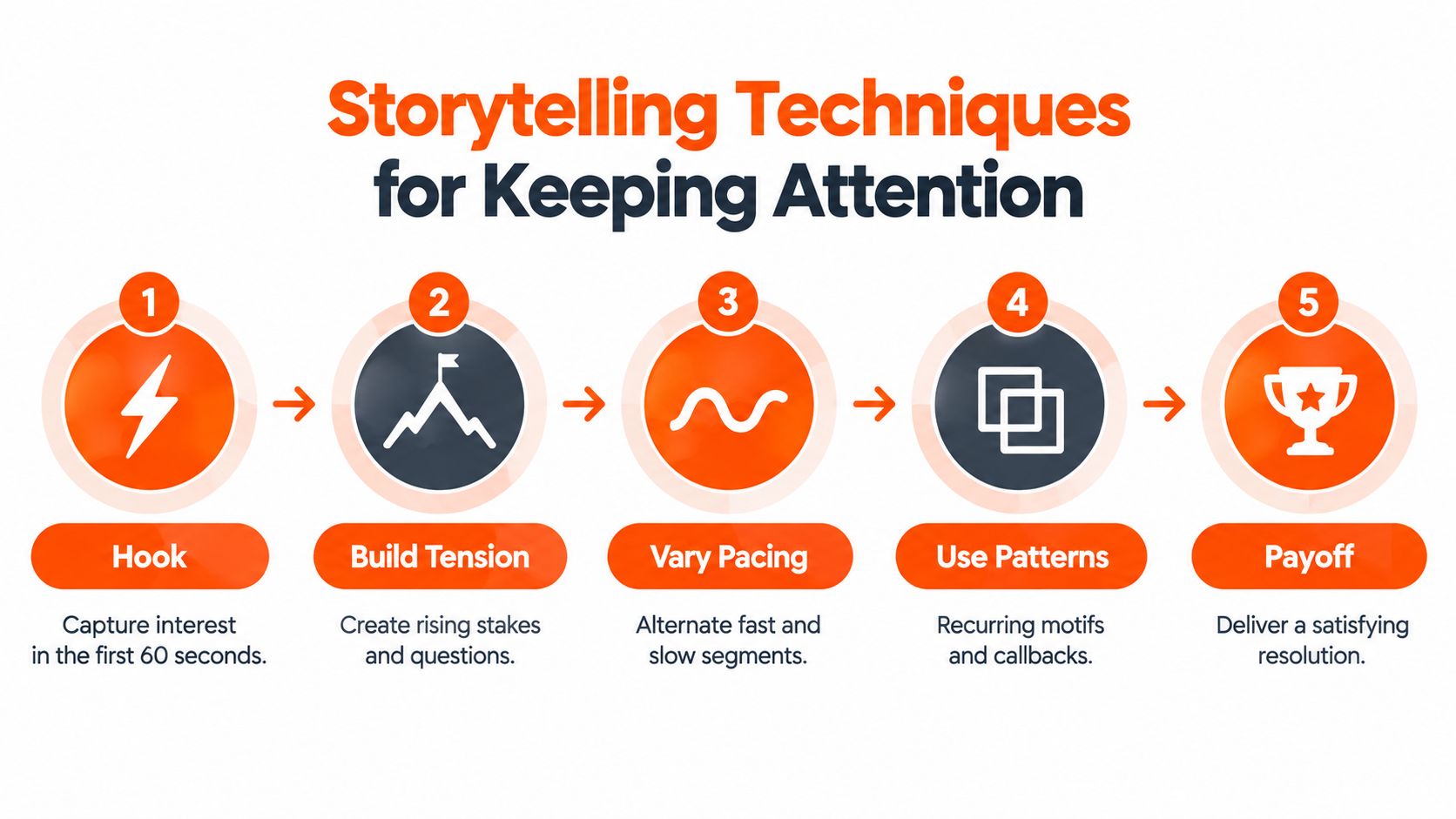
Use this sequence as a story-design aid.
<a id="make-each-scene-change-something"></a>
Make each scene change something
A scene should add knowledge, alter the situation, or move the viewer toward resolution. If nothing changes, attractive visuals won't make it necessary.
- Establish the premise immediately. An educational opening might show a failed result and identify the problem. A mystery might reveal the troubling discovery.
- Create meaningful progression. In a fictional lost-animal story, finding the animal is different from discovering why returning it is difficult.
- Vary the viewing task. Alternate explanation with demonstration, or dialogue with action. Change pace because the story needs it, not because a timer says to.
- Use a callback. Return to an earlier object, question, or detail so the ending feels connected to the beginning.
- Resolve the original promise. Don't substitute a request to subscribe for the answer or outcome viewers came to see.
A documentary-style explanation can build tension through competing interpretations rather than artificial suspense. An educational video can do it by showing why an intuitive solution fails before demonstrating the correct approach.
Every scene should answer a question or make the next question worth asking.
<a id="remove-avoidable-reading-friction"></a>
Remove avoidable reading friction
Keep recurring characters recognizable so viewers don't waste effort deciding who's on screen. Leave captions visible long enough to read, and avoid placing them over essential action.
For implementation guidance, use this walkthrough on how to add subtitles to a video. When localizing, adjust phrasing for natural delivery rather than forcing a literal translation into the original timing.
Finally, inspect percentage retention and absolute minutes watched together. Completion tells you how much of the story viewers experienced; viewing duration tells you how much time they gave it. Neither metric alone explains why a particular scene worked.
<a id="production-approaches-for-long-form-video"></a>
Production Approaches for Long Form Video
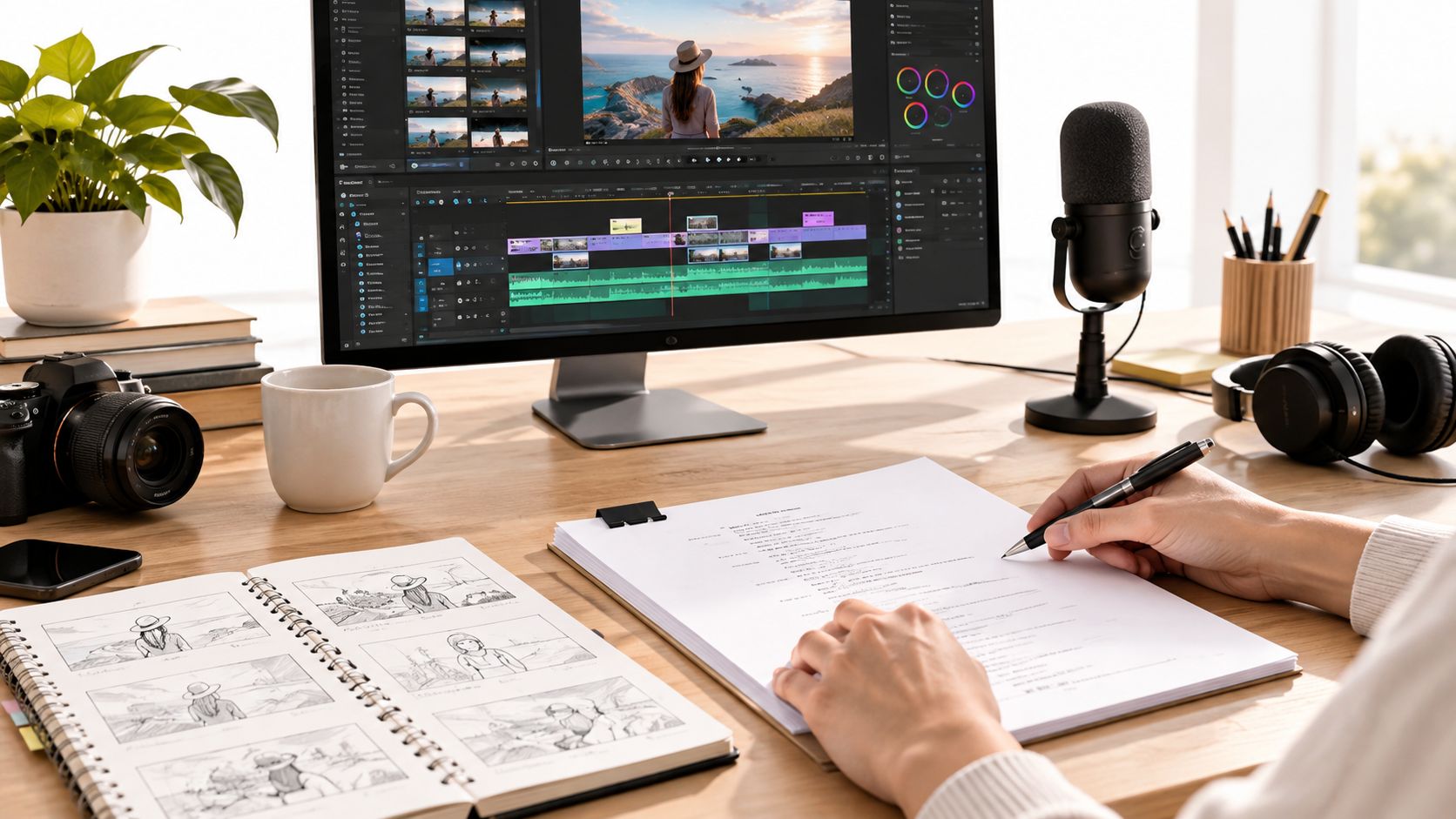
Production starts with dependencies: the script determines what must happen, the storyboard determines what viewers must see, and the audio determines how long spoken passages need to last.
A simple planning workspace can keep those decisions connected.
<a id="choose-the-production-unit"></a>
Choose the production unit
Traditional production gives you direct control over filmed performances, locations, and editing. For nonfiction, that control can be essential when the footage itself is evidence.
AI-assisted production offers a different workflow. ClipNova AI is one option that makes finished videos up to 5 minutes at up to 1080p, assembling script, original scenes, voiceover, captions, and background music in one pass; its video creation app offers narration in 18 languages, 9:16, 16:9, or 1:1 output, and plans from $19/mo with commercial rights.
Its saved characters keep the same face and outfit across scenes, while Series supports a cast of up to 8 characters across episodes with story memory. Characters can speak on screen with lip sync, and Studio lets you fix or regenerate an individual scene.
The useful comparison is what each workflow produces:
- Runway, Kling, Veo, and Hailuo are shot-oriented generators; a complete-story workflow also handles assembly.
- InVideo and Pictory use stock-footage templates, rather than original scenes featuring your saved characters.
- Revid, StoryShort, and Zebracat focus on shorts, rather than the complete multi-minute format.
- HeyGen and Synthesia center on presenters, a different job from multi-scene storytelling.
For narrative planning before generation, this guide to making your own movies offers a relevant starting point.
The embedded video provides another viewing reference.
<iframe width="100%" style="aspect-ratio: 16 / 9;" src="https://www.youtube.com/embed/dVrkSNxQn6I" frameborder="0" allow="autoplay; encrypted-media" allowfullscreen></iframe><a id="keep-human-review-in-the-workflow"></a>
Keep human review in the workflow
Finished doesn't mean unchecked. Review factual accuracy, visual continuity, speech timing, and music balance before posting.
In a controlled study involving 75 college-educated adults, viewers receiving high-error automatic captions without audio made more comprehension errors than those receiving more reliable caption information, as reported in this caption accuracy study. Check names, numbers, punctuation, and technical terms in every language you publish.
<a id="why-long-form-video-wins-for-loyalty-and-monetization"></a>
Why Long Form Video Wins for Loyalty and Monetization
Longer stories give viewers more opportunity to understand your work. That can support loyalty, but only when you deliver a recognizable experience people want again.
The clearest business argument isn't that longer automatically pays more. It's that discovery and continued viewing can work together.
Google reports that 59% of Gen Z users use short-form video apps to discover material they later watch in longer form on YouTube; its short- and long-form viewing analysis also says creators publishing both Shorts and long-form videos see longer overall watch time and subscriber growth. That's an association, not a guarantee for an individual channel.
The following graphic summarizes the strategic appeal.
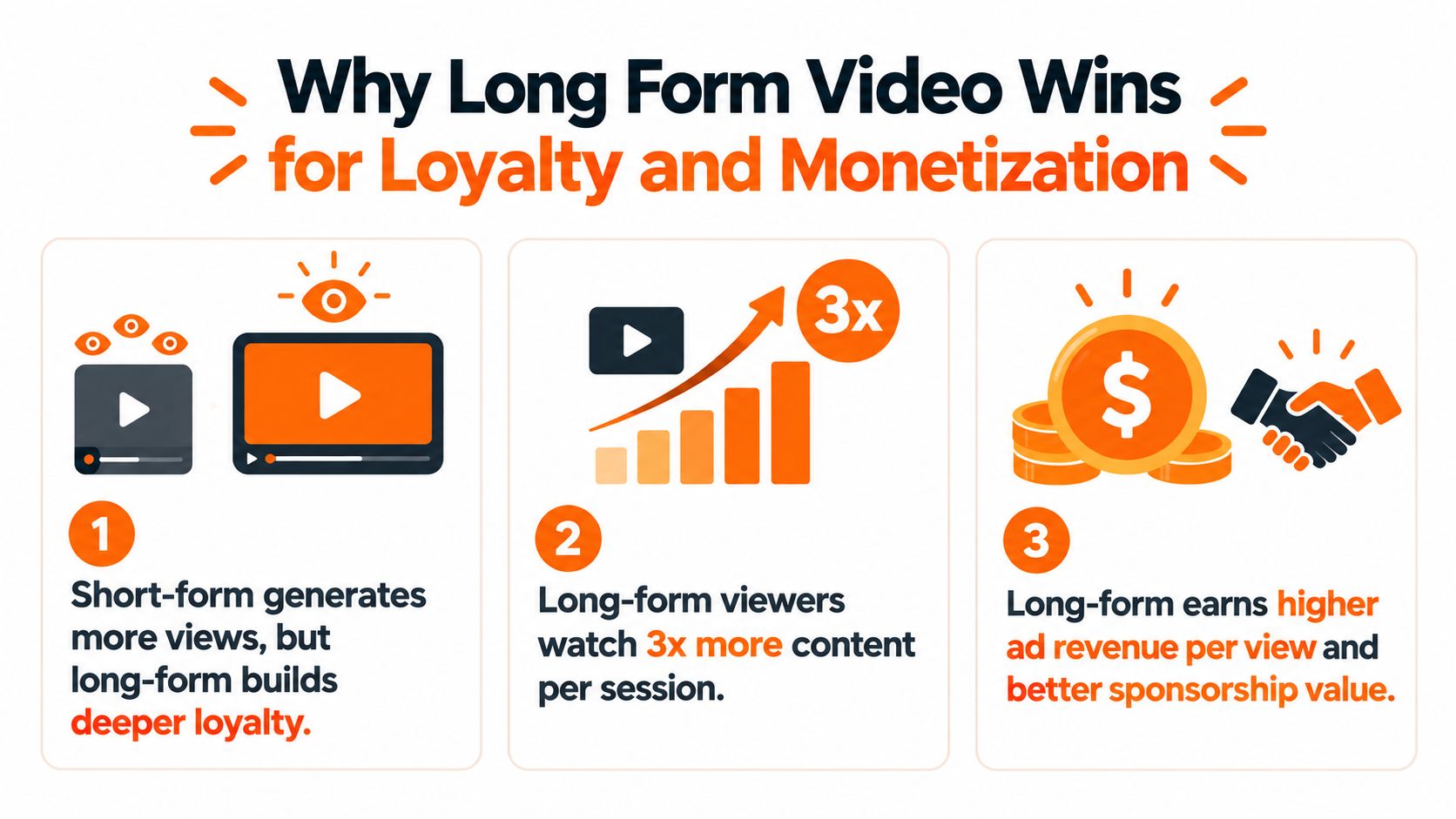
Its numerical session multiplier and categorical revenue claims aren't established by the evidence discussed here. Don't use them to forecast earnings.
<a id="package-a-destination-not-disconnected-fragments"></a>
Package a destination, not disconnected fragments
A discovery clip should leave viewers with a meaningful next step. For a recurring mystery series, introduce the central dilemma without publishing the entire resolution. For an educational channel, demonstrate the problem and point toward the complete explanation.
The longer video must then fulfill that promise. If viewers arrive expecting a practical answer and find unrelated narration, the packaging has worked against the relationship you're trying to build.
Business principle: Measure whether the audience takes the next meaningful action, not just whether a clip attracts attention.
For brands connecting explanation to purchase, the FLYP LTD shoppable video guide is a useful resource to consult when planning commerce-focused video.
<a id="build-reasons-to-return"></a>
Build reasons to return
Recurring episodes can establish familiar characters, subjects, or teaching styles. Give each episode its own resolution while leaving room for future development.
The earlier fan survey supports taking long-form value seriously. It doesn't justify padding a story, assuming sponsorship income, or treating every casual viewer as a prospective paying fan.
Build the audience relationship first. Choose monetization methods that fit what those viewers value.
<a id="how-to-plan-and-publish-your-first-long-form-video"></a>
How to Plan and Publish Your First Long Form Video
Pick an idea you can finish, not a subject you can discuss indefinitely. “A history of navigation” is broad; “a sailor must choose between conflicting directions” offers a manageable narrative problem.
Don't borrow an ideal runtime from unrelated content. A Glossy Research analysis found that 15-to-30-minute YouTube videos received more views on average than shorter or longer categories, while 30-to-45-minute videos had the highest reported interaction rates, with 5.5% liking and 0.8% commenting relative to average viewership. Those findings don't establish the optimum duration for your compact story.
<a id="a-practical-publishing-checklist"></a>
A practical publishing checklist
- Write the promise. Finish the sentence: the viewer will understand, experience, or learn something specific.
- Define the ending before expanding the script. Know what resolves the central question.
- Choose a production method. Decide whether you need filmed evidence, original generated scenes, stock footage, or a presenter.
- Mark essential visual information. Identify what must be shown rather than merely narrated.
- Test the script aloud. Remove repeated explanations and sentences that sound unnatural.
- Review the finished file. Watch once for story clarity, then inspect captions, audio, and continuity.
- Match the packaging to the payoff. Your title and thumbnail should describe the video's real promise.
- Publish where the story belongs. A supporting article can add context; this guide to video for blogs explains that publishing approach.
<a id="diagnose-before-changing-everything"></a>
Diagnose before changing everything
After publication, compare the retention curve with the actual scenes. An early departure may indicate that the premise was unclear; a later dip may align with repetition or a confusing transition. Treat those as hypotheses, not automatic explanations.
Look for patterns across your work before adopting a rigid rule. Preserve what viewers came for, and change the weakest storytelling decision in the next production.
A compact complete narrative is a deliberate format. You don't need to extend it merely to make it look more substantial.
<a id="frequently-asked-questions-about-long-form-video"></a>
Frequently Asked Questions About Long Form Video
<a id="what-if-the-story-needs-more-than-the-generators-limit"></a>
What if the story needs more than the generator's limit?
Split it at a genuine narrative boundary, or assemble separate outputs in an editor. Don't interrupt a resolution because you've reached a production limit. Plan transitions, character references, and audio continuity before generating the parts.
<a id="is-lip-sync-the-same-as-voiceover"></a>
Is lip sync the same as voiceover?
No. Voiceover adds speech; lip synchronization aligns visible mouth movements with that speech. The 2025 OmniSync paper defines that distinction and reports an 87.78% success rate for stylized characters, compared with 67.78% for MuseTalk, in its benchmark. Those results don't validate another product's performance.
<a id="can-i-reuse-the-same-visuals-for-another-language"></a>
Can I reuse the same visuals for another language?
Sometimes, but review the translated version as a separate production. Translated speech can change timing and mouth-shape requirements; this discussion of multilingual lip-sync challenges explains why pose, occlusion, and identity preservation complicate the task. Check pronunciation, captions, and visible speech together.
<a id="can-ai-replace-documentary-footage"></a>
Can AI replace documentary footage?
Generated scenes can illustrate an explanation, but they aren't evidence that an event happened. Label reconstructions clearly and preserve the distinction between documented material and imagined visualization. For product advertising, verify that generated demonstrations accurately represent the product.
<a id="how-should-i-choose-an-ai-tool"></a>
How should I choose an AI tool?
Choose by the output you need: an individual shot, a stock-based edit, a presenter, or a finished narrative. Then test the difficult part of your own project, such as recurring characters or dialogue, rather than judging only an attractive opening scene.
ClipNova AI makes finished long AI videos with consistent characters, combining the story and production elements into an upload-ready video. Visit ClipNova AI to explore the workflow, then make your first video with a clear premise and a complete payoff.
Ready to ship your own?
Start creating viral videos with AI in under twenty minutes, no credit card required.