
AI voice cloning is not categorically illegal in 2026. Tennessee's ELVIS Act has been in force since July 1, 2024, deepfake statutes were on the books in 24 U.S. states in 2024, and EU transparency duties reach realistic synthetic audio, yet no major regime bans the technology outright.
Which is why the advice you see everywhere, "just get permission," is half a rule. Permission answers one question, whether you took someone's identity. It says nothing about whether the finished clip lies to a buyer, breaks a robocall rule, or leaves the company supplying the cloning tool exposed under a statute that names distributors as well as publishers.
Treat legality as a set of switches, not a verdict. Flip the wrong one and a project that felt routine becomes a claim waiting to be filed.
Table of Contents
- When AI Voice Cloning Is Legal
- Why a Voice Is Not a Copyright
- How Tennessee the US and the EU Differ
- What Real Consent Has to Cover
- A Pre-Publish Check for Creators
- Enforcement Scams and What to Save
- Choose a Voice You Can Stand Behind
<a id="when-ai-voice-cloning-is-legal"></a>
When AI Voice Cloning Is Legal
You can settle most projects with four questions before you open a tool. Whose voice is in the file? Did that person authorize this exact use, in this channel, for this long? What is the clip doing, selling, informing, entertaining, campaigning? And which rule governs the speaker, the company that supplies the software, and the listener at the other end?
Two teams can run identical technology through those questions and land in completely different places. A library narrator reading a product page is ordinary business. The same pipeline, retrained on a senator's voice and pushed into a get-out-the-vote call, is not.
| Use | Usual posture | Main legal hook | Control that changes it |
|---|---|---|---|
| Fictional or library voice, no real person imitated | Generally permitted | License terms and consumer-protection rules | Do not drift into a recognizable impression |
| Your own voice with written scope | Generally permitted | Contract and privacy law | Limit channels, territory, ads, and duration |
| Actor, employee, or client voice for an agreed campaign | Conditional | Contract plus publicity rights | Written scope covering ads, languages, and sublicensing |
| Public figure or private person without proof of consent | High risk | Publicity, privacy, and impersonation laws | Verifiable authorization, or do not generate |
| Outbound calls or robocalls with any AI voice | Restricted in the US | TCPA rules on artificial or prerecorded voices | Prior express consent or a genuine exemption |
| Realistic audio listeners could take as a real statement | High risk if undisclosed or false | Fraud, deepfake, and advertising rules | Consent plus clear disclosure and truthful claims |
Read the rows top to bottom and notice where the risk sits. It rarely tracks the software. It tracks the identity in the file and the audience that receives the result. The row that catches people who never meant to clone anybody is the phone line, because a synthetic voice can trigger consent obligations even when it sounds like nobody famous.
<a id="the-control-that-flips-each-row"></a>
The control that flips each row
Most conditional rows have one lever. A contracted actor becomes safe when the paper names paid social, the languages you'll ship, the end date, and whether you may hand the audio to a client. A lookalike request becomes safe only when someone produces verifiable authorization, which is why the practical answer for a celebrity impression is usually a polite no. Your own voice is the least complicated asset you'll ever license, but even that needs a written boundary so an old recording can't resurface in a category you've since left.
Notice that consent and disclosure are separate switches. Authorization fixes appropriation. Labeling fixes deception. Neither one substitutes for the other, and a clip can fail on both at once.
The line worth memorizing: a release decides who owns the voice. It doesn't decide whether the sentence is true.
<a id="where-a-permitted-voice-still-fails"></a>
Where a permitted voice still fails
Consent covers identity, not content. A clone of a willing spokesperson can still invent a price, promise a medical outcome, or imply an endorsement the person never gave, and advertising and consumer-protection rules take over from there. Investigators and regulators treat a fabricated statement in a real person's voice as a deception problem first and a voice problem second.
For teams that need to teach these distinctions internally, an AI explainer video turns a consent matrix into something a junior marketer will finish watching, which matters more than the elegance of the policy document.
<a id="why-a-voice-is-not-a-copyright"></a>
Why a Voice Is Not a Copyright
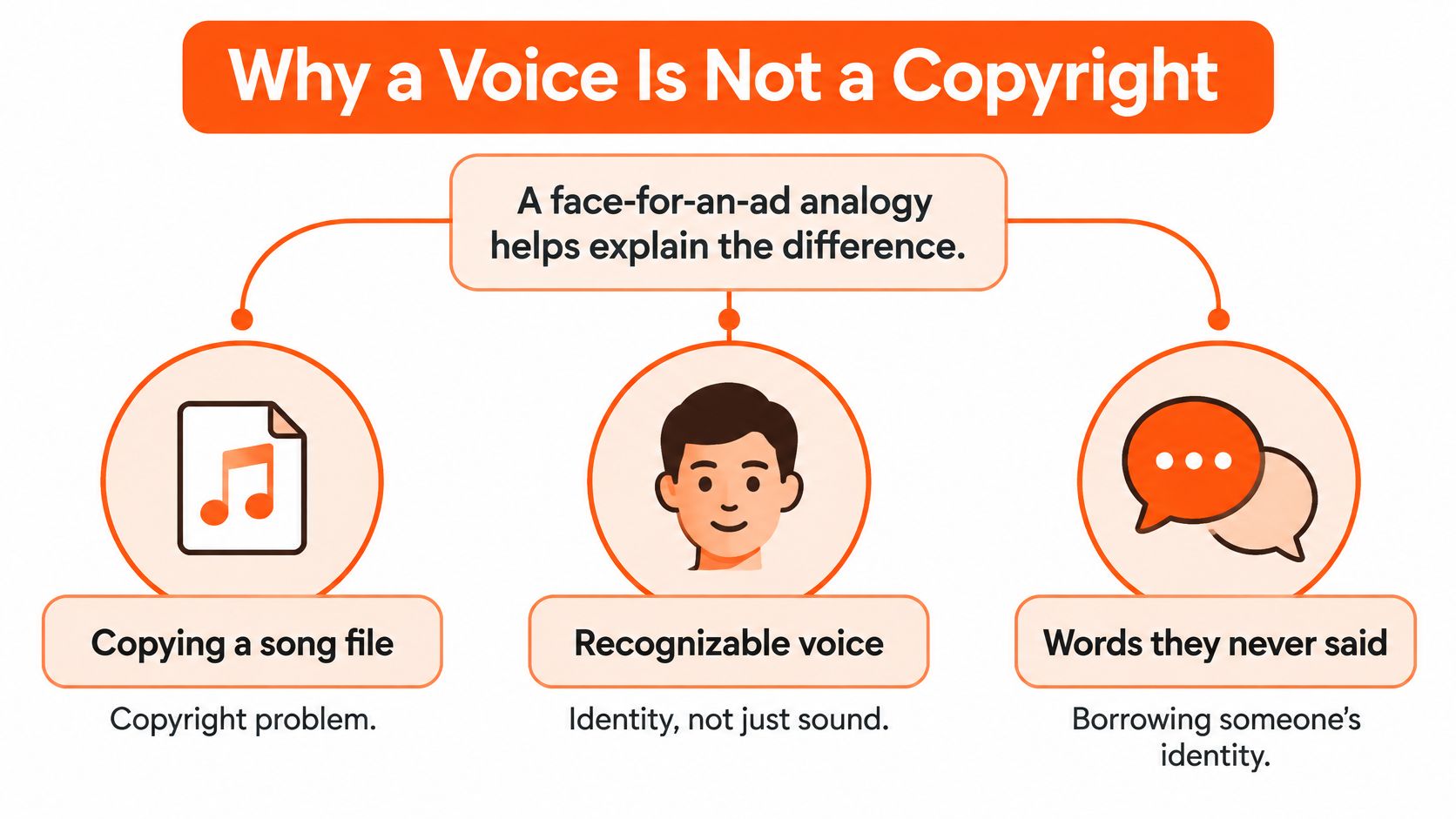
A fresh synthetic jingle can sound like a famous singer without copying any existing recording. Copyright protects works such as the song, script, and sound recording. A person's recognizable voice raises a different question: whether using that identity violates other rights.
Berkeley Law's analysis of vocal identity explains how an identifiable voice may raise right-of-publicity, personality-rights, contract, unfair-competition, or consumer-protection claims, even when the system does not use the original recording.
<a id="generic-narrator-versus-conditioned-model"></a>
Generic narrator versus conditioned model
A generic synthetic voice is designed around qualities such as pace, warmth, and emphasis. It is not modeled on a specific person. A voice model conditioned to imitate someone identifiable is different: its output can create confusion about who is speaking or suggest a commercial association.
Neither copyright nor consent alone settles every question. The relevant rules depend on how the voice is made and used.
<a id="the-claims-that-replace-copyright"></a>
The claims that replace copyright
When someone's recognizable voice is the asset, identity-related laws may matter more than copyright. Publicity rights can restrict commercial use of a person's identity; contracts define agreed uses; and unfair-competition or consumer-protection rules may apply when listeners are misled. In some circumstances, voice data may also raise privacy or data-protection questions, depending on how it is collected and processed.
Copyright still matters for the underlying recording and script. Kons Law's intellectual property guidance discusses what creators can register and control on that side. A license to use a recording does not automatically authorize a simulation of the person, and a simulation may raise identity-rights concerns even if no original file was copied.
<a id="how-tennessee-the-us-and-the-eu-differ"></a>
How Tennessee the US and the EU Differ
The identity principle travels well. The rules don't. A tool built in Texas, sold to a creator in Manchester, and used by a marketer in Munich answers to three different texts with three different remedies.
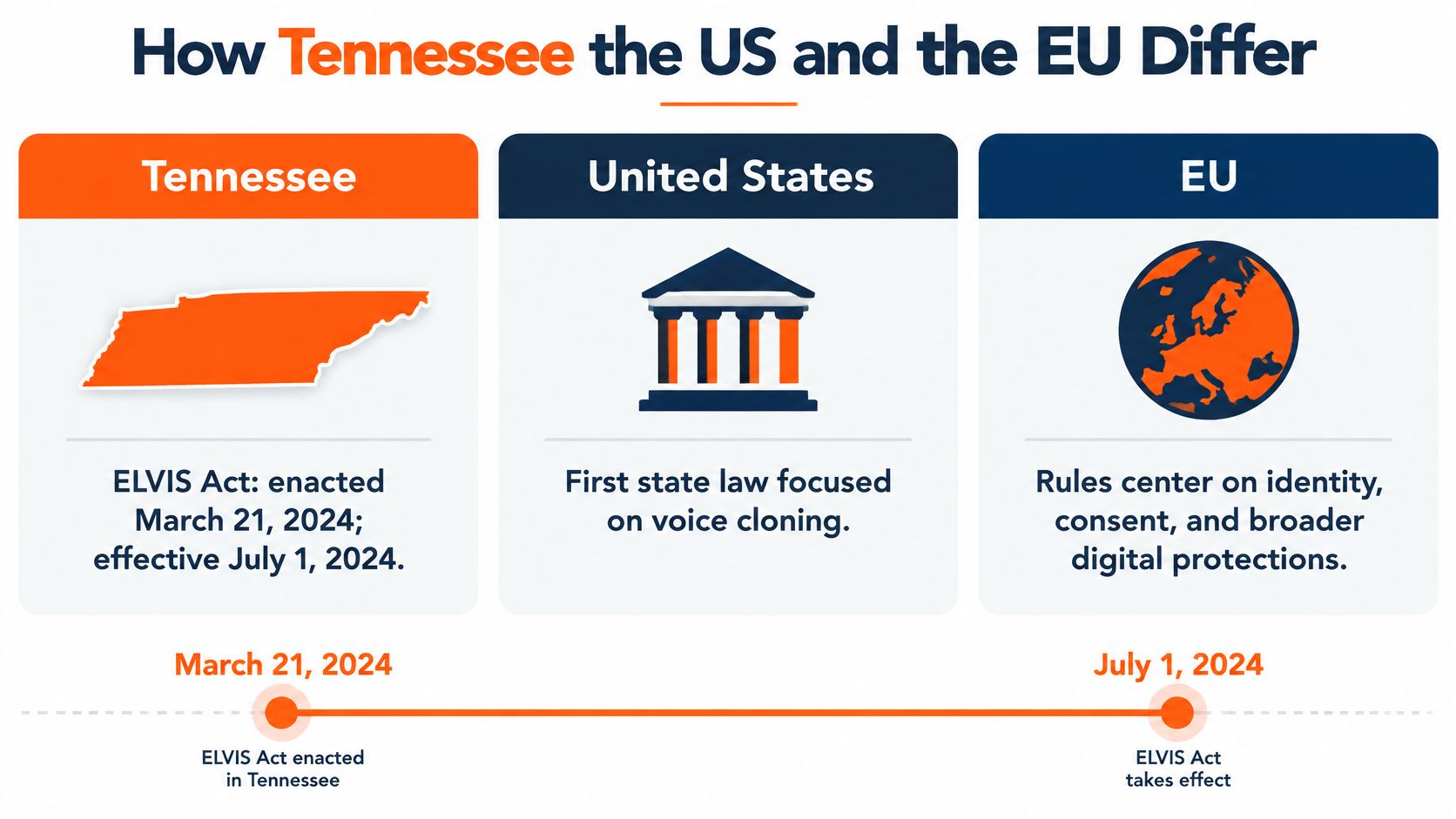
Start with the American milestone. Tennessee enacted the Ensuring Likeness, Voice, and Image Security Act on March 21, 2024, and it took effect on July 1, 2024. Holland & Knight's analysis of the ELVIS Act describes it as the first U.S. state law specifically protecting musicians' voices from unauthorized AI impersonation.
<a id="the-elvis-act-in-plain-language"></a>
The ELVIS Act in plain language
Protected voice reaches a sound that is readily identifiable and attributable to a particular person, even when the recording is a simulation rather than the person's real voice. Civil liability attaches to knowingly publishing, performing, distributing, transmitting, or otherwise making an unauthorized voice available to the public.
The provision that surprises businesses is the distributor clause. The statute can reach a person or company that knowingly distributes an algorithm, software tool, service, or device whose primary purpose is producing a particular identifiable person's voice without authorization. Penalties escalate too: violations can be enforced as a Class A misdemeanor, with up to 11 months and 29 days in jail and/or a fine of up to $2,500.
<a id="phone-calls-and-labels-have-their-own-rulebooks"></a>
Phone calls and labels have their own rulebooks
Separate from identity law, the Federal Communications Commission ruled in 2024 that AI-generated voices fall inside the Telephone Consumer Protection Act's restrictions on artificial or prerecorded voice calls, which generally require prior express consent from the called party (an overview of the FCC's ruling on AI voices). That exposure exists whether or not the voice resembles a living person.
The European Union takes a transparency path instead of a ban. Under Article 50, providers of systems that generate synthetic audio must mark outputs in a machine-readable way that is detectable, effective, and reliable, while deployers must disclose deepfake material clearly at or before a person's first exposure. For audio-only exports, the European Commission's Article 50 FAQ points toward a spoken notice, since there's no visual label to attach.
| Place | What is covered | Main duty | Consequence |
|---|---|---|---|
| Tennessee ELVIS Act, effective July 1, 2024 | Identifiable voice, including a simulation | No unauthorized public use; tools built mainly to produce one person's voice are in scope | Civil liability, plus a Class A misdemeanor carrying up to 11 months and 29 days and/or a $2,500 fine |
| US phone calls, FCC 2024 ruling | AI-generated voices treated as artificial or prerecorded voices | Prior express consent under the TCPA unless an exemption applies | TCPA exposure even when the voice imitates nobody |
| US identity and advertising law | An identifiable person's voice used commercially or deceptively | Publicity, contract, and truthful-ad rules; the voice itself usually isn't copyright | Civil claims, and fraud charges if the use deceives |
| EU AI Act Article 50 | Realistic synthetic audio that could seem authentic | Provider marking plus deployer disclosure at first exposure, audible notice when audio-only | Disclosure doesn't legalize an unauthorized clone |
| 24 US states with deepfake laws in 2024 | State deepfake statutes, each drafted on its own terms | Check where the speaker lives and where the audience is | Fragmented remedies; one state's silence isn't a safe harbor |
That last row matters for anyone shipping nationally. Stanford University's AI Index 2025 counted deepfake regulations in 24 U.S. states in 2024, according to compiled AI regulation statistics, so building to the loosest state's standard is a bet, not a compliance strategy.
Two principles fall out of the comparison. Authorization matters when a real person is replicated. Disclosure and call consent can matter even for a lawful synthetic voice. A label never cures a clone made without rights.
<a id="what-real-consent-has-to-cover"></a>
What Real Consent Has to Cover
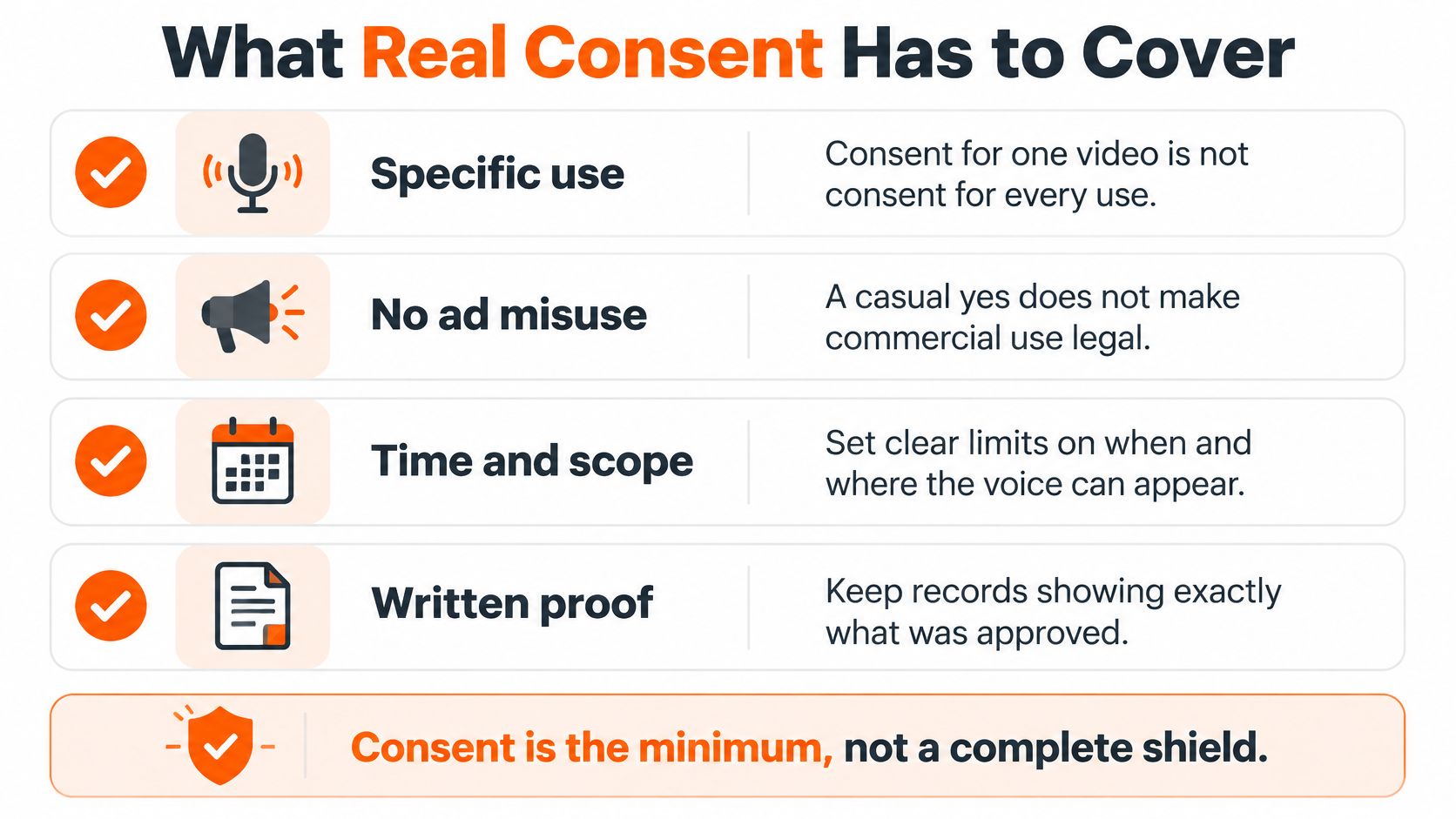
The checkbox is the most overrated document in this field. It records that someone clicked, not who they were, what they approved, or which channel they had in mind. Consent is the minimum standard, and legal analysis from Berkeley's center on law and technology makes the reason plain: an authorized clone can still mislead an audience or exploit the person's identity, so a yes doesn't finish the analysis.
<a id="the-fields-a-release-actually-needs"></a>
The fields a release actually needs
Walk the authorization in the order you should collect it, and the gaps show up fast. Identity comes first, meaning legal name and how you verified it. Then the permitted channels, because organic social, paid ads, phone scripts, and internal training are four different products. Languages next: re-voicing one script into a new language is a new statement, not a free extra. Territory, campaign length, and an end date follow.
Then the harder questions. May the voice endorse a product? May it say words the person never recorded? May the file or model be sublicensed to a client, or used to train a further model?
| Consent item | What to write | Why it matters |
|---|---|---|
| Speaker identity | Legal name and how identity was verified | A checkbox isn't proof of who agreed |
| Channels | Organic social, paid ads, phone, or internal training | Permission for one video isn't permission for ads or calls |
| Languages | Each language, including multilingual re-voicing | A new language is a new statement |
| Territory and term | Places, campaign length, and end date | Publicity rules differ by place and time |
| Synthetic statements and endorsements | Whether the voice may say words never recorded or endorse a product | Authorization isn't a fake endorsement |
| Sublicensing and training | Client handoff and further model training, yes or no | Resale and training are separate uses |
| Revocation and death | How consent ends and whether it survives the speaker | Post-mortem publicity rules aren't uniform |
The agency gap: a creator may hold clean permission to clone a host for a YouTube series and still have nothing that covers a paid ad, a client handoff, or a sponsored read.
That gap is where most disputes start. Someone licensed a voice for content, the brand reused it for media, and the paper never said so. Tennessee-style distributor language adds a second layer: the company supplying the cloning tool can't file user consent under someone else's problem.
Even a flawless release doesn't authorize fraud. A perfect signature on a document still leaves you exposed if the clone announces a fake endorsement, a false medical claim, or undisclosed political messaging.
<a id="a-pre-publish-check-for-creators"></a>
A Pre-Publish Check for Creators
A consent form is a starting point, not a safety system. Before publishing, check who the voice represents, what the permission covers, and whether the finished audio could mislead someone. A checkbox alone cannot answer those questions.
Run these eight checks before anything ships.
- Classify the voice first. Is it a library voice, a fictional voice, your own voice, a contracted speaker's voice, or one that resembles a real person? The answer shapes the checks that follow.
- Stop lookalikes before you generate. Get verified, scope-specific permission before cloning a public figure or private individual. Generating first and asking later can lead to takedowns.
- Match the cut to the permission. Check that the agreement covers the intended use, including paid ads, phone use, additional languages, and client handoff. Leave out uses it does not name.
- Assign a risk tier. A generic licensed voice calls for ordinary licensing checks. A voice resembling a real person calls for consent, a record of where the voice came from, and disclosure. Political, financial, medical, or endorsement scripts need senior human review.
- Disclose realistic audio. Give listeners notice, including a spoken disclosure for audio-only exports. Keep machine-readable provenance attached through export when the tool allows it.
- Save the production record. Keep the consent record, voice or model version, generation log, and name of the person who approved the script.
- Watch the finished cut. A permitted voice can still say the wrong price, an outdated date, or a claim the legal team did not review.
- Publish a takedown contact. Make it easy for rights holders to reach someone who can respond. A generic support form can slow that response.
For host-led videos, a guide to AI talking avatars explains where a reference voice enters the production process. That is a useful point to check that the voice and its use match the permission.
Common failure: treating a platform checkbox as identity verification. It shows that someone clicked, not who they were or what they were authorized to approve.
The content matters as much as the voice. Editing speech a person recorded is generally a different risk from generating a statement they never made, even when both use the same voice.
<a id="enforcement-scams-and-what-to-save"></a>
Enforcement Scams and What to Save
A cloned voice can cause harm even when no copyright is involved. A finance colleague's voicemail may request a wire transfer, or a grandparent may hear a familiar voice describing an arrest. These scams can use only a few seconds of audio. The FBI's Internet Crime Complaint Center tracks complaints involving AI-enabled fraud, but a fraud report and a voice-licensing dispute are different matters.
<iframe width="100%" style="aspect-ratio: 16 / 9;" src="https://www.youtube.com/embed/DCWWIN5C0Cw" frameborder="0" allow="autoplay; encrypted-media" allowfullscreen></iframe><a id="match-the-remedy-to-the-harm"></a>
Match the remedy to the harm
The right response depends on what happened. Impersonation or commercial use of someone's identity may raise publicity or privacy issues. A request for money may call for a fraud report. A platform or payment provider can also be notified to address the clip's distribution or sales. Election and intimate-image laws may apply when the facts meet their requirements.
<a id="the-sequence-when-it-happens-to-you"></a>
The sequence when it happens to you
Act promptly, and preserve the evidence before asking for removal.
- Save the material. Keep the URL, a copy of the audio or video, captions, account handle, and screenshots showing timestamps. A page may disappear after a complaint.
- Record its spread. Note dates, platforms, view counts, and known reposts. This helps show how far the content traveled.
- Document the impersonation. Gather information that identifies the person whose voice was copied, along with a clean reference recording if available.
- Contact the host and payment provider. Report the clip to the platform where it appears. If it is being sold, notify the payment processor.
- Report suspected fraud. If money was involved, contact law enforcement. A lawyer can help assess whether publicity, privacy, consumer-protection, or contract rules fit the circumstances.
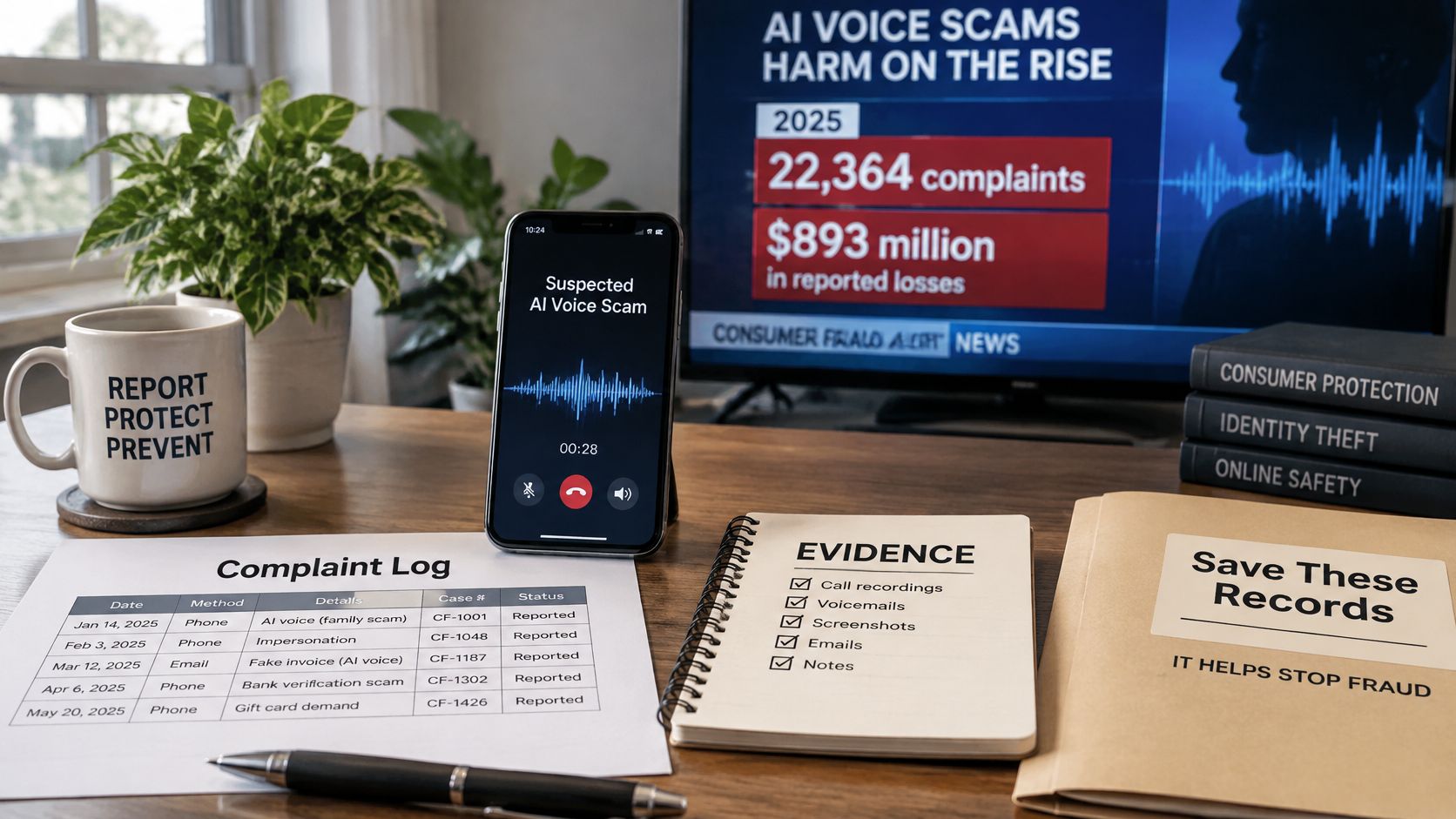
Brands and estates should set up a response process before a copied voice circulates. State identity laws, telecom rules, and platform policies may all matter, and a clip can spread before a complaint is resolved. Keep reporting contacts and evidence-handling steps easy to find.
<a id="choose-a-voice-you-can-stand-behind"></a>
Choose a Voice You Can Stand Behind
A familiar voice can make a message feel trustworthy, which is exactly why using it without permission can mislead an audience. For narration, a host, or an ad read that does not need to sound like a specific person, choose a synthetic voice and keep the script's claims accurate. That avoids an identity dispute, though it does not make a deceptive message acceptable.
If a project uses a real person's voice or recognizable identity, get written authorization before generating it. Define the permitted channels, languages, territory, campaign end date, endorsement, and sublicensing in the agreement. A voice clone is like a signature: permission for one use does not automatically cover every use.
ClipNova's voices come from a curated internal library tuned for natural pacing, breath, and emphasis. To compare narration options, read this guide to AI voiceover tools.
Before publishing, check dates, prices, names, and any medical or financial claims, then watch the finished video. Label realistic synthetic speech when the audience, an advertising rule, or an EU disclosure requirement calls for it, and keep the approval record with the export.
ClipNova's studio brings scripts, visuals, captions, and music together with its curated voice library. Creators can start with a prompt or a link and generate a finished video. Explore ClipNova.
Ready to ship your own?
Start creating viral videos with AI in under twenty minutes, no credit card required.