
Purely AI-generated content generally has no US copyright, while the human-authored parts of an AI-assisted work can be protected under the Copyright Office's January 2025 guidance. That single distinction overturns the most popular advice creators repeat, which is that a clever prompt makes you the owner. It doesn't. A prompt is an instruction. Authorship is creative control you can prove.
Table of Contents
- What AI Generated Content Means and Who Owns It
- How US Law and Other Jurisdictions Treat AI Works
- Key Legal Terms and Licensing Risks
- How to Build Protectable Human Authorship into AI Videos
- Documenting Human Contributions for Registration and Disputes
- Confirm Your Rights Before You Publish
<a id="what-ai-generated-content-means-and-who-owns-it"></a>
What AI Generated Content Means and Who Owns It
In the United States, content generated purely by AI from a prompt generally has no copyright, because copyright protects human authorship. Content made with AI help can still be protected, but only in its human-made parts.
That distinction explains why the question Is AI generated content copyrighted rarely has a useful yes or no answer. You're usually looking at layers, not a single asset. A finished short can contain a protected script, unprotected generated visuals, licensed music you don't own, and a protected arrangement of scenes you sequenced yourself.
<a id="a-spectrum-not-a-category"></a>
A spectrum, not a category
Think in three positions. At one end, a creator types one line, accepts the first clip, and posts it unchanged. In the middle, a creator writes a script, generates several takes, rejects most of them, reorders scenes, adds original graphics, and records narration. At the other end, a production team shoots its own footage and uses AI for two transition shots.
Your control decides where the work sits. The more the system decides composition, wording, timing, camera perspective, and sequencing, the less you can claim. The more you decide those expressive elements and keep evidence of deciding them, the stronger your claim over your contribution.
Provenance tools make that evidence harder to fake after the fact. If you're trying to understand how invisible signals survive edits, how SynthID marks AI writing is a useful primer on the text side, and the same logic is spreading to images, audio, and video through machine-readable marks that platforms and regulators can read even when viewers can't see them.
<a id="copyright-status-by-how-the-content-was-made-us"></a>
Copyright status by how the content was made (US)
| How the content was made | Copyright status | What the creator can claim |
|---|---|---|
| Prompt only, output accepted as generated | Generally no copyright in the generated elements | Contractual permission to use, not exclusive copyright |
| Human script with AI visuals and voice | Script protected; generated visuals and voice generally not | Protection for the written script and its arrangement |
| Human selection, arrangement and editing of AI outputs | Protection may cover the creative compilation | Selection, sequencing and edits, documented |
| Human graphics or footage mixed with AI clips | Human-made parts protected | Ownership of the human elements only |
| AI output with no meaningful human creative choice | No copyright in the machine-made parts | Must disclose AI material if registering |
Read the middle rows carefully. They are where most commercial creators live. You don't need to abandon AI to have something protectable. You need to contribute expression that remains perceptible in the finished work, or shape generated material through selection, arrangement, compositing, or substantial revision.
AI use doesn't automatically destroy copyright. It changes which parts of a finished video or image you can claim, and what evidence supports that claim.
That also means a competitor who copies only your unprotected generated background may not infringe your copyright, even if the copying feels unfair. Your enforceable advantage may instead sit in your script, your edit structure, your branding, your contract terms, or platform complaints based on other policies. Creators who understand that in advance design their workflow differently. They put original, recognizable human expression in places competitors are most likely to copy, such as the hook, narration, character dialogue, on-screen graphics, and scene order, instead of relying on a distinctive generated backdrop alone.
<a id="how-us-law-and-other-jurisdictions-treat-ai-works"></a>
How US Law and Other Jurisdictions Treat AI Works
A prompt is not authorship. Under the US approach, the central question is whether a person determined enough of the work's expressive elements, and whether those contributions can be identified in the finished result. The U.S. Copyright Office announcement of its January 29, 2025 report explains that protection may apply when human-authored material remains perceptible, when a person creatively selects or arranges AI-generated elements, or when human modifications are sufficiently creative. Merely entering prompts normally does not give a person enough control over the final expression.
The Office's reports also address a separate issue. Its Copyright Office AI reports page lists a report on digital replicas and a report on the copyrightability of generative AI outputs. These address different questions: rules about replicas concern imitating a real person, while copyrightability concerns whether a person authored protectable expression.
Using AI as an assistive tool does not automatically prevent copyright protection. AI-generated material may appear in a larger human-authored work, but any protection applies to the human-authored portions and qualifying creative arrangements or modifications, not necessarily to the machine-generated material itself. The practical test is therefore not how elaborate the prompt was, but what creative control the person exercised and what records can demonstrate it.
<a id="copyright-treatment-of-ai-generated-works-by-jurisdiction"></a>
Copyright treatment of AI-generated works by jurisdiction
| Jurisdiction | Human authorship rule | Registration or disclosure position | Labeling or transparency direction |
|---|---|---|---|
| United States | Copyright requires human authorship; prompts alone generally are insufficient | Disclose more-than-minimal AI material and describe the human contributions | Platform and sector rules may require synthetic-content labels |
| European Union | Emphasizes human authorship | Rules depend on the member state and the relevant EU requirements | Moving toward transparency, labeling, and machine-readable watermarking for generated media |
For creators distributing content in the European Union, transparency can be a separate compliance concern from copyright ownership. Ads, influencer posts, and multilingual social content may require attention to labeling as well as rights. A work may be lawful to use while offering limited grounds for exclusive copyright claims, and transparency requirements may still apply.
No single rule covers every market. Treat the US position as the baseline for US registration, not as a universal answer. Borderline cases remain fact-specific, particularly when prompting, editing, and selection are combined in ways that have not been directly resolved by an authority. Keep records that show the choices made during production, since the prompt alone may not establish who shaped the finished expression.
The United Kingdom and other markets apply their own rules. Before making ownership claims, accepting client warranties, or promising exclusivity to a sponsor, check the relevant market's requirements with its copyright authority or local counsel.
<a id="key-legal-terms-and-licensing-risks"></a>
Key Legal Terms and Licensing Risks
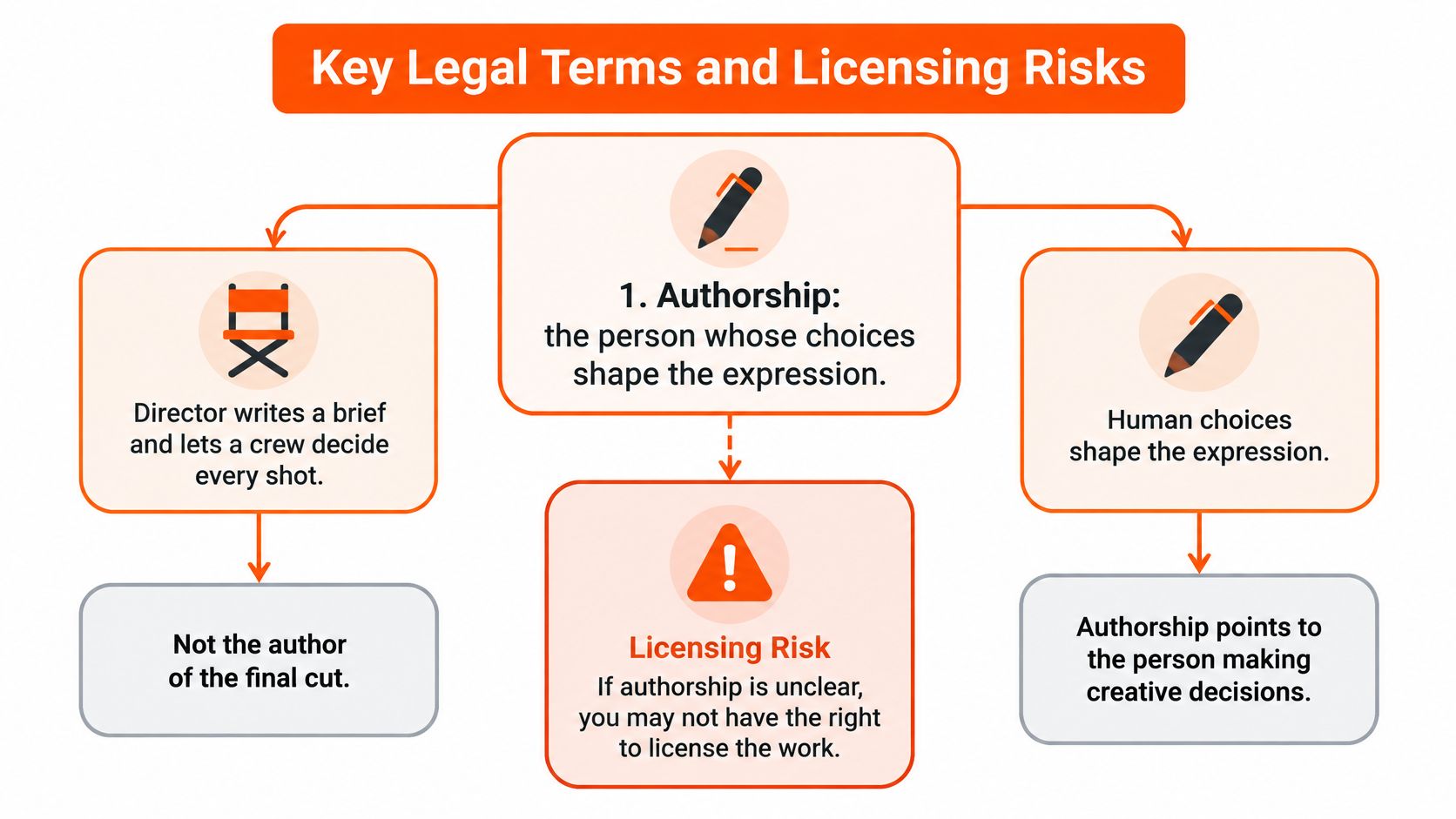
A prompt is not authorship by itself. Copyright questions turn on who shaped the final expression and what evidence shows those choices. The distinction matters when you claim ownership, seek permission, or respond to a platform or client asking about an asset's origin.
<a id="authorship-and-human-contribution"></a>
Authorship and human contribution
Authorship concerns the person whose creative choices shape protected expression. A director who supplies a brief, leaves every shot to others, and approves a finished cut has made different contributions from one who rewrites dialogue, frames scenes, reorders the edit, and replaces weak shots. The second director's choices are more visibly expressed in the work. Supplying an idea alone does not establish authorship of the resulting expression.
Human contribution is the evidence of those choices. Drafts, rejected takes, edit decisions, compositing layers, and revisions can show what you created or changed. Without records, it may be difficult to establish which elements reflect your work, even if you made substantial creative decisions.
The Copyright Office annual report summary records that the U.S. Court of Appeals for the D.C. Circuit unanimously upheld the human-authorship requirement in Thaler v. Perlmutter in March 2025. The case concerned an image identified as autonomously generated by an AI system. It does not establish that every AI-assisted work lacks copyright protection. The practical question remains how much human creative control is expressed in the work.
<a id="joint-works-derivative-works-and-infringement"></a>
Joint works, derivative works, and infringement
A joint work involves human co-authors who intend their contributions to merge into a single work. A human writer and editor may share authorship, depending on their contributions and agreement. An AI system cannot be named as a human co-author to resolve uncertainty about who created the expression.
A derivative work uses or adapts protected expression from an existing work. Feeding a copyrighted clip into a tool and publishing a remix that retains recognizable scenes, dialogue, or character design does not remove the source owner's rights. Permission may be required, and new human contributions do not automatically make copied material lawful to use.
Infringement can arise from substantial similarity, even if a model generated the result and you never handled the original file. For example, a generated mascot that closely resembles a protected cartoon character in its face, costume, and catchphrase may create risk. Lack of intent does not by itself make the output safe to sell on merchandise.
<a id="licensing-is-permission-not-ownership"></a>
Licensing is permission, not ownership
Licensing grants permission to use an asset under stated conditions. If you use licensed music in a video made with an application for making a video with music, the licence may permit that use without making you the composer or owner of the track. Its terms may restrict territory, duration, paid advertising, or resale. Check the actual licence rather than assuming permission covers every use.
For each asset, keep three questions distinct:
- Exclusive rights: Do you own copyright in the element, or only in the human contribution you added?
- Infringement risk: Could the input or output copy protected expression, or use someone's voice or likeness without permission?
- Disclosure duty: Does the relevant market or platform require an AI-generated or altered-content label?
Disclosure and copyright are separate issues. A federal courts panel paper on AI on display discusses transparency, labeling, and machine-readable watermarking for generated text, images, audio, and video, including a summary of an EU watermarking date. Confirm applicable requirements before publishing rather than treating a date mentioned in a legal summary as a universal rule. On YouTube, turn on the altered or synthetic content label when realistic scenes could be mistaken for real footage.
Monetization is another distinct question. YouTube, not ClipNova, decides which channels qualify for monetization, and YouTube does not pay for mass-produced or repetitive videos. A video may avoid infringement and still fail monetization review if it is templated, repetitive, or adds little original value.
Make risk controls specific. Get written releases for voices and likenesses. Avoid using a recognizable living artist's style as a selling point, and do not use a celebrity's identity without authorization to imply endorsement. Save the provider terms that applied when you generated each asset, since plan and model terms can change.
Practical rule: Track each asset by who authored its expression and who granted permission for every other element. “Copyrighted” or “not copyrighted” is too blunt to answer those questions.
That asset-by-asset record matters when promising exclusivity to a client. An agency needs human expression it can assign, licences that permit the intended use, and a disclosure record the brand can review. A paid subscription alone does not establish ownership of every element in a finished video.
<a id="how-to-build-protectable-human-authorship-into-ai-videos"></a>
How to Build Protectable Human Authorship into AI Videos
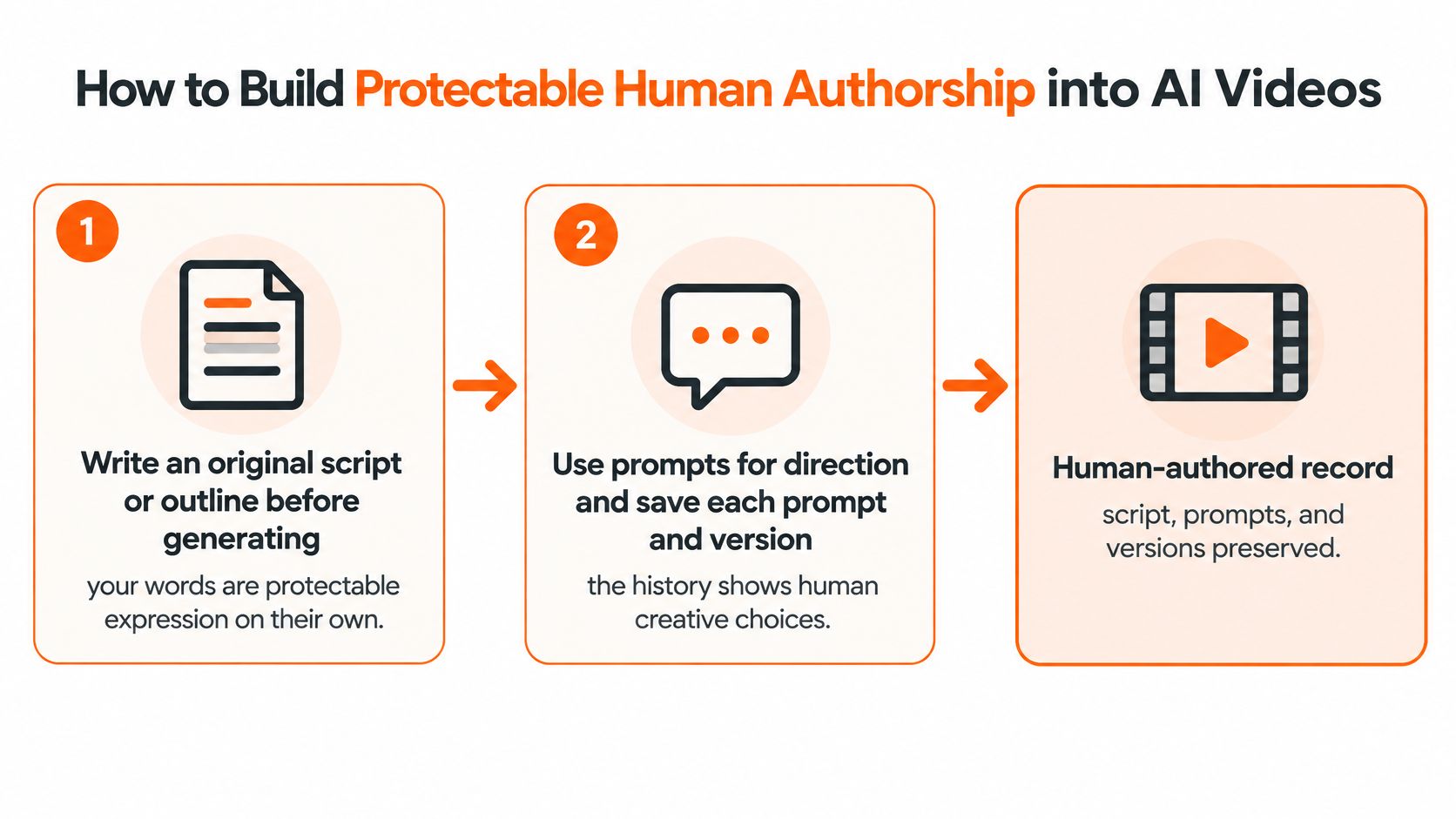
You build a claim during production, not after a dispute starts. The workflow below puts your creative decisions into the video and into the project file at the same time.
-
Write an original script or outline before generating. Your words are protectable expression on their own, and they anchor later choices in something you authored first. The common slip is prompting for a topic and letting the system write, voice, and pace the whole piece.
-
Use prompts for direction and save each prompt and version. A careful history around a text to video prompt workflow shows iteration, even though prompts alone usually aren't enough. The slip is keeping only the final prompt after you've deleted the drafts that show your direction changing.
-
Select, reject, and rank outputs, noting why you kept each one. Choosing three scenes from thirty for a deliberate emotional arc is different from accepting a default sequence. The slip is saving winners without the rejected set, which makes your selection invisible.
-
Arrange scenes on a timeline in your own order and pacing. Sequencing, transitions, pauses, and caption timing can express a structure that's yours. The slip is exporting the auto-assembly because it looks polished, then claiming an arrangement you never made.
-
Edit, composite, or replace generated elements with your own material. Add original graphics, diagrams, product footage, screen recordings, or human narration where they carry meaning. The slip is cosmetic tweaking, such as a slight crop or filter, and describing it later as substantial authorship.
-
Review every generated fact, name, and date yourself. AI can still get a date, a name or a detail wrong, so facts should be checked and the video watched before posting. The slip is publishing a confident voiceover with an uncorrected date, then discovering the error in comments after a sponsor has shared it.
Watch how those choices compound in a finished edit rather than treating each generated clip as the product.
<iframe width="100%" style="aspect-ratio: 16 / 9;" src="https://www.youtube.com/embed/JSKEaeYloYk" frameborder="0" allow="autoplay; encrypted-media" allowfullscreen></iframe>- Export the finished file and archive the project file with its layers. Keep the timeline, source assets, captions, and revision history together so another editor could reconstruct your decisions. The slip is deleting the project after export to save storage, which leaves you with a flat file and a story you can't substantiate.
Strong authorship in a finished video has three visible traits. There's a human element a viewer can identify, a creative order that isn't the obvious default, and records that connect both to named people. If you removed the generated scenes and nothing original remained, your claim is probably thin. If your script, structure, graphics, and edit still communicate the work, you've built something a registration examiner or a client can understand.
That test also improves the content itself. Human selection usually means a clearer hook, fewer generic shots, and a point of view. Copyright strategy and editorial quality pull in the same direction here. The laziest prompt-only workflow creates the weakest rights position and, usually, the most forgettable video.
<a id="documenting-human-contributions-for-registration-and-disputes"></a>
Documenting Human Contributions for Registration and Disputes
Registration works when your file already separates human expression from generated material. The Copyright Office AI policy guidance requires applicants to disclose more-than-minimal AI-generated material and identify the human-authored portions, describe those contributions in the application, and exclude unprotectable AI-generated content from the claimed authorship.
Start with the register, then write disclosure notes from it. Don't draft an application narrative from memory and hope the project folder agrees with you.
<a id="rights-register-for-an-ai-video-or-image-project"></a>
Rights register for an AI video or image project
| Element | Who created it | Evidence to keep | Registration note |
|---|---|---|---|
| Script and narration text | Human writer | Dated drafts and revision history | Claim as human authorship |
| Generated scenes and visuals | AI model | Prompt history, versions and export settings | Disclose as AI-generated material |
| Human edits and compositing | Creator | Edit timeline and layer files | Describe the human contribution |
| Licensed music | Music licensor | Licence agreement and receipt | Exclude from claimed authorship |
| Voice and likeness | Speaker or subject | Signed release on file | Exclude from claimed authorship |
| Stock footage | Stock provider | Licence terms saved with the project | Exclude from claimed authorship |
Fill the disclosure column in plain, specific language. Write what the person did, not a slogan about creativity. For example, say a bakery owner writes a sixty-second script, generates kitchen scenes, replaces the opening with phone footage of her own bakery, reorders four scenes, and designs price graphics. Her register can claim the script, footage, graphics, and arrangement, disclose the generated kitchen scenes, and exclude the licensed music.
A useful text to video prompt record belongs in that same folder. Save the prompt, model or tool name if available, date, output versions, and your keep or reject note. Screenshots help when a platform doesn't export history cleanly.
Keep these evidence types together:
- Dated drafts: Scripts, outlines, storyboards, and caption files with revision history turned on.
- Source files: Original photos, footage, graphics, and audio you supplied or created.
- Edit timelines: Layered project files showing cuts, compositing, replacements, and sequencing.
- Permissions: Music and stock licences, provider terms, and signed voice or likeness releases.
Contractual commercial rights can't replace this file. A licence can authorize use even where no copyright exists in generated pixels, and copyright can exist in your script even where a music licence restricts distribution. They're different legal concepts solving different problems.
A defensible file names which elements were generated, which were supplied or created by people, and which editing materially shaped the final export.
Keep the register beside each project from the first draft. Rebuilding it after a rejected application, a takedown, or a client dispute means hunting through chat threads and cloud folders while memories diverge. Ten minutes during production saves a reconstruction project later.
<a id="confirm-your-rights-before-you-publish"></a>
Confirm Your Rights Before You Publish
Run this check before scheduling, boosting, or delivering the file to a client. Each item needs a yes you could prove with a document, not a confident nod.
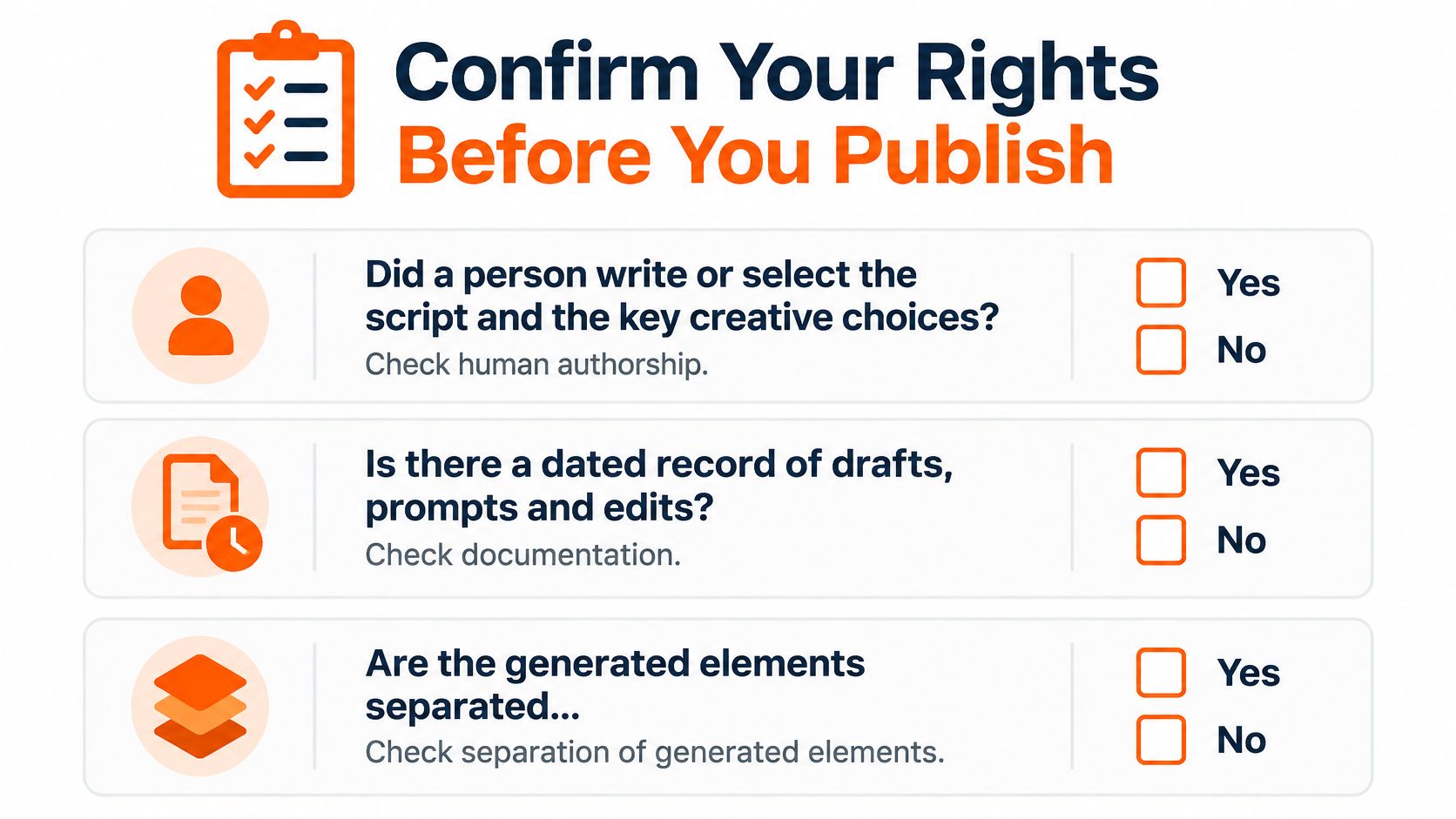
- Human authorship: Did a person write or select the script and the key creative choices?
- Dated record: Is there a dated record of drafts, prompts, versions, and edits?
- Separation: Are the generated elements separated from human elements in your register?
- Disclosure: Is AI material disclosed where registration or platform rules require it?
- Licences on file: Are music, stock, voice, and likeness licences or releases saved with the project?
- Use rights confirmed: Have you confirmed your plan terms in writing, remembering that use rights don't create copyright in pure AI output?
- Prompt hygiene: Did you avoid prompts imitating living artists or unauthorized celebrities?
- Synthetic label: Did you add the synthetic-content label where realistic scenes require it?
On paid plans, our videos come with full commercial rights and no watermark, and they can be used on any platform, including monetized channels. That answers the permission question for your export. It doesn't convert a prompt-only generated scene into your exclusive copyright, and it doesn't license third-party music or a real person's likeness that you introduced without rights.
Apply a simple decision rule. If most answers are yes and no core element is unowned or unlicensed, publish and keep the register with the export. If a key element fails, replace it, license it, or add documented human expression before release. Don't publish first and negotiate from a live campaign.
For high-value campaigns, product launches, broadcast use, or rollouts in several markets, consult a copyright lawyer in each market before release. That's especially important when a contract asks you to warrant exclusive ownership, indemnify a brand, or assign all rights in material that may include unprotectable generated elements. A lawyer can help you phrase what you're assigning, which is your human contribution and your contractual rights, instead of overpromising ownership of every pixel.
<a id="four-fast-answers"></a>
Four fast answers
Can a fully AI-generated video be copyrighted in the US? Generally no for its purely generated elements, so don't rely on exclusive copyright in them.
Do I need to label AI video? It depends on the market and platform, so check the applicable rules and turn on the synthetic label for realistic scenes.
Does a paid commercial-use plan give me copyright? No, it grants use rights under contract, not copyright in pure AI output.
Do I have to disclose AI-assisted work when registering? Yes, when AI material is more than minimal, and you must describe the human contribution you're claiming.
The creators who handle this well aren't more fearful than everyone else. They're more deliberate. They write first, generate second, edit with intent, and keep the receipts. That habit gives them better videos, cleaner client conversations, and a rights position that survives the first serious question.
Turn your own script, topic, or prompt into a finished short with voiceover, captions, music, and multi-format export, then keep your drafts, prompts, and edit records beside the final file so your human contribution is easy to prove. Visit ClipNova to build your next video with commercial-ready exports and a workflow you can document from first draft to publish.
Ready to ship your own?
Start creating viral videos with AI in under twenty minutes, no credit card required.