
Instagram's advertising tools reached approximately 1.74 billion users worldwide in January 2025. That audience grew by 90.8 million people, or 5.5%, compared with the year before, according to DataReportal-based figures summarized by Pace Ads. The figure is advertising reach, accounts Meta's system could target, not a count of unique monthly users. Even with that limit, the addressable audience was about 31.3% of the global online population in early 2025, and Instagram's ad reach grew faster than Facebook's rise of about 4.3%.
Reach is not a buyer. Instagram video ads still have to stop a thumb, hold attention, and show up in a placement report that can mix cheap inventory with real sales. Match length to what the viewer must understand. Then score completion, purchases, and Reels delivery as three different results.
Table of Contents
- Why Most Instagram Video Ads Now Land in Reels
- Specs for Feed, Reels and Stories Video
- When a Longer Ad Beats a Short Clip
- Creative Rules That Raise Hook and Hold
- Ad Concepts You Can Brief Without a Shoot
- How to Tell If Reels Actually Converted
- Make the Next Instagram Video Ad
<a id="why-most-instagram-video-ads-now-land-in-reels"></a>
Why Most Instagram Video Ads Now Land in Reels
Say you sell a $28 serum and you open last quarter's placement report. Most of the spend didn't sit in a tidy square post. It landed between other vertical clips, where someone can leave in a flick.
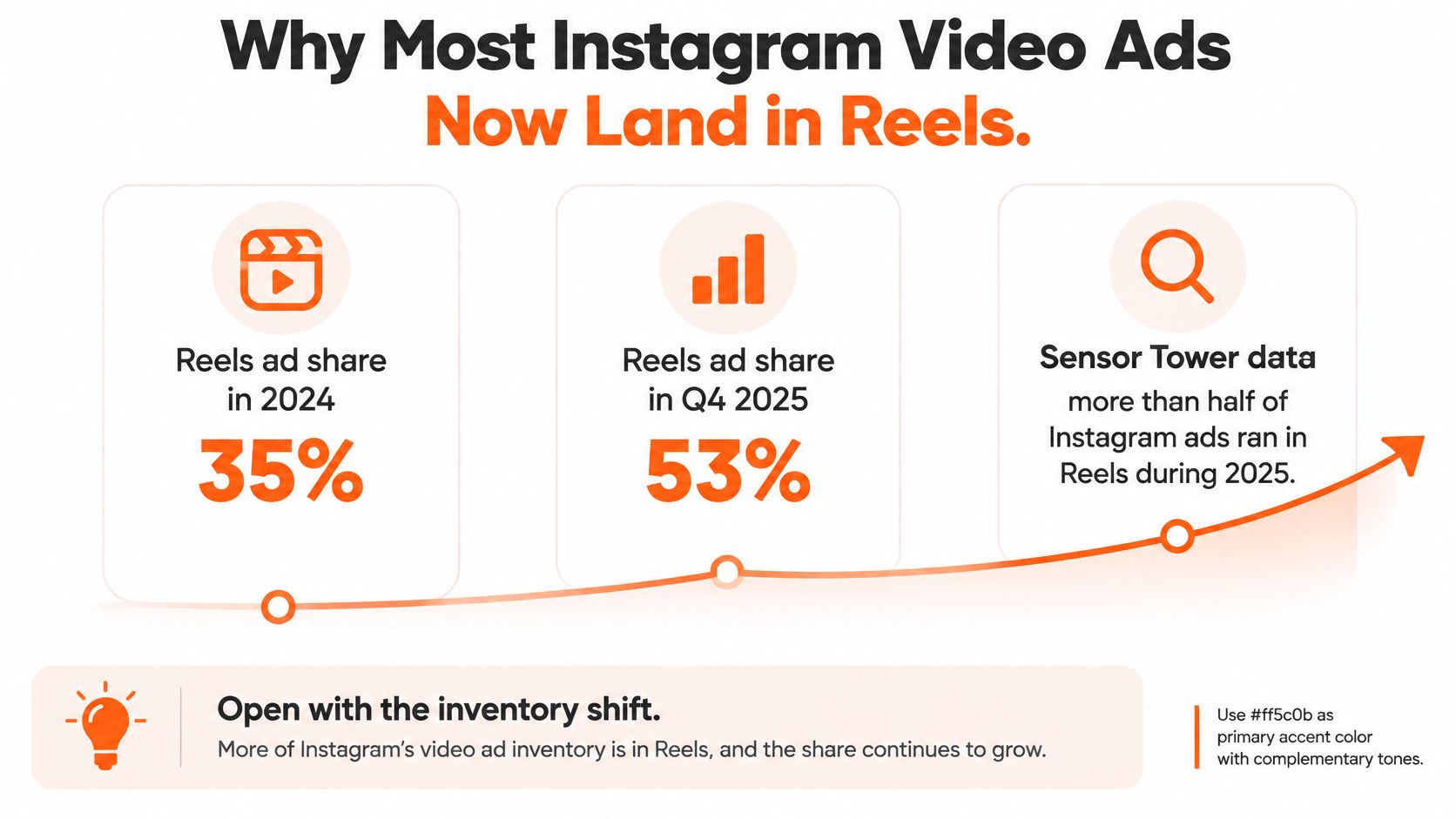
Sensor Tower data reported by eMarketer, and summarized by Voxbooster, showed that more than half of Instagram ads ran in Reels during 2025, compared with approximately 35% in 2024. One industry summary puts the fourth-quarter share at 53%. Alongside that shift, Meta reported that Reels generated more than 200 billion plays per day across Facebook and Instagram by the third quarter of 2025, about double the roughly 100 billion daily plays from a year earlier. Meta also stated that Reels had surpassed a $50 billion annual revenue run rate across its platforms in 2025.
<a id="what-that-share-actually-counts"></a>
What that share actually counts
That Reels share is paid inventory inside a scroll feed. It is not a side placement, and it is not the same number as total accounts, impressions, or buyers. An Instagram video ad is video you purchase through Meta and serve in Feed, Reels, Stories, or a mix of those placements.
An organic Reel is a post you publish to your own followers and whoever the feed happens to show. Creator branded content is a separate label rule, covered later, for posts shaped by a paid relationship with a partner.
For the serum brand, a 9:16 file with the bottle in frame by the second scene will get more of the delivery than a cropped TV spot. Opening seconds, mobile framing, captions, and a picture you can read at a glance decide whether that delivery is useful. If you also want the unpaid post to travel, Next Point Digital's tips for boosting Instagram content are a practical companion to the paid file, not a substitute for it.
Pick the main placement before you edit. Ratio and length follow that choice. Specs come next, then the question of when a longer story beats a short clip, how to read hook and hold, how to separate Reels growth from new buyers, and how to brief three concepts that keep one consistent face.
<a id="specs-for-feed-reels-and-stories-video"></a>
Specs for Feed, Reels and Stories Video
Start with the placement, then export to fit it. The ratio and pixel dimensions determine how much of the frame your product, face, and text can occupy. Duration limits tell you what the platform accepts, not how long an ad should run.
| Placement | Aspect ratio | Pixels | Duration allowed | Use it when |
|---|---|---|---|---|
| Feed | 4:5 recommended | 1080 x 1350 | 1 second to 60 minutes | The ad needs more of the frame than a square and will run in Feed |
| Reels | 9:16 | 1080 x 1920 | Up to 15 minutes | Most of the buy is vertical scroll inventory |
| Stories | 9:16 | 1080 x 1920 | Full-screen vertical; design for a short watch | The ad is a reminder, offer, or swipe between stories |
| Square fallback | 1:1 | 1080 x 1080 | Supported in Feed, Stories, and Reels | One file must work across mixed placements |
Metadata's ad creative specifications list the practical ratios and sizes for these placements. Feed video can run from 1 second to 60 minutes, while Reels can run for up to 15 minutes. For vertical placements, use 9:16 at 1080 × 1920. Feed favors 4:5 at 1080 × 1350, and 1:1 at 1080 × 1080 is supported across Feed, Stories, and Reels.
<a id="safe-zones-and-one-file-per-placement"></a>
Safe zones and one file per placement
Keep the product, face, and captions near the center of the frame. Interface elements such as profile icons, like buttons, and the call-to-action bar can cover the edges of Stories and Reels. Burn captions into the video so viewers can follow the message without sound, and keep important words clear of interface overlays.
Export MP4. Make a master for each placement instead of forcing a widescreen television spot into a vertical frame. Cropping can remove hands demonstrating the product, cut off a label, or hide the text that explains the offer.
Practical rule: If most delivery will be in Reels, build the story in 9:16 first. Then adapt the framing for 4:5 and 1:1, keeping the product and key message visible in each crop.
A single file may not frame well in every placement, so choose the ratio based on where you expect to buy delivery. Keep the platform's maximum duration separate from your creative decision: make the ad long enough to explain what the viewer needs to understand, then judge completion and purchases as different outcomes.
<a id="when-a-longer-ad-beats-a-short-clip"></a>
When a Longer Ad Beats a Short Clip
Cutting every Instagram video ad under 15 seconds is a habit, not a rule. One 2025 analysis, cited by Electroiq, reports an 82% completion rate for video ads under 15 seconds. Another cited benchmark finds 60-to-90-second Reels generating the strongest engagement.
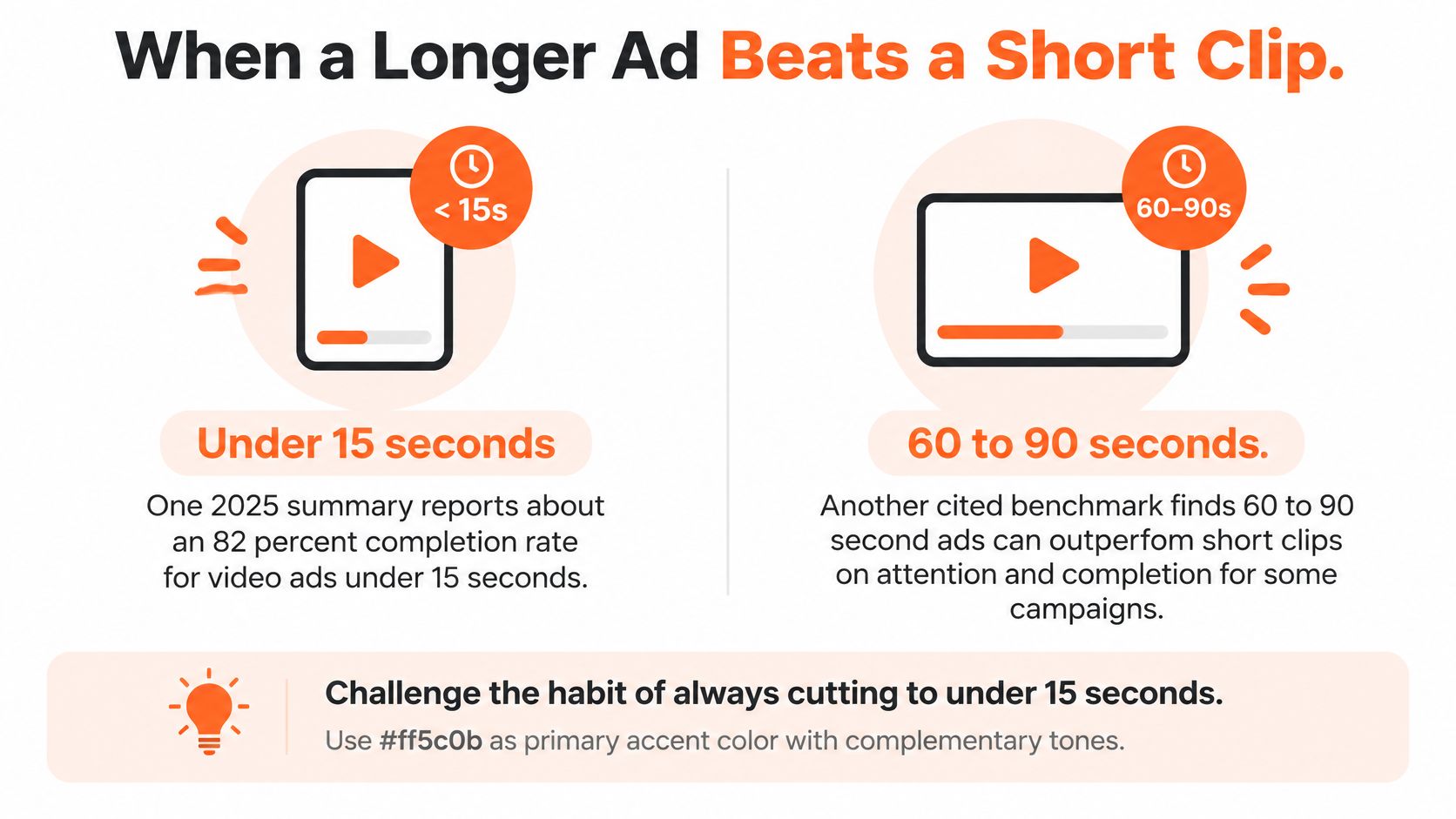
Treat both figures as directional. Published benchmarks mix objectives, placements, industries, and measurement methods. They can both be true. Short ads raise the share of people who finish. Longer ads supply the context a purchase needs when the product has to be shown, compared, or trusted.
<a id="a-length-for-each-job"></a>
A length for each job
| Job of the ad | Length to test | What the benchmark suggests | What the viewer must get |
|---|---|---|---|
| One claim and one action | Under 15 seconds | About 82 percent completion reported for ads under 15 seconds | Product, promise, and CTA only |
| Demo or comparison | 15 to 30 seconds | No single benchmark here; judge by qualified clicks and purchases | The product in use or the difference versus the alternative |
| Trust, education, or story | 60 to 90 seconds | Cited for the strongest Reels engagement, not for ad conversions | Enough plot or proof that a short clip would leave out |
Extra runtime only pays when the extra information changes the action. A lip balm with one claim doesn't need a minute. A device with a setup step, or a supplement that has to answer a safety question, often does.
Test two lengths of the same concept. Hold the audience, the offer, and the landing page constant. Score qualified clicks, purchases, and assisted conversions apart from completion. A 12-second cut can "win" completion while the 75-second cut produces the orders, because people who needed the demo never got it in the short file.
A useful longer ad still opens like a short one. The stake appears before second three. Later scenes earn the rest of the watch. If that longer cut uses spoken proof, keep the voice consistent across versions. A practical pass over AI voiceover tools helps you hear whether the line is clear before you spend on the test.
<a id="creative-rules-that-raise-hook-and-hold"></a>
Creative Rules That Raise Hook and Hold
The first three seconds are the whole job of the open. After that, you're only keeping people who already stopped.
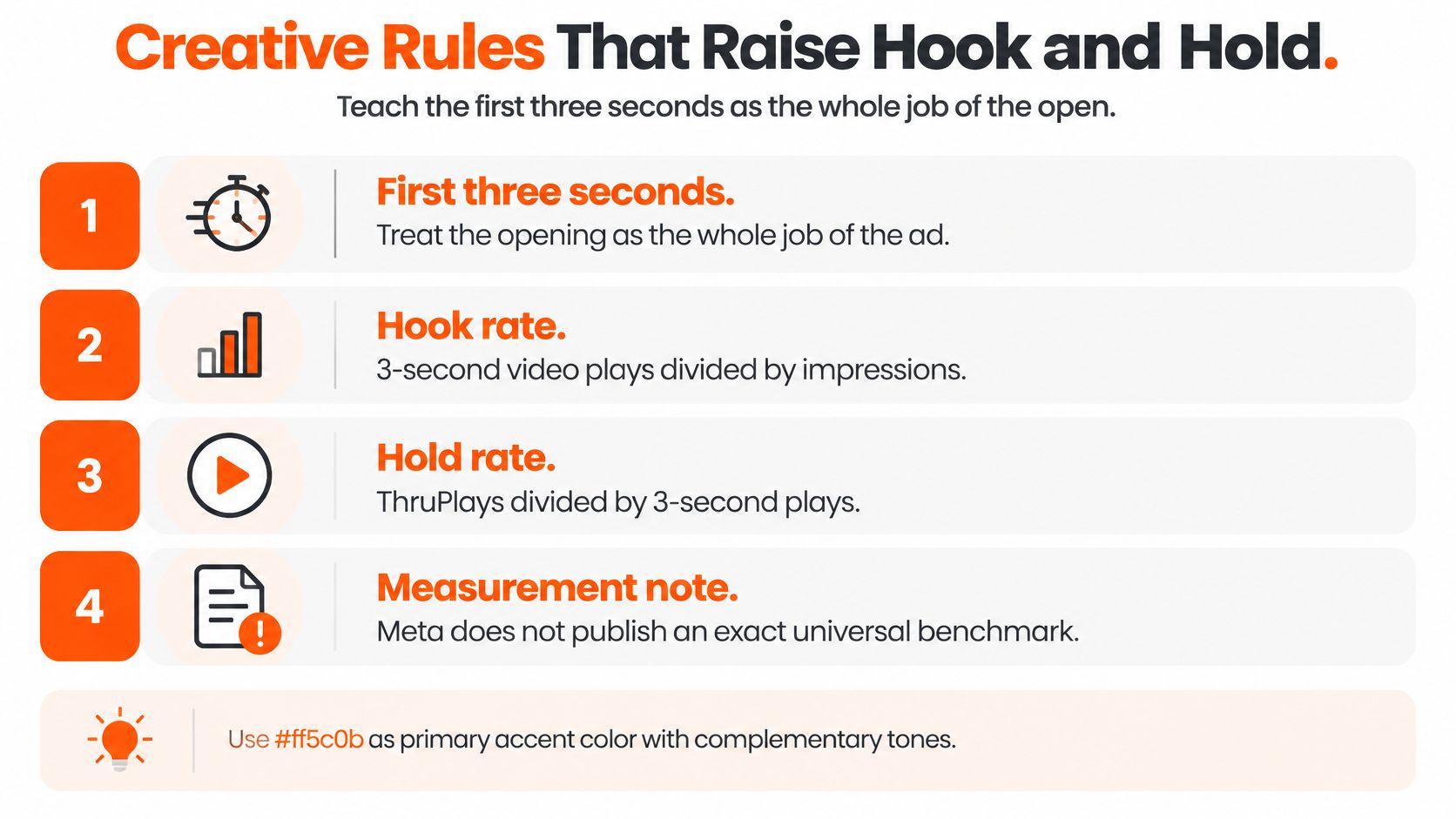
For Reels, full-screen vertical creative is the production target, and attention has to land before the scroll. Instagram's help on Reels video sits next to a useful pair of diagnostics. An independent Harvard Kennedy School research appendix notes that Meta doesn't publish an official benchmark, while digital marketers commonly regard a hook rate of about 20% or higher as decent. Use 20% as a working line, not a platform guarantee.
Hook rate is 3-second video plays divided by impressions. Hold rate is ThruPlays divided by 3-second plays.
In those three seconds, show the character, the product, the conflict, or the payoff. Skip logo intros and slow establishment shots. A kitchen counter and a logo for four seconds is a wasted open. A stained shirt and the bottle in hand is an open.
<a id="design-for-mute-then-change-one-thing"></a>
Design for mute, then change one thing
Captions: Make them large, and match the spoken line. A walkthrough of how to add subtitles to a video is worth doing before upload, because a caption that trails the voice looks like a different ad.
Product: The label or the result should be readable with sound off.
CTA: Use one action tied to the objective, such as shop, learn more, or sign up. Two buttons split the click.
Change only the opening scene. Keep audience, offer, and landing page fixed. Keep the same face, outfit, and product so the test is the message. SimpleLab Digital's Facebook and Instagram best practices for 2024 is a useful wider checklist for account setup, but the creative read still comes down to the two rates.
| Reading | Likely cause | What to change |
|---|---|---|
| Hook rate under about 20 percent | Weak stop in the first three seconds | Replace the opening scene only, keeping offer and audience fixed |
| Hook rate fine, hold rate low | Pacing, unclear message, or product not matching the promise | Shorten the middle scenes or sharpen the product claim in the same cut |
| Both rates fine, conversions low | Landing page, offer, or attribution setting | Check the page and attribution before editing the creative |
Before upload, run three checks. Captions are on. The product is visible by second three. There is one CTA only.
<a id="ad-concepts-you-can-brief-without-a-shoot"></a>
Ad Concepts You Can Brief Without a Shoot
A small brand can brief these three from a product photo and a short script. No set, no talent day. Each concept has one placement and one metric that picks the winner.
The still below is the kind of reference a brief starts from. Same person, same jar, three beats you can turn into scenes.
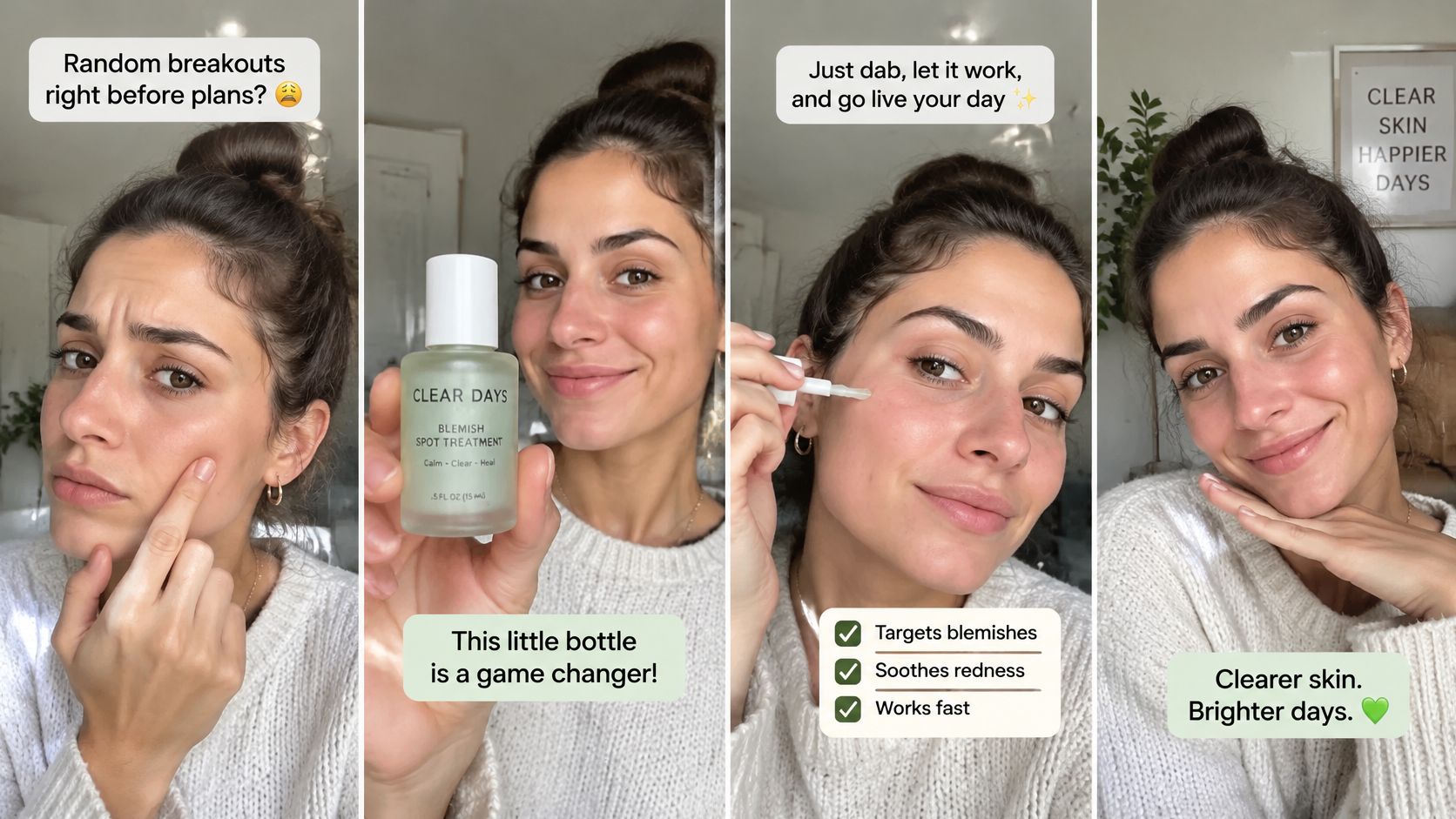
UGC-style product ad. Vertical Reels, about 12 to 15 seconds. Problem in second one, product in hand by second five, one CTA at the end. Winner is the version with the higher hook rate. If the photo is all you have, a picture to video pass can turn that still into the first moving scene without a reshoot.
Trust story. Same person and same product across three scenes, 60 to 90 seconds, for a product that needs a demo. Cold open on the failure, middle scene on the fix, last scene on the result and the CTA. Judge purchases and assisted conversions, not completion. A high finish rate on a story that never shows the fix is a vanity score.
Second-market cut. Same scenes and the same on-screen product. Swap the narration into another language and keep the vertical frame. The test is the market, not a new film. Winner is cost per purchase in that country, with the original cut as the control.
This short walkthrough shows how a simple on-camera demo is framed before you adapt it into those three briefs.
<iframe width="100%" style="aspect-ratio: 16 / 9;" src="https://www.youtube.com/embed/pRtkjKD38SM" frameborder="0" allow="autoplay; encrypted-media" allowfullscreen></iframe><a id="two-compliance-paths"></a>
Two compliance paths
A business running its own product as an ad must meet Meta's advertising standards. Instagram's branded content help says branded content is creator or publisher content that features or is influenced by a business partner in exchange for value, and that value can include a free product. That content needs the paid partnership label and the branded content tool. A brand posting about its own goods doesn't add that label only because it is promoting itself. Instagram's terms on branded content describe a second path. Users may see branded content from accounts promoting products through a commercial relationship, which is not the same rule set as a placement you buy as an ad. Other laws can still require a disclosure. Keep claims the product can support.
<a id="how-to-tell-if-reels-actually-converted"></a>
How to Tell If Reels Actually Converted
A cheaper Reels result may reflect more available impressions, not a stronger ad. Attn Agency's read of Tinuiti data reports that Reels' share of Instagram ad impressions rose from 18% in Q4 2024 to 29% in Q4 2025. In Q4 2025, Feed accounted for 27% and Stories for 43%.
| Placement | Share of impressions in Q4 2025 | What it changes |
|---|---|---|
| Reels | 29 percent | More delivery in vertical scroll, so the creative needs to stop the thumb |
| Feed | 27 percent | A 4:5 cut can still reach a substantial share of impressions |
| Stories | 43 percent | Full-screen reminders may receive credit without being the last click before a sale |
<a id="hold-the-test-still"></a>
Hold the test still
Reels' lower cost can result from expanded inventory, a different audience, or attribution settings. Treat the result as a starting point, not proof the edit performed better.
Keep the offer, audience, budget, and conversion event constant. Then compare reach, three-second views, completed views, click-through rate, landing-page quality, conversion rate, and blended cost per acquisition. These measures separate attention from purchases: a completed view shows someone watched, while a conversion shows the action you chose to track.
Last-click attribution has limits. A person may visit your profile or search for your brand later, then buy after seeing another placement. Ask whether Reels brought in buyers who otherwise would not have purchased, or received credit for people already on their way to buying. A placement report alone cannot answer that. Use a test designed to measure incremental revenue from campaigns.
Match the ad's length to what viewers need to understand. A 60-second story can explain a product or build a narrative more clearly than a 10-second cut, even if fewer people finish watching it. Completion and purchase are different outcomes, so judge each version against its job and the conversion event. Matched versions also let you change the opening or placement without changing the offer.
Before launch, write down the spend and minimum impressions each version needs, the stop date, the metric that selects the winner, and the objective tied to the conversion event. Choose either a Reels-only placement or the automatic placement set for each comparison. Running both at once makes it harder to tell which choice changed the result.
<a id="make-the-next-instagram-video-ad"></a>
Make the Next Instagram Video Ad
Start with one vertical concept, two opening lines, and one offer. Those are the only variables the first test needs.
Run a short cut and a longer cut only if the product needs a demo or a story. If it doesn't, skip the long cut and spend the budget on the two openings. Read hook rate, hold rate, and cost per result by placement before you make more variants. Stop any version that fails the hook line.
Once the concept works, production becomes the bottleneck. Every new opening, language, or crop has to keep the same face, outfit, and product. ClipNova is one way to ship those matched versions. It builds script, scenes, voiceover, captions, and background music in one pass, for videos up to 5 minutes at up to 1080p, watermark-free. Saved characters keep the same face and outfit across scenes, characters can talk with lip sync, and narration is available in 18 languages. You can export MP4 in 9:16, 16:9, or 1:1, with commercial rights on plans from $19 a month. Clip generators such as Runway, Kling, Veo, and Hailuo make individual shots. ClipNova makes the whole story with your characters. Make your first video.
ClipNova AI builds finished Instagram video ads from a brief, with the script, scenes, voiceover, captions, and music in one file and the same character in every version. That is the practical way to test two openings, a longer demo, and another language without reshooting. Visit ClipNova AI and make the first matched cut.
Ready to ship your own?
Start creating viral videos with AI in under twenty minutes, no credit card required.