

Most backstory advice gets this backward. It treats a character's past like a folder of interesting facts, when the only facts worth keeping are the ones that explain what the character does right now, in front of the camera, under pressure. If a detail doesn't change a choice, a fear, a habit, a relationship, or a line of dialogue, it's not backstory. It's clutter.
That shift matters because narrative engagement isn't just about general absorption. Research distinguishes transportation, the feeling of being immersed in the story world, from character identification, which happens when viewers experience events through a character's viewpoint, goals, emotions, and knowledge. In one 2022 study of identification with a fictional detective, the model explained 67% of the variance in character identification, and narrative transportation was the strongest predictor, with a coefficient of β = 0.70 compared with β = 0.09 for general immersive tendencies (Springer study). That's the practical clue. Viewers don't remember a biography. They remember a pattern of behavior that feels earned.
A detective who avoids smoke because of a childhood fire, or a trader who refuses partnership after an early betrayal, feels real because the past is doing work in the present. When you're comparing tools for drafting or testing that kind of structure, it also helps to compare AI writing software with an eye on how well each tool supports continuity, not just word generation.

Table of Contents
- Why Most Backstories Fail the Character
- The Five Building Blocks Every Backstory Needs
- Building a Dated Timeline Before the Story Begins
- Tagging Facts by Function and Planning the Reveal
- Testing the Backstory With the Removal Question
- Using Backstory in Serialized Video Production
- Backstory Checklist and Common Pitfalls
<a id="why-most-backstories-fail-the-character"></a>
Why Most Backstories Fail the Character
A flat backstory usually fails for one simple reason, it explains the wrong thing. Writers often stack up birthplaces, parents, childhood incidents, and old rivalries, but none of those details matter unless they shape the character's current objective, fear, belief, relationship, or decision. The story becomes a résumé instead of a cause-and-effect system.
<a id="the-past-has-to-affect-the-present"></a>
The past has to affect the present
Backstory works when it answers a causal question. What happened, what did the character conclude from it, and how does that conclusion affect the current scene? That chain is stronger than a long history because it makes the character's behavior legible without forcing the audience to sit through explanation.
Practical rule: if a past event doesn't change how the character acts now, cut it or keep it in the writer's notes.
That's also why generic origin pages usually disappoint in long-form video. They can be rich on paper and dead on screen. Audiences don't need every fact, they need a reason for the next choice.
<a id="identification-beats-explanation"></a>
Identification beats explanation
The research on narrative communication points in the same direction. A peer-reviewed study found that transportation, character identification, and emotion each contributed to changes in audience knowledge, attitudes, or behavioral intentions, and that transportation was especially associated with increased knowledge while identification and emotion predicted attitude shifts (PMC study). A 2024 systematic review also found 38 distinct outcomes of narrative transportation, with 23 cognitive outcomes and 5 affective outcomes, or 60.5% and 13.1% respectively (same review source). The point isn't to turn backstory into an academic exercise. The point is to write only the memories that alter what the viewer understands, expects, or feels.
That's why the best backstories behave like engines. They don't sit in the background. They push the character toward specific avoidance patterns, risky choices, and recurring conflicts.
<a id="the-five-building-blocks-every-backstory-needs"></a>
The Five Building Blocks Every Backstory Needs
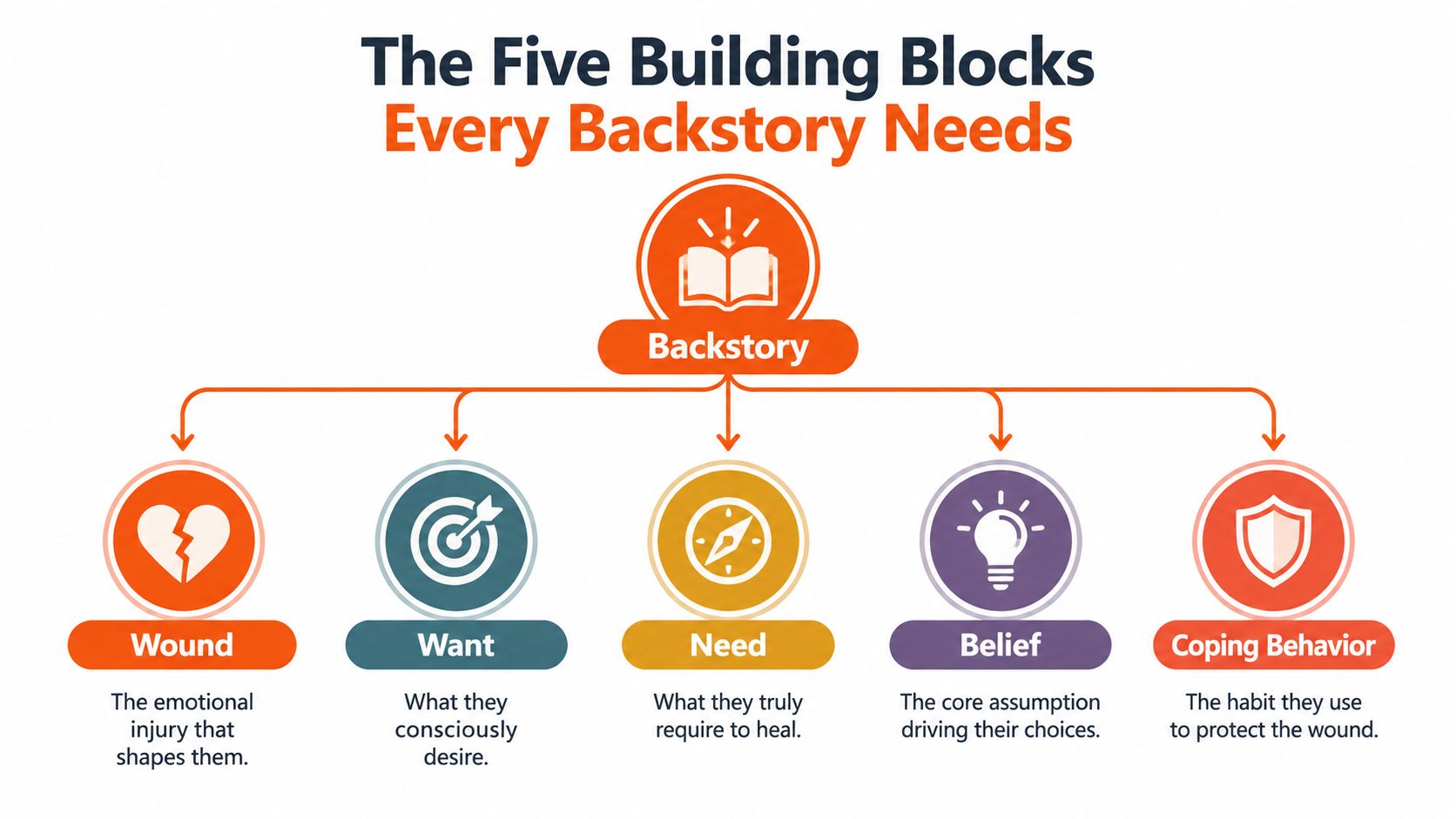
Every useful backstory needs five things in working order, wound, want, need, belief, and coping behavior. Leave one out and the character starts to feel like a sketch. Build all five, and you've got a structure that can survive episode after episode without drifting.
<a id="start-with-the-wound"></a>
Start with the wound
The wound is the emotional injury that still shapes the character. It might be betrayal, shame, grief, neglect, failure, or something quieter, but it has to leave a mark. For a recurring video character, that wound should show up in a visible pattern, not just in an invented sad event.
<a id="add-the-want-and-the-need"></a>
Add the want and the need
The want is what the character chases on purpose. The need is what would make them whole. Those two are not the same thing, and the gap between them is where the drama lives. A character may want revenge, status, or escape, while needing accountability, trust, or self-respect.
<a id="lock-in-the-belief-and-the-coping-behavior"></a>
Lock in the belief and the coping behavior
The belief is the conclusion the character drew from the wound. “People leave.” “Authority can't be trusted.” “If I'm not useful, I'm disposable.” The coping behavior is how that belief shows up on screen, avoidance, humor, overwork, control, silence, or aggression. Without that behavior, the backstory stays abstract.
- Wound: the event that hurt them
- Want: the goal they chase out loud
- Need: the deeper change they resist
- Belief: the rule they now live by
- Coping behavior: the habit that protects the wound
A compact prompt for a character bible works better than a page of lore: “After [wound], the character believes [belief], so they [coping behavior] while trying to get [want], even though they really need [need].”
<a id="building-a-dated-timeline-before-the-story-begins"></a>
Building a Dated Timeline Before the Story Begins
A dated timeline keeps backstory from turning into mush. It also catches the mistake that ruins a lot of recurring characters, namely letting one episode contradict the ages, relationships, or emotional logic established in an earlier one.
<a id="use-dates-or-ages-not-vague-memories"></a>
Use dates or ages, not vague memories
A practical timeline usually starts with five to seven pre-story events, each anchored to an age or year. That doesn't mean the audience sees all of it. It means you can check chronology fast when writing, revising, or regenerating scenes.
| Sample Timeline Columns for a Recurring Video Character | |||
|---|---|---|---|
| Age | Event | Resulting Wound or Belief | Visible Coping Behavior |
| 8 | A public humiliation at school | Belief that mistakes invite rejection | Overprepares and speaks carefully |
| 12 | A parent leaves after repeated conflict | Belief that attachment ends in loss | Avoids asking for help |
| 16 | A mentor takes credit for their work | Belief that authority steals credit | Distrusts supervisors and double-checks everything |
| 19 | First solo success after failure | Belief that competence is possible, but fragile | Works harder than necessary to stay safe |
<a id="keep-most-of-it-offscreen"></a>
Keep most of it offscreen
The main function of the timeline is not exposition. It's continuity. It tells you who the character is at the opening scene, what they believe, what they avoid, and how old they were when those patterns formed. The audience only needs the load-bearing moments, the ones that directly explain an action or relationship in the present.
A timeline should make your present tense feel inevitable, not overdetermined.
If a detail doesn't help you preserve age, sequence, or consequence, leave it in the notes. That keeps the backstory lean enough to use and rich enough to support repeat appearances.
<a id="tagging-facts-by-function-and-planning-the-reveal"></a>
Tagging Facts by Function and Planning the Reveal
Most guides stop at “know your character's past.” That's not enough for serialized video. Once you know the facts, you need to decide what each fact does, when it appears, and how it enters the story so the audience never feels dumped on.
<a id="tag-each-fact-by-narrative-function"></a>
Tag each fact by narrative function
A childhood fire, for example, can do several jobs. It can explain motivation, create conflict, act as a visual symbol, define a relationship, or point toward a future reveal. Tagging the fact by function tells you where it belongs in the episode structure.
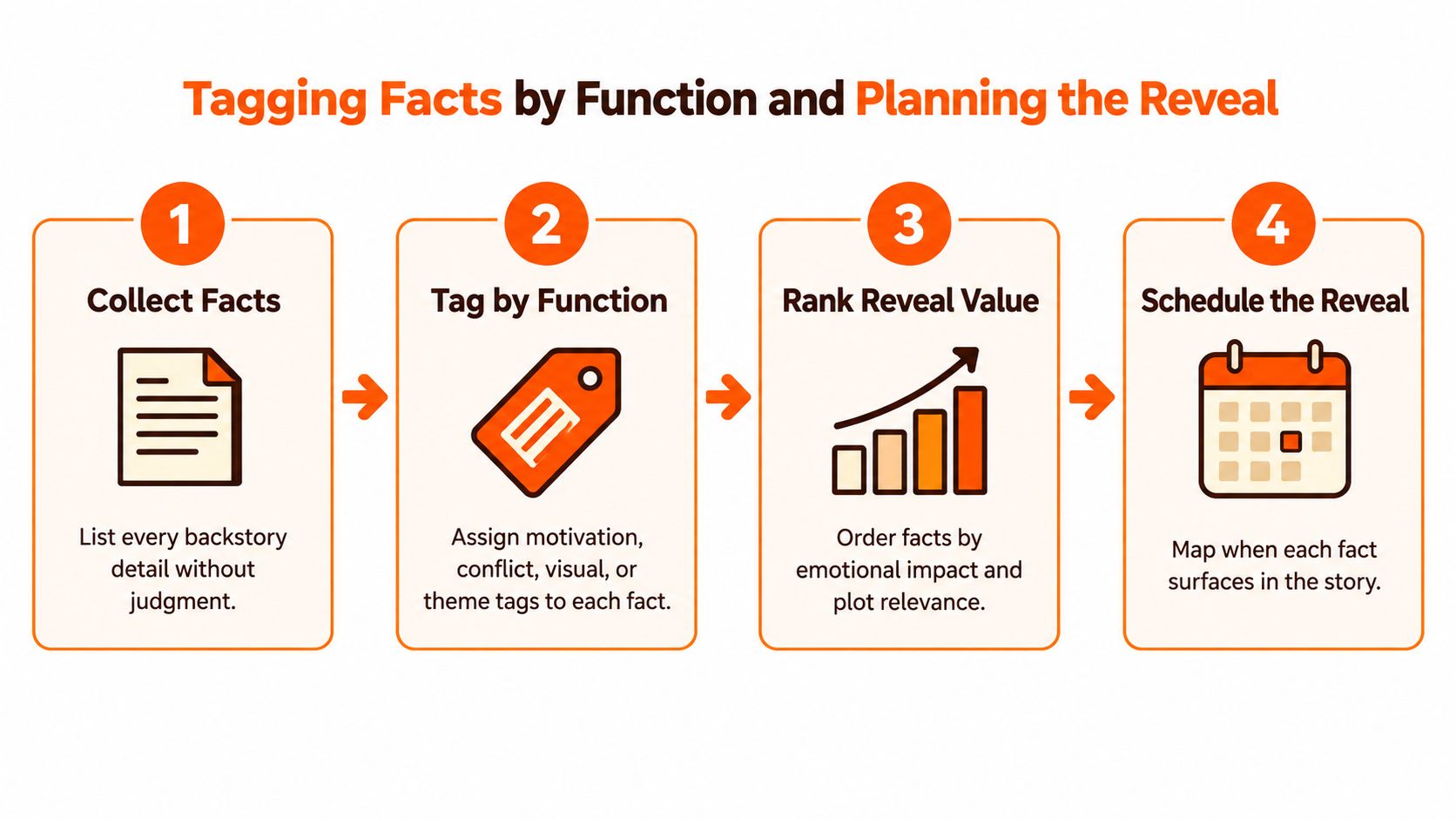
A useful workflow is simple:
- Collect every fact without editing.
- Tag each one by function.
- Rank each fact by emotional impact and plot relevance.
- Schedule when it appears.
<a id="give-each-fact-a-reveal-stage"></a>
Give each fact a reveal stage
A fact should not arrive all at once unless the plot needs it. A childhood fire might first appear as smoke-triggered avoidance, then as a damaged photograph on a shelf, and only later as a spoken confession. That sequence turns backstory into pressure, not exposition.
A reveal schedule also helps recurring series stay coherent. If the same detail can be shown through action first, then dialogue, then memory, the audience gets continuity without repetition. The backstory becomes a reusable system of cues, not a speech someone gives once and never again.
| Tagging Worksheet | |||
|---|---|---|---|
| Fact | Function | Reveal Stage | Cue |
| Childhood fire | Fear and conflict | Episode 1 | Smoke avoidance |
| Damaged family photo | Visual symbol | Episode 3 | Broken frame on a desk |
| Admission about the fire | Future reveal | Episode 5 | Confession in dialogue |
The key is restraint. Reveal the smallest fragment that makes the present scene clearer, then let later scenes reveal the next layer.
<a id="testing-the-backstory-with-the-removal-question"></a>
Testing the Backstory With the Removal Question
The fastest way to cut weak backstory is to ask a hard question: if this fact disappeared, would the current scene, conflict, or relationship become less understandable? If not, cut it. That test protects the story from trauma decoration, where something dramatic happened but changed nothing.
<a id="use-the-removal-question-before-you-write-the-scene"></a>
Use the removal question before you write the scene
This filter is blunt on purpose. A tragic childhood, a lost sibling, or a failed business only belongs on the page if it explains an observable choice now. If the character behaves the same way with or without the detail, the detail isn't doing work.
The same logic applies to visual history. A scar, keepsake, or old photograph should either affect decisions or expose an emotional trigger. If it's only there to decorate the character, it will read as empty signaling.
<a id="audit-each-surviving-fact"></a>
Audit each surviving fact
A five-column check keeps the logic tight.
| Event | Resulting Belief | Trigger | Visible Behavior | Consequence |
|---|---|---|---|---|
| Betrayal by a partner | Trust leads to loss | Partnership offers | Refuses collaboration | Misses useful help |
| Public failure | Visibility equals shame | A crowd forms | Becomes defensive | Escalates conflict |
| Loss of a parent | Attachment feels unsafe | Intimate conversation | Changes the subject | Stays isolated |
If you can't point to the behavior, the audience can't feel the backstory.
This audit also catches chronology slips. If the belief doesn't match the event, or the behavior doesn't match the belief, the scene needs revision. The result is a character who reacts predictably at the level of motivation, while still leaving room for surprising tactics.
<a id="using-backstory-in-serialized-video-production"></a>
Using Backstory in Serialized Video Production
Serialized video lives or dies on consistency. A one-page character bible gives you a locked source for that consistency, so every episode draws from the same wound, desire, taboo, coping behavior, speech pattern, visual anchors, and stress responses. Without that lock, characters start drifting, and long AI videos feel stitched together instead of lived in.

<a id="build-the-bible-before-the-episode-machine-starts"></a>
Build the bible before the episode machine starts
For a recurring cast, the bible should hold the minimum facts that never change. Core wound. Desire. Taboo. Coping behavior. Speech pattern. Visual anchors. Three stable reactions under stress. That's enough to keep a character recognizably themselves even when the plot moves quickly.
Those stable reactions matter because viewers notice inconsistency before they notice style. A character who distrusts authority should speak, hesitate, and resist in the same underlying pattern from scene to scene, even if the tactic changes. That's how lip sync, regenerated scenes, and repeat appearances feel grounded instead of random.
<a id="keep-history-behind-the-performance"></a>
Keep history behind the performance
The cleanest production habit is to treat most backstory as writer-only knowledge. The audience should see the effects, not the entire archive. That keeps momentum up and gives each episode a fresh dramatic task instead of a recap.
The same logic helps when you're planning scene voice, gesture, and composition. A character who fears abandonment shouldn't need a speech about it every time. They can glance at a doorway, avoid an answer, or overcommit to a promise. Those choices carry the history farther than exposition ever will.
An internal production guide on making your own movies fits naturally with this approach because the work is not just inventing a past, it is keeping that past visible through repeatable scene choices.
<a id="backstory-checklist-and-common-pitfalls"></a>
Backstory Checklist and Common Pitfalls
Before scripting, check six things, a locked wound, a clear want versus need, a dated timeline, tagged facts, a reveal plan, and a five-column audit. If any one of those is missing, the character will usually wobble under repetition. The most common failures are trauma decoration, dumping the full history in episode 1, chronology contradictions, and facts that never matter again.
<a id="fast-checklist"></a>
Fast checklist
- Wound: can you name the injury that still drives them?
- Want versus need: is the public goal different from the deeper fix?
- Timeline: can you place the major events by age or year?
- Tags: do the facts have narrative jobs?
- Reveal plan: do the facts surface through action, dialogue, or visual cues?
- Audit: does each fact explain a choice, conflict, or relationship?
<a id="common-pitfalls-to-avoid"></a>
Common pitfalls to avoid
A dramatic event with no effect is just decoration. A fully narrated childhood in the opening episode kills momentum. A character who changes belief without cause breaks trust. A detail that never returns wastes the space it took to learn it.
A better habit is to build the character bible first, then write the opening episode from the behavior that bible demands. If you want a practical next step for keeping recurring characters consistent and moving, start there and then use ClipNova AI's automated video production workflow to keep the production side aligned with the story logic.
ClipNova AI helps you turn that kind of backstory work into finished long AI videos with the same characters from scene to scene. If you're building a recurring cast and want the story memory, lip sync, captions, voiceover, and scenes to stay aligned, ClipNova AI is built for that workflow.
Ready to ship your own?
Start creating viral videos with AI in under twenty minutes, no credit card required.