
Does a post comply just because it includes #ad? A hashtag alone rarely settles the question. The FTC's Endorsement Guides focus on whether a material connection is disclosed clearly and conspicuously, and whether the post's claims are truthful and substantiated.
Those are separate checks, not a three-part FTC test. A disclosure can identify a paid relationship while leaving a misleading product claim untouched. And whether viewers need to know that a person, voice, or scene is synthetic is a distinct question from whether an endorsement has been disclosed.
For creators, the practical lesson is to check each issue on its own. Clear wording and placement address disclosure; truthful, supportable statements address the claims in the post. This is general guidance, not a guarantee of legal compliance.
Table of Contents
- When a Material Connection Requires Disclosure
- Disclosure Wording That Passes and Fails
- Platform Rules for Instagram, TikTok, YouTube and Facebook
- Enforcement Cases and What They Cost
- Disclosing AI-Assisted and Synthetic Content
- Run This Pre-Publish Check Before Every Post
<a id="when-a-material-connection-requires-disclosure"></a>
When a Material Connection Requires Disclosure
Disclose it, in the same post as the endorsement, whenever something of value has changed hands or a relationship exists that your audience wouldn't reasonably expect. That is the rule in one sentence. The FTC's guidance on disclosures for social media influencers calls this a material connection: a tie that could affect the perceived credibility of the endorsement. Payment, free or discounted products or services, employment, family relationships and other financial or personal ties all count.
| Situation | Disclosure needed? | Why it counts |
|---|---|---|
| Paid sponsorship | Yes | Payment is the clearest material connection |
| Free or discounted product or service | Yes | The value received can change how the review reads |
| Affiliate link with commission | Yes | Earning money per sale is a financial tie |
| Ownership stake in the brand | Yes | An insider relationship consumers would not expect |
| Employment with the brand | Yes | A working relationship that shapes credibility |
| Family relationship with the brand | Yes | A personal tie that changes how the endorsement is weighed |
| Unpaid personal use with no ties | No | No connection exists to disclose |
The distinction creators trip over sits between a product they chose and a product they were given. Say a creator buys a blender at full price, uses it for a year, and posts a review. Nothing changed hands, nobody at the brand knows their name, and there's nothing to disclose. Swap one detail: the brand ships the same blender for free. Same creator, same sincere opinion, same editorial control over every word. The post now needs a disclosure, because the free product is the connection, and readers would weigh the review differently if they knew.
The FTC Endorsement Guides put the test in exactly those terms, asking whether the relationship "could affect how consumers evaluate the endorsement." They also settle placement. The disclosure belongs with the endorsement itself, in unambiguous language, and easy to notice. Notes hidden behind a link, a profile page or a "more" button can fall short, and on visual formats such as Instagram Stories the text should be superimposed on the image or video long enough to be noticed and read.
<a id="three-questions-that-settle-the-edge-cases"></a>
Three questions that settle the edge cases
- Did anything of value change hands? Money is the obvious one. So are credits, a free subscription, gifted production access, a commission per sale, or a discount that pays you back.
- Is there a personal or business tie followers wouldn't expect? A sibling who owns the brand, a former employer, an equity stake, a paid consulting arrangement.
- Would a follower discount your review if they knew? If yes, the relationship is material no matter how small the benefit felt to you.
Any yes means the disclosure goes in before the post goes live, in every version you publish: the feed post, the Story, the Reel, the Short, the livestream. Editorial control doesn't offset it. A review you wrote, shot and cut yourself still needs the note if the product arrived free.
Practical rule: if learning about the relationship would change how a follower reads your recommendation, they needed to know before they read it.
Brands carry a share of the duty too. The same guidance puts responsibility on advertisers to instruct and monitor the creators they engage, while the creator stays responsible for a prominent disclosure. If you want a model for how a regulated industry logs and evidences that kind of disclosure, managing financial disclosures for accredited CE shows how a paper trail is built and kept, which is the same discipline that holds up when a brand asks you to prove compliance months later.
<a id="disclosure-wording-that-passes-and-fails"></a>
Disclosure Wording That Passes and Fails
Most disclosure failures aren't caused by creators hiding anything. They're caused by a label that feels clear to the person writing it and says nothing to the person reading it.
| Label | Clear to consumers? | Use it? |
|---|---|---|
| Ad or Paid ad | Yes | Use it |
| Sponsored or Paid partnership | Yes | Use it |
| #ad | Widely recognised | Use it |
| Thanks, [Brand] | No, does not say payment or product | Avoid |
| Partner or Ambassador alone | No, too vague | Avoid |
| #sp or #collab | Not reliably understood | Avoid |
Every label in the top half names what changed hands or who paid. That's the whole test, and it's worth applying to the failing phrases one at a time.
"Thanks, [Brand]" expresses gratitude without stating a fact. A reader can't tell whether you got a discount, a free unit or a cheque, so the phrase carries no information about the relationship.
"Partner" and "Ambassador" on their own describe a relationship without saying whether money moved. If your contract calls you a brand ambassador, write "Paid brand ambassador" or "Sponsored by [Brand]" instead.
"#sp" and "#collab" are shorthand that may work inside your niche, but the standard is the ordinary consumer, who won't reliably decode either one.
Affiliate links need their own plain sentence: "I earn a commission if you buy through this link." Gifted items need the same treatment, so "Free product from the brand" beats "gifted" and beats a tag alone. Consistency matters more than cleverness. Pick one label and use that same phrasing every time.
Placement does the rest of the work. The disclosure goes before or with the claim, not at the end of a hashtag block, not only behind a link, not in a pinned comment most viewers never open. On a platform that truncates captions, the first line is the only guaranteed real estate, so that's where it lives.
Model opener: "Ad: this brand sent me the kit for free, and these are my honest results."
Video needs a second layer. Say the disclosure aloud in the first few seconds and burn it into the frame, because a muted viewer who never opens the caption still has to see it. If you produce captions at volume, choose a caption generator for video that writes subtitles into the exported file rather than a separate text field, so the label travels with the picture instead of sitting in a description that gets dropped on re-export.
<a id="platform-rules-for-instagram-tiktok-youtube-and-facebook"></a>
Platform Rules for Instagram, TikTok, YouTube and Facebook
Every major platform now ships a paid-partnership switch. None of them is a complete disclosure, so keep the switch on and write your own line anyway.
| Platform | Built-in tool | Extra step required |
|---|---|---|
| Paid partnership label | Clear caption opener and Story overlay | |
| TikTok | Branded content toggle | Caption and on-screen text in the first seconds |
| YouTube | Includes paid promotion checkbox | Spoken disclosure early, repeated in description, altered content label for realistic synthetic scenes |
| Paid partnership label | Disclosure written in the post text |
<a id="instagram-and-tiktok"></a>
Instagram and TikTok
On Instagram, switch on the paid partnership label and open the caption with a plain statement, not a hashtag buried after your hook. In Stories, the disclosure becomes a text overlay sitting on the image or video for long enough to read, which usually means the first frame and a repeat if the Story runs long.
TikTok truncates captions aggressively, so the "Ad" line has to come first, and the same words belong on screen during the opening seconds. A viewer who scrolls past the caption still sees the frame.
<a id="youtube-and-facebook"></a>
YouTube and Facebook
On YouTube, tick the paid promotion box, say the sponsorship aloud in the first minute, and repeat it in the description. If your video includes realistic generated scenes that could pass for real footage, turn on the altered or synthetic content label as well, since the checkbox alone doesn't tell viewers the footage itself isn't real.
On Facebook, treat the built-in label as a supplement and write the disclosure into the post text. The feed crops long captions, so the relationship belongs in the visible opening rather than after the "see more" cut.
Livestreams break every assumption built for edited posts. Someone joins forty minutes in and never sees the opening, so state the relationship at the start and repeat it at reasonable intervals, on screen and out loud.
"The disclosure isn't a one-time event in a live stream. It's a recurring caption."
If your campaigns run in regulated categories, platform tools sit on top of a second set of marketing rules. Teams working with registered investment advisers plan paid social around both the platform's ad policies and the sector's own requirements, and this walkthrough of paid social advertising for RIAs shows how those layers stack in practice.
<a id="enforcement-cases-and-what-they-cost"></a>
Enforcement Cases and What They Cost
Creators often assume a disclosure failure lands on the brand, with the creator as a footnote. The enforcement record runs the other way: the person who received the benefit is named, and the remedy shapes the next thousand posts.
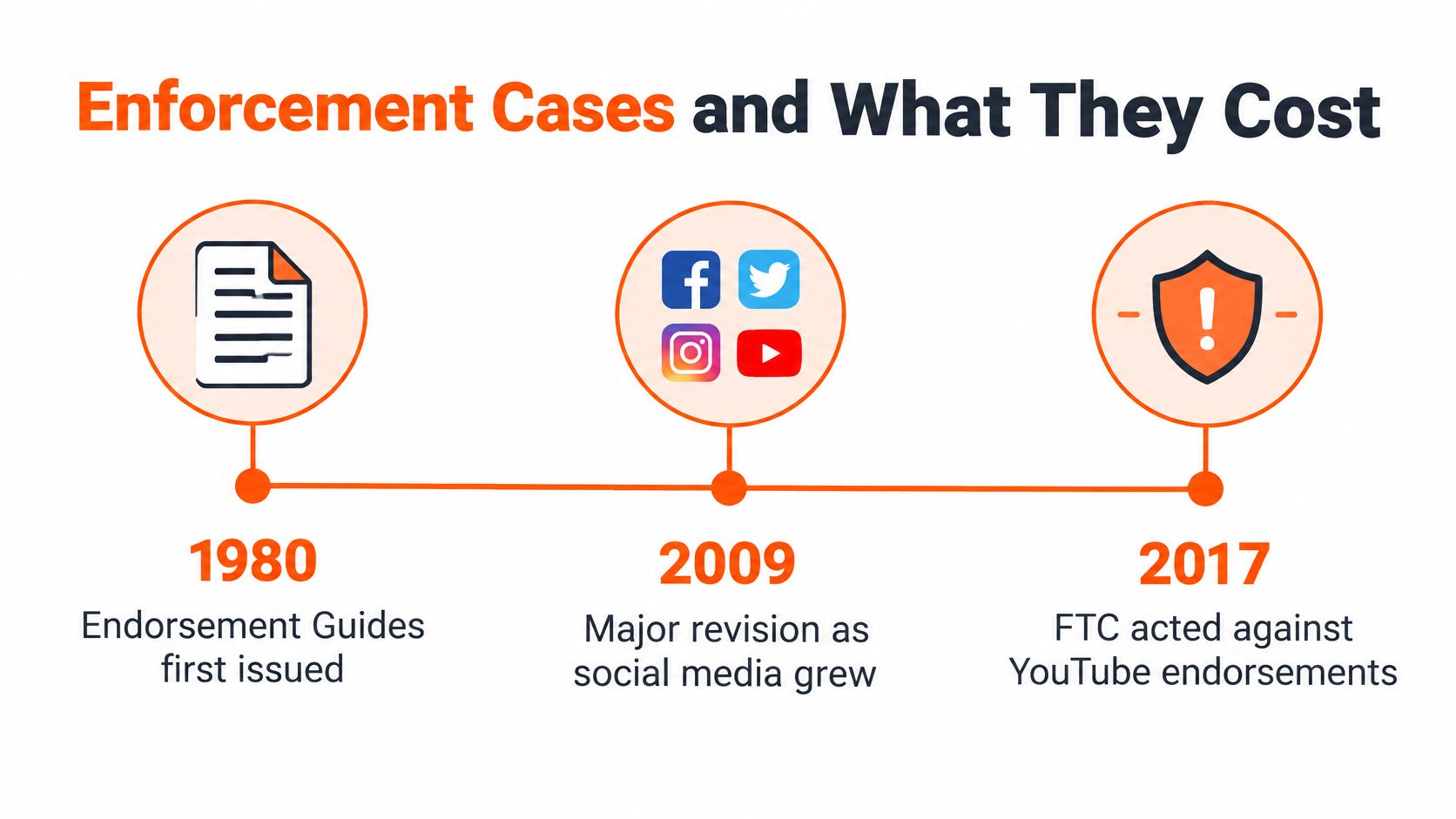
In 2017 the FTC pursued action involving YouTube personalities Trevor Martin and Thomas Cassell, who promoted an online gambling site without disclosing that they owned the company. The proposed settlement required future clear and conspicuous disclosures. Ownership, not payment, was the hidden fact.
The 2020 Teami case made a related point about weight-loss products. The FTC alleged that paid Instagram endorsements lacked adequate disclosures and required monitoring systems for the people doing the endorsing. A brand that hands out product and looks away is exposed along with the creator.
<a id="what-the-june-2023-revision-changed"></a>
What the June 2023 revision changed
On 28 June 2023, the FTC announced its first substantial update to the Endorsement Guides since 2009. The revision extended the framework to fake reviews, employee endorsements, incentivized reviews, social media tags, virtual influencers and the responsibilities of advertisers, endorsers and intermediaries. It added a definition of "clear and conspicuous" built around disclosures that are difficult to miss and understandable to ordinary consumers. It also warned that a platform's built-in disclosure tool may not always be sufficient by itself, so ticking a paid-partnership label doesn't automatically satisfy the law.
Remedies carry real weight. The Guides are guidance rather than a statute, but deceptive advertising is enforced, and outcomes include orders, ongoing monitoring obligations, consumer refunds and, where an existing rule or order is breached, civil penalties. Brands share the exposure.
The compliance gap isn't American. In 2024, the UK Advertising Standards Authority reported that approximately 57% of analysed influencer advertisements complied with its disclosure rules, which leaves a large minority getting it wrong in a market with an active regulator.
Health, financial and gambling promotions draw the closest scrutiny, because a missing disclosure there combines with claims that carry their own risk.
The lesson for your own campaigns is unglamorous. Put the disclosure in the script, in the on-screen text and in the caption before export, so it can't be cut in an edit or lost in a resize.
<a id="disclosing-ai-assisted-and-synthetic-content"></a>
Disclosing AI-Assisted and Synthetic Content
Does a disclosure about AI cover a paid endorsement, a realistic generated scene and a product claim? No. Each raises a different question, and one label cannot answer all three.
The FTC's guidance on endorsements, influencers and reviews focuses on endorsements and material connections. AI assistance alone does not generally trigger an FTC disclosure, but the usual endorsement rules still apply when a post promotes a product or service.
Check synthetic content, commercial relationships and truthfulness separately:
- Synthetic content: Check whether the platform or local law requires a label for realistic generated media. For YouTube, turn on the altered or synthetic content label when realistic scenes could be mistaken for real footage.
- Commercial relationship: Payment, a free product, commission, employment or another material tie may require a clear disclosure. An “AI-generated” note does not replace “Ad” or “Paid partnership,” and a paid-partnership label does not replace a required synthetic-content label.
- Truthfulness: The post must not suggest that a real person used a product if they did not. Objective claims still need support, whether a person or an AI-generated presenter delivers them.
AI-labeling requirements are emerging across markets. Check current platform policies and local legal requirements before publishing to an audience in another jurisdiction.
Consider a paid skincare post with a generated poolside scene and a synthetic presenter saying, “This cleared my skin in ten days.” The payment raises the commercial-disclosure question. The lifelike scene may need a synthetic-content label under platform rules. The skincare claim raises a separate truthfulness question: the presenter cannot have personally used the product. A talking avatar for AI-generated videos does not change that. The words it delivers still need to be truthful and supported.
Original stories, generated scenes and a consistent narrator keep a channel eligible for the YouTube, TikTok and Instagram creator programmes. On YouTube, that does not guarantee monetization: YouTube decides who gets monetized and does not pay for mass-produced or repetitive videos. A synthetic presenter reading brand copy over stock footage also does not make an unsupported claim truthful.
<a id="run-this-pre-publish-check-before-every-post"></a>
Run This Pre-Publish Check Before Every Post
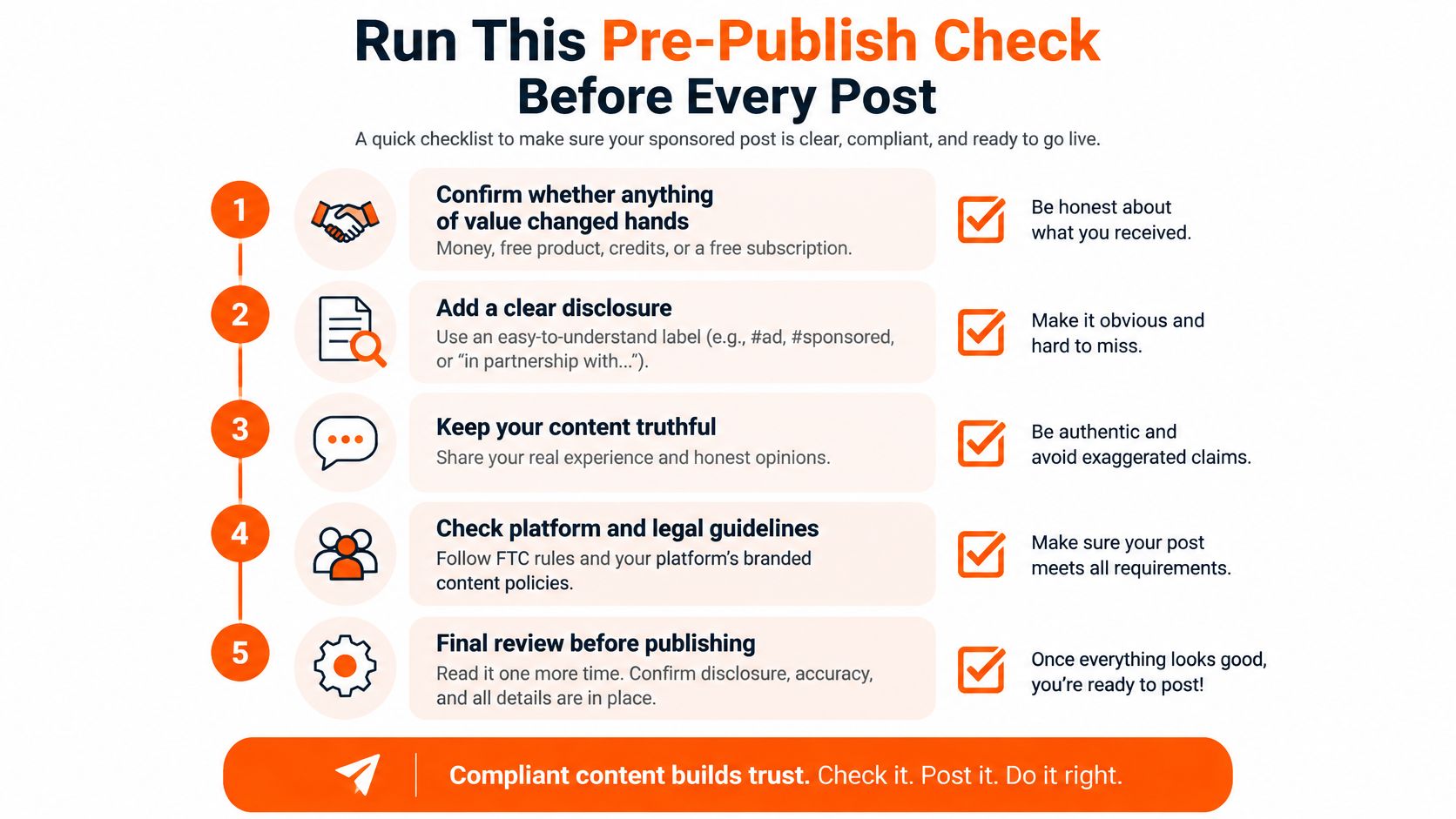
Treat this as a gate, not a reminder. Seven checks, in order, before anything goes live.
- Confirm what changed hands. Money, a free product, credits, a free subscription, commission, equity, gifted production access, or a family or employment tie. Write down which one applies.
- Write the label first. Open the caption with "Ad" or "Paid partnership with [Brand]" and name a gift or commission in plain words.
- Put it on screen and say it aloud. Overlay the disclosure long enough to read, and speak it in any format with audio.
- Check every exported version. The 9:16 cut, the 1:1 square, the 16:9 upload, each translated voiceover and each subtitle track needs its own copy. Full commercial rights on a paid plan mean the same file can go anywhere, including monetized channels, which also means more places for a label to fall off.
- Turn the platform tool on anyway. The paid-partnership or branded-content toggle stays on, and your own line stays in the caption.
- Verify the claims and the experience. Every objective claim has evidence, and the post implies no personal use that didn't happen.
- Add a synthetic label where required. Realistic generated footage or a synthetic presenter may need one under platform policy or local law.
<a id="three-templates-you-can-paste"></a>
Three templates you can paste
Caption opener: "Ad: this brand sent me the kit for free, and these are my honest results."
On-screen overlay: "Paid partnership with [Brand]"
Campaign clause: "Creator will disclose the paid relationship clearly and conspicuously in the published content, and Brand will review each version before publishing."
The visual version of this routine belongs on your phone before a shoot day.
Batching multiplies the risk, because one missing overlay becomes eight posts. If you automate video editing with a saved template, build the disclosure into the preset itself so it's part of the export rather than a step someone has to remember at 11pm.
Community platforms deserve the same attention. Teams that want to strengthen your brand's Reddit presence should know that threads get read out of order, so a disclosure attached only to the original post may never be seen by someone arriving from search. Repeat it in each comment where you recommend the product.
Then do one last pass on each published cut, not on the master file. Open the export, watch it muted, check the first three seconds, and confirm the caption's first line still says what changed hands. If it doesn't survive the resize, it doesn't survive the scrutiny.
ClipNova turns a prompt, script or link into publish-ready short-form video and burns the captions into every aspect ratio, so a disclosure written into the script and caption track appears in the 9:16, 1:1 and 16:9 exports instead of living in a campaign brief. If you publish sponsored content across several platforms or languages, that removes one whole category of version-by-version auditing. Build the label into the first draft at ClipNova.
Ready to ship your own?
Start creating viral videos with AI in under twenty minutes, no credit card required.