
Sunspring (2016) is the film most commonly identified as the first with a screenplay written entirely by an AI system. The answer changes, however, with the milestone being measured: writing a script isn't the same as generating the pictures or making a film without human creative decisions.
The usual advice is to find the earliest release date and declare a winner. That skips the more revealing question: what did the AI decide? A machine-written screenplay performed by actors and a human-written story illustrated with generated images represent different achievements.
Table of Contents
- Which Film Counts as the First AI Movie
- Who Made Each Creative Decision
- Timeline of Early AI Films and What Each Proved
- Techniques Behind Text, Visuals and Synthetic Actors
- Audience Trust and Where AI Films Get Rejected
- Checklist and Disclosure Before Publishing
<a id="which-film-counts-as-the-first-ai-movie"></a>
Which Film Counts as the First AI Movie
The “first AI movie” depends on what the AI contributed. Sunspring is a useful starting point for AI-authored screenplays, but it does not show that a system independently handled acting, cinematography, or editing.
A film credit needs a verb. “AI-written” describes the screenplay; “AI-generated” might describe the images. Neither label alone tells you who approved the story or assembled the finished film.
<a id="milestones-behind-first-ai-movie-claims"></a>
Milestones behind first AI movie claims
| Milestone | Example | Scale | Year |
|---|---|---|---|
| AI-written screenplay | Sunspring | Short film | 2016 |
| AI-generated shots from a human script | The Frost | Short film | Not specified |
| AI-written feature film | The Last Screenwriter | Feature-length | 2024 production |
| AI-generated short film | Sacred Mountain | 15 minutes | 2025 |
| Long AI-generated film | Imperia | About 35 minutes | Not specified |
These examples mark different kinds of work, not steps on a ladder toward fully autonomous filmmaking. The Frost used a human-written script and AI-generated shots, while Sunspring is associated with an AI-written screenplay. The Last Screenwriter is a feature-length example, not evidence that AI controlled every part of production.
Envato Elements' overview of AI filmmaking describes Sacred Mountain as a 15-minute AI-generated short from 2025 and Imperia as an approximately 35-minute AI-generated film. Runtime describes the finished work's scale; it does not identify who made its creative decisions.
<a id="what-the-table-doesnt-establish"></a>
What the table doesn't establish
A production year does not necessarily give a release date. Online publication, theatrical opening, commercial distribution, and festival acceptance are different milestones. Likewise, calling a film AI-generated does not by itself show that a system made the creative decisions independently.
For any “first” claim, ask what the system did: write, illustrate, animate, or assemble? Then identify the milestone being claimed, such as completion or public release.
A film can be first only for a specific milestone. An AI-written screenplay does not establish a record for an AI-made movie.
Runtime is not a measure of machine independence. A longer production can involve close human control, while a brief experiment can leave more generated choices intact.
<a id="who-made-each-creative-decision"></a>
Who Made Each Creative Decision
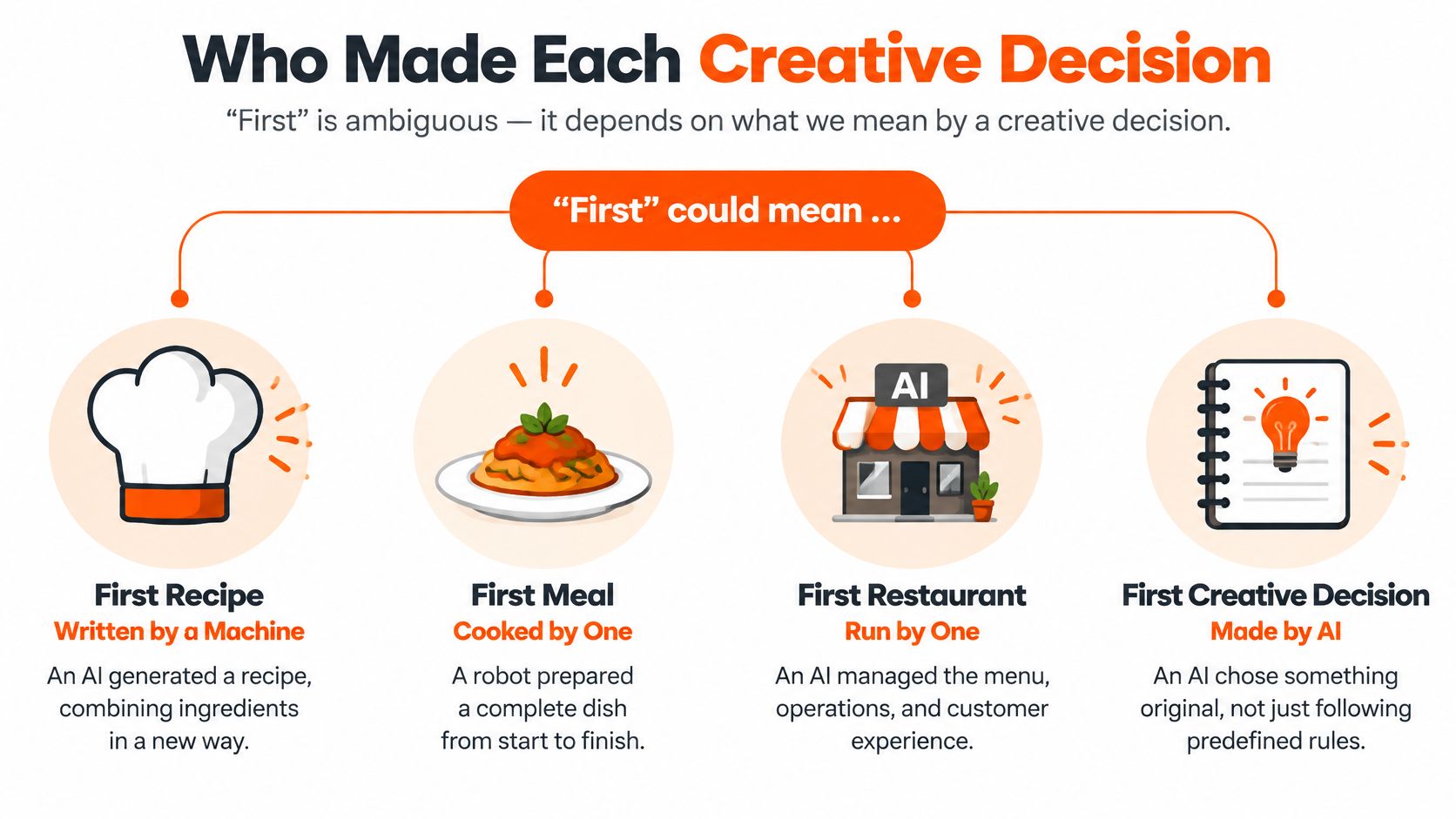
In cooking, a machine could write a recipe, prepare a meal, or operate a restaurant. Those achievements require different capabilities, even if someone describes all of them as automated cooking.
Films need the same distinction. Writing dialogue doesn't choose a camera angle, and generating a face doesn't decide when an editor should cut away from it.
The concept map separates those different meanings of creative control.
<a id="sort-films-by-responsibility"></a>
Sort films by responsibility
Tech Wire Asia's discussion of AI in filmmaking distinguishes AI-written work from generated imagery, including The Frost, a 12-minute film made with DALL·E 2 shots from a human-written script and animation using D-ID. That distinction supports a more useful production taxonomy:
- Human-written and AI-produced. A person establishes the story and intended action, then uses generation tools to produce material; the person approving shots and the final edit still controls how that story reaches viewers.
- AI-written and human-performed. Sunspring fits this category: the system supplied the screenplay, while people interpreted it through casting, performance, filming, and editing.
- AI-generated visuals with human post-production. The Frost illustrates a workflow in which people specify the story, generate candidate images, and shape the result through animation and editorial choices.
- Predominantly synthetic films. AI generates most of the picture and sound, but that label alone doesn't identify who selected the premise, rejected outputs, or approved the finished sequence.
These categories overlap. A film can have synthetic imagery, a machine-generated script, human narration, and a carefully supervised edit without fitting neatly into a single bucket.
<a id="selection-is-a-creative-decision"></a>
Selection is a creative decision
Say a filmmaker generates several versions of a character entering a room. Choosing the hesitant entrance rather than the confident one changes how viewers understand the character, even though the filmmaker didn't draw either image.
That's why fully AI usually describes a production process rather than the absence of people. Prompting, rejecting, arranging, and approving can all affect the final meaning.
For creators planning their own workflow, a guide to making your own movies is most useful when paired with a responsibility sheet, not just a tool list. Record who owns the script, shot selection, and final cut.
Before accepting an AI-film claim, check those roles explicitly: who wrote the script, who chose the shots, and who made the final cut? Missing credits are unanswered questions, not evidence of autonomy.
<a id="timeline-of-early-ai-films-and-what-each-proved"></a>
Timeline of Early AI Films and What Each Proved
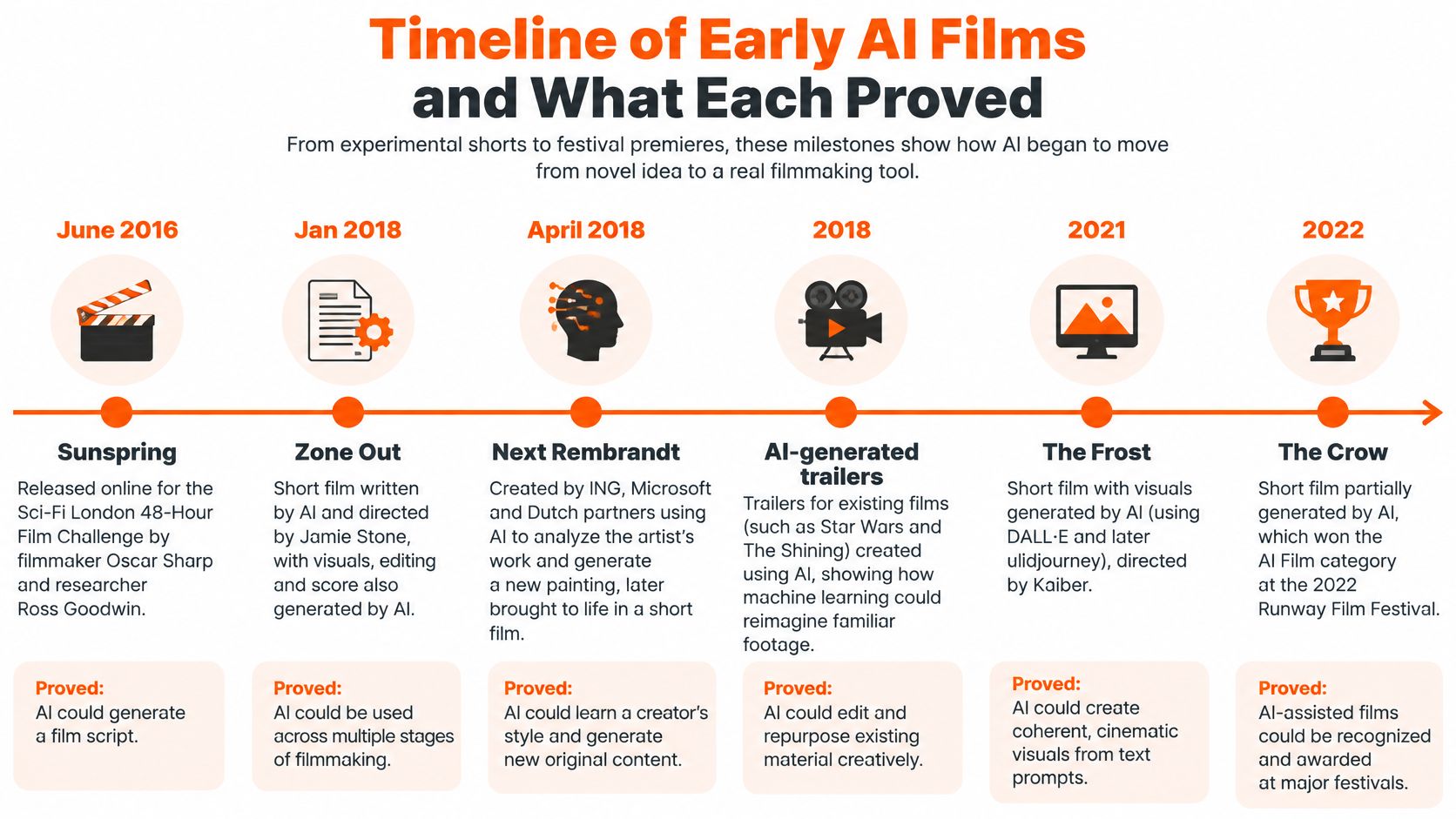
Sunspring began as a filmmaking challenge, not an attempt to replace a production crew. Its value becomes clearer when you follow the handoff from generated writing to human interpretation.
The timeline provides a visual orientation to that shift.
<a id="from-generated-script-to-performed-film"></a>
From generated script to performed film
According to Wikipedia's account of Sunspring, filmmaker Oscar Sharp and researcher Ross Goodwin created it for the Sci-Fi London 48-Hour Film Challenge, and Ars Technica released it online on June 9, 2016. The system, initially called Jetson and later Benjamin, learned patterns from science-fiction screenplays and generated dialogue and stage directions from contest prompts.
The practical test was whether people could turn that output into something watchable. The Curator's review describes a roughly two-day production window, three human actors including Thomas Middleditch, and a top-ten competition result. The team demonstrated that performers could interpret generated writing, but abrupt plot changes and strange dialogue left narrative quality unresolved.
The Frost moved the experiment toward the image-making side of production. Its importance wasn't machine authorship of the story, but the use of generated shots as material for a finished screen work. That leaves a different evaluation task: do the images connect into a coherent sequence rather than merely look compelling individually?
<a id="from-experiments-to-longer-productions"></a>
From experiments to longer productions
Window Seat belongs in discussions of early feature-length experimentation. Its inclusion raises a question that a short proof of concept can avoid: can the production sustain visual identity and audience attention across an extended narrative? Calling a work feature-length doesn't, by itself, settle its release history or degree of automation.
The Last Screenwriter tested generated writing within conventional production. Professional performers and crew supplied the physical filmmaking, allowing the screenplay workflow to be examined separately from synthetic actors or generated cinematography. Its significance is that AI-authored material could enter an established production pipeline, not that every filmmaking task had been solved.
Sacred Mountain and Imperia add further examples of AI-generated films at different lengths. Their runtimes describe the scale of the finished works; they don't establish dialogue quality, continuity, distribution success, or independent machine decision-making.
Treat each early film as a specific capability test, not a demonstration that every other filmmaking problem has disappeared.
A screenplay experiment should be judged on writing and interpretation. A generated-visuals experiment should be judged on shot design and coherence. Combining those achievements into a single historical victory makes the technology harder to understand.
<a id="techniques-behind-text-visuals-and-synthetic-actors"></a>
Techniques Behind Text, Visuals and Synthetic Actors
Predictive text on a phone offers a useful starting analogy: it estimates what might follow the text you've entered. A script-generating model also learns sequential patterns, but producing screenplay-shaped text isn't the same as maintaining a convincing dramatic situation.
The technologies grouped under AI filmmaking operate on different material. Some generate language, some generate pictures, and others animate a face or produce moving footage.
<a id="core-techniques-in-early-ai-films"></a>
Core techniques in early AI films
| Technique | What It Does | Early Example | Main Limit |
|---|---|---|---|
| LSTM recurrent neural network | Predicts text from learned script patterns | Sunspring | Abrupt plot changes and nonsensical dialogue |
| Large language model prompting | Builds premise, characters, scenes, and dialogue in stages | The Last Screenwriter | Repetition and pacing need human editing |
| Text-to-image generation | Turns written shot descriptions into images | The Frost using DALL·E 2 | Keeping a character consistent across shots |
| Text-to-video generation | Turns a written prompt into moving footage | No specific early example established here | Clip duration and continuity between cuts |
| Generative adversarial network (GAN) | Trains a generator against a discriminator | No specific early example established here | Unstable training and uneven results |
| Synthetic actor animation | Animates a still face to match a voice track | The Frost using D-ID | Uncanny lip sync and likeness consent |
LSTM recurrent networks process sequences while carrying information forward through an internal memory mechanism. Benjamin used this approach for Sunspring, producing recognizable screenplay conventions without reliably preserving the relationships and intentions needed for a stable plot.
With large language model prompting, a filmmaker can request a premise, develop characters, outline scenes, and expand dialogue in separate passes. The Last Screenwriter represents this staged approach; the practical check is whether each generated scene advances the drama rather than restating what viewers already know.
Text-to-image generation produces visual candidates from descriptions. In a workflow like The Frost, the filmmaker must inspect those candidates as connected shots: a convincing face in isolation is insufficient if clothing, proportions, or the surrounding room change unexpectedly.
<a id="motion-requires-different-checks"></a>
Motion requires different checks
Text-to-video generation produces movement rather than a single frame. Review the action itself and the connection to neighboring clips, because a plausible opening image doesn't guarantee that objects, gestures, or screen direction remain coherent.
A generative adversarial network uses a generator to create outputs and a discriminator to distinguish generated examples from training examples. Their competing objectives can improve realism, but training can become unstable, and visual realism alone doesn't produce a story or a usable edit.
Synthetic actor animation links facial movement to speech or performance information. D-ID's role in The Frost illustrates why animation and voice generation should be treated separately: a suitable voice doesn't automatically produce convincing mouth movement, and a convincing face doesn't establish permission to use someone's likeness.
When selecting narration, compare AI voiceover tools for pronunciation, delivery, and controllable pacing rather than judging only the most dramatic demo. For reviewing suspicious footage, AI Image Detector's practical steps for detecting deepfakes offer a useful inspection resource, though visual checks shouldn't substitute for provenance.
The review question should match the technique. Check narrative logic for generated writing, visual identity for generated images, temporal stability for video, and permission records for recognizable synthetic performers.
<a id="audience-trust-and-where-ai-films-get-rejected"></a>
Audience Trust and Where AI Films Get Rejected
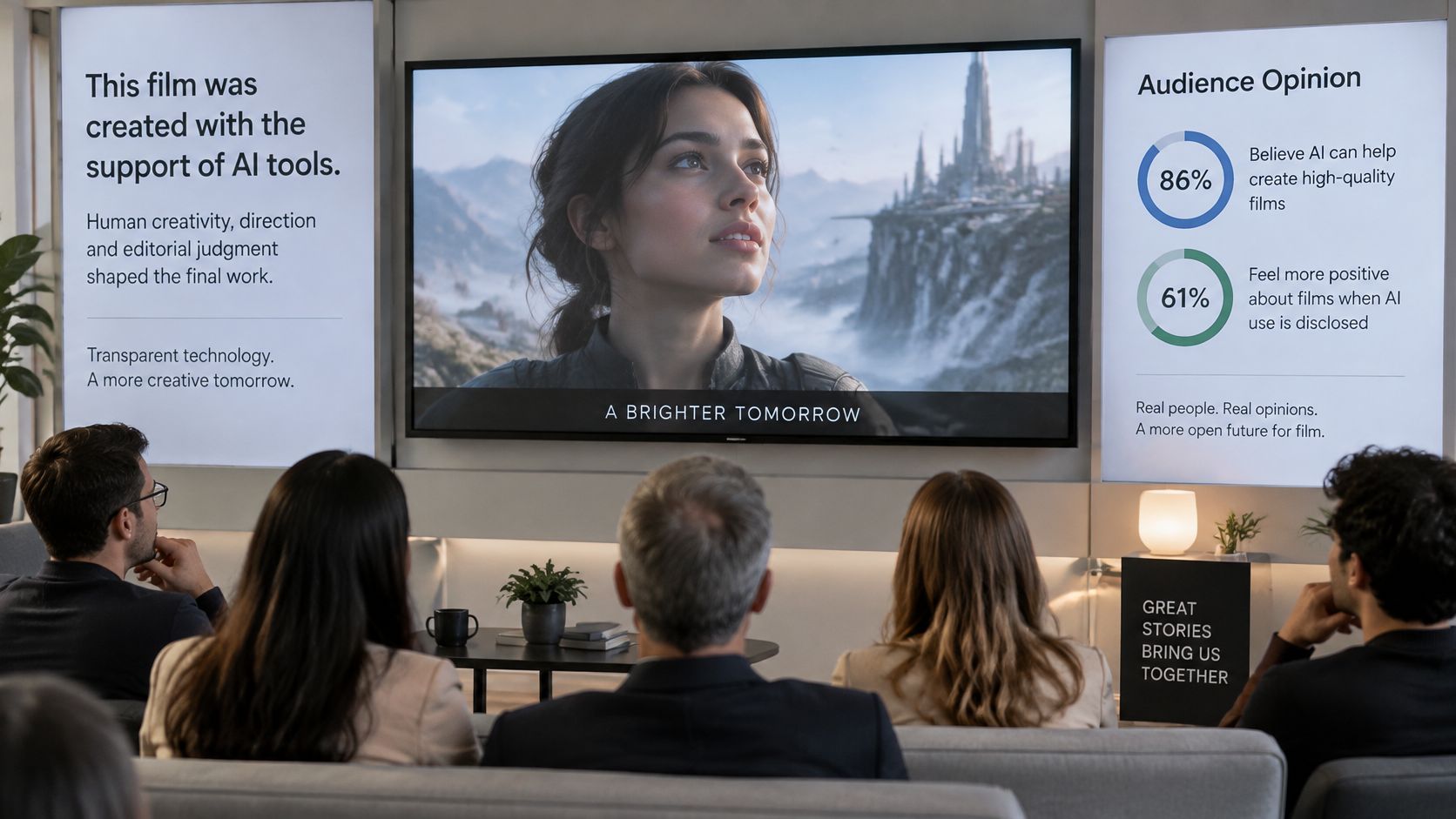
A February 2025 YouGov poll, reported by HackerNoon, found that 86% of respondents wanted AI use disclosed in media production, while 61% considered AI in filmmaking acceptable or had no strong opinion. Those findings don't describe blanket rejection; they distinguish acceptance of the technology from acceptance of hidden use.
Viewing context matters because audiences encounter a film as a finished experience, not a production diagram.
<a id="the-role-matters-more-than-the-novelty"></a>
The role matters more than the novelty
The same reporting describes greater audience receptiveness to visual effects, environment extension, and translation than to acting or screenwriting. A background extension and a synthetic lead performance therefore shouldn't receive the same vague disclosure.
The ethical questions are concrete:
- Face and likeness. If a generated performer resembles a real person, establish whether that resemblance is authorized rather than assuming generation removes the issue.
- Recorded or cloned voice. Confirm permission for the intended use, including the context in which the person appears to speak.
- Creative labor. Explain whether writers and actors contributed, supervised, or were absent, instead of using automation as a substitute for accurate credits.
- Viewer expectations. Don't present invented footage as a real event or imply that a synthetic performance came from a human actor.
A small production budget doesn't make these questions disappear. When considering free AI video workflows, evaluate permissions and presentation alongside the ability to generate an appealing clip.
<a id="disclose-the-role-not-just-the-tool"></a>
Disclose the role, not just the tool
A statement that names software but hides what it did isn't very informative. AI-generated backgrounds with human performances tells viewers something useful; made with AI leaves the central authorship questions unanswered.
When watching an AI-film example, evaluate both the creative result and the way its production is described.
<iframe width="100%" style="aspect-ratio: 16 / 9;" src="https://www.youtube.com/embed/aie452NoWkk" frameborder="0" allow="autoplay; encrypted-media" allowfullscreen></iframe>Disclosure rule: Describe the material viewers see or hear, not merely the software somewhere in the workflow.
Disclosure doesn't determine whether a film is good. Viewers can know how a work was made and still respond to its performances, rhythm, imagery, and emotional stakes. Clear credits allow that judgment without asking them to accept a misleading account of authorship.
<a id="checklist-and-disclosure-before-publishing"></a>
Checklist and Disclosure Before Publishing
The Last Screenwriter offers a useful publishing lesson because its generated screenplay still required selection and editorial judgment. A Frontiers in Communication article describes structured prompting with ChatGPT-4.0, human selection of scenes and cuts to repetitive passages, and conventional production of the 76-minute film in January 2024 with an approximate budget of $850,000.
The important operational distinction is between generating material and approving it. A complete output can still contain factual errors, weak motivation, unsuitable imagery, or a misleading credit.
<a id="review-the-work-and-its-provenance"></a>
Review the work and its provenance
-
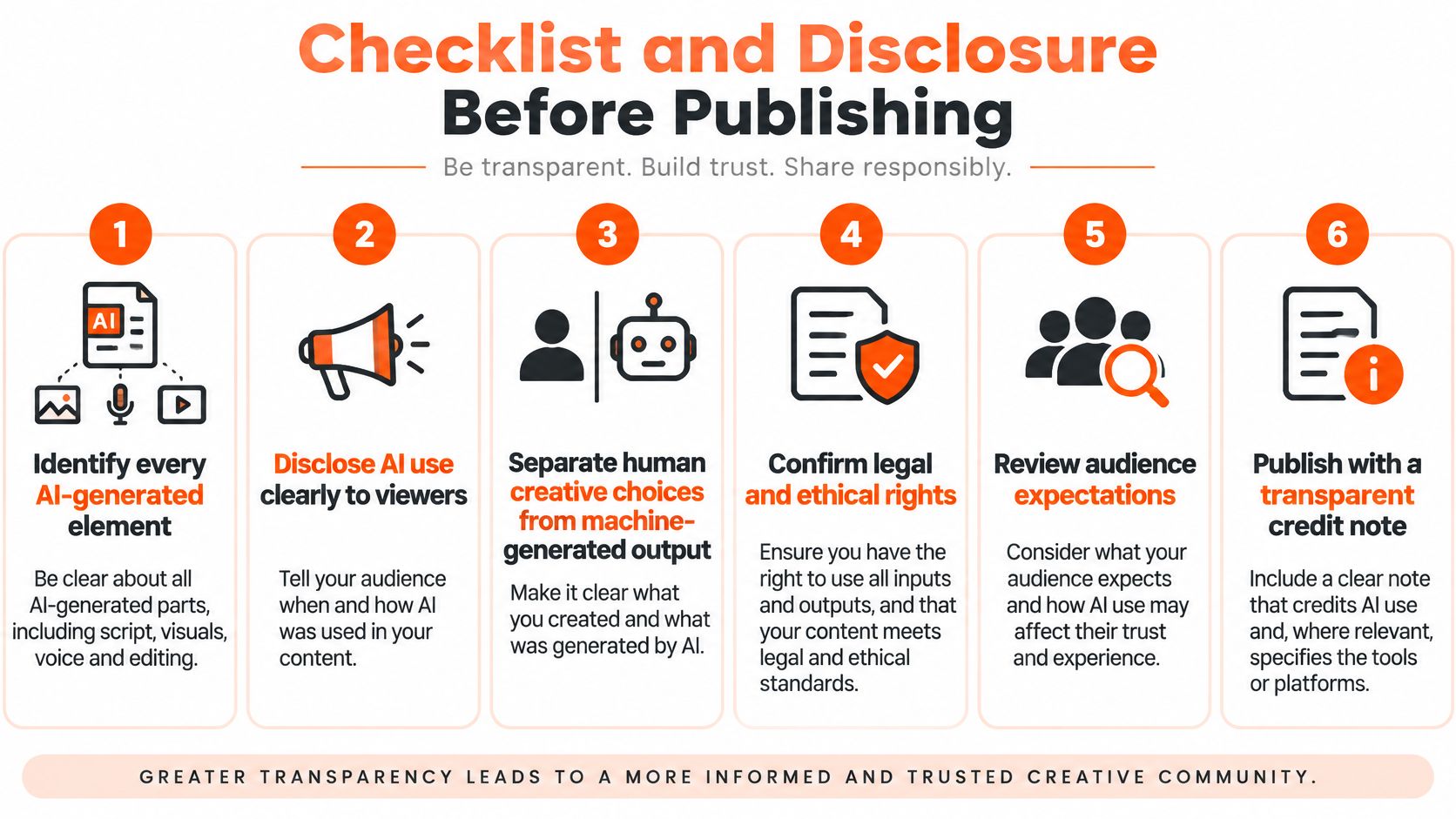
Identify every AI-generated element. Inventory the script, visuals, voice, performers, and editing assistance, because a general AI label won't reveal which parts require review.
-
Confirm voice and likeness permissions. Keep the relevant authorization for any recognizable person or cloned voice, because technical access to a face or recording isn't permission to publish a synthetic performance.
-
Keep prompts, drafts, and edit logs. Preserve the source material and meaningful human changes so you can explain how the finished work was developed if its provenance is challenged.
-
Separate facts from invented visuals. Check dates, names, and details against reliable references, because generated scenes can look documentary-like even when their contents are fictional.
-
Review the drama by hand. Examine continuity, pacing, repetition, and character motivation, because selecting readable scenes doesn't guarantee that their combined sequence makes sense.
-
Watch the complete video before posting. Review the exported version from beginning to end, because a script preview won't reveal every pronunciation error, caption mismatch, awkward transition, or unintended visual detail.
Use the visual checklist as a final reminder before release.
<a id="write-a-credit-that-answers-the-real-question"></a>
Write a credit that answers the real question
A useful label names the milestone and the remaining human roles. For a scenario modeled on Sunspring, AI-written screenplay, human performances, direction, and editing is more precise than fully AI-made.
For a human-scripted visual experiment, the credit could identify AI-generated imagery alongside human writing, shot selection, and post-production. If a voice or face is synthetic, identify that contribution separately rather than hiding it within a broad production label.
Legal status can depend on jurisdiction and the human creative contribution. For commercial work, confirm the relevant licenses, permissions, and contractual terms with a qualified adviser rather than assuming that generated output settles ownership.
For creators using our workflow, factual review remains a publishing responsibility: AI can still get a date, a name, or a detail wrong. Run the checklist on each draft, then write the production credit before you export so omissions can be fixed while the project is still open.
The most useful answer to the first AI movie question isn't an unqualified winner. It's a precise description of what the machine produced and what people did to turn that material into a film.
ClipNova brings script, visuals, voiceover, captions, and music into a single AI-powered video workspace. Visit ClipNova to create a short-form project, then apply the same authorship checks before publishing it. To begin, pick a plan and open Series for a recurring show or AI Video Studio for a single video.
Ready to ship your own?
Start creating viral videos with AI in under twenty minutes, no credit card required.