
You exported a fifteen-second clip last night. The face is a client's, the voice is a studio preset, and the caption is already written. Before you hit publish, the important question is not whether the model did a good job. It is which deepfake laws treat that clip as ordinary creative work, and which treat it as a fake that has to be marked, consented, or taken down.
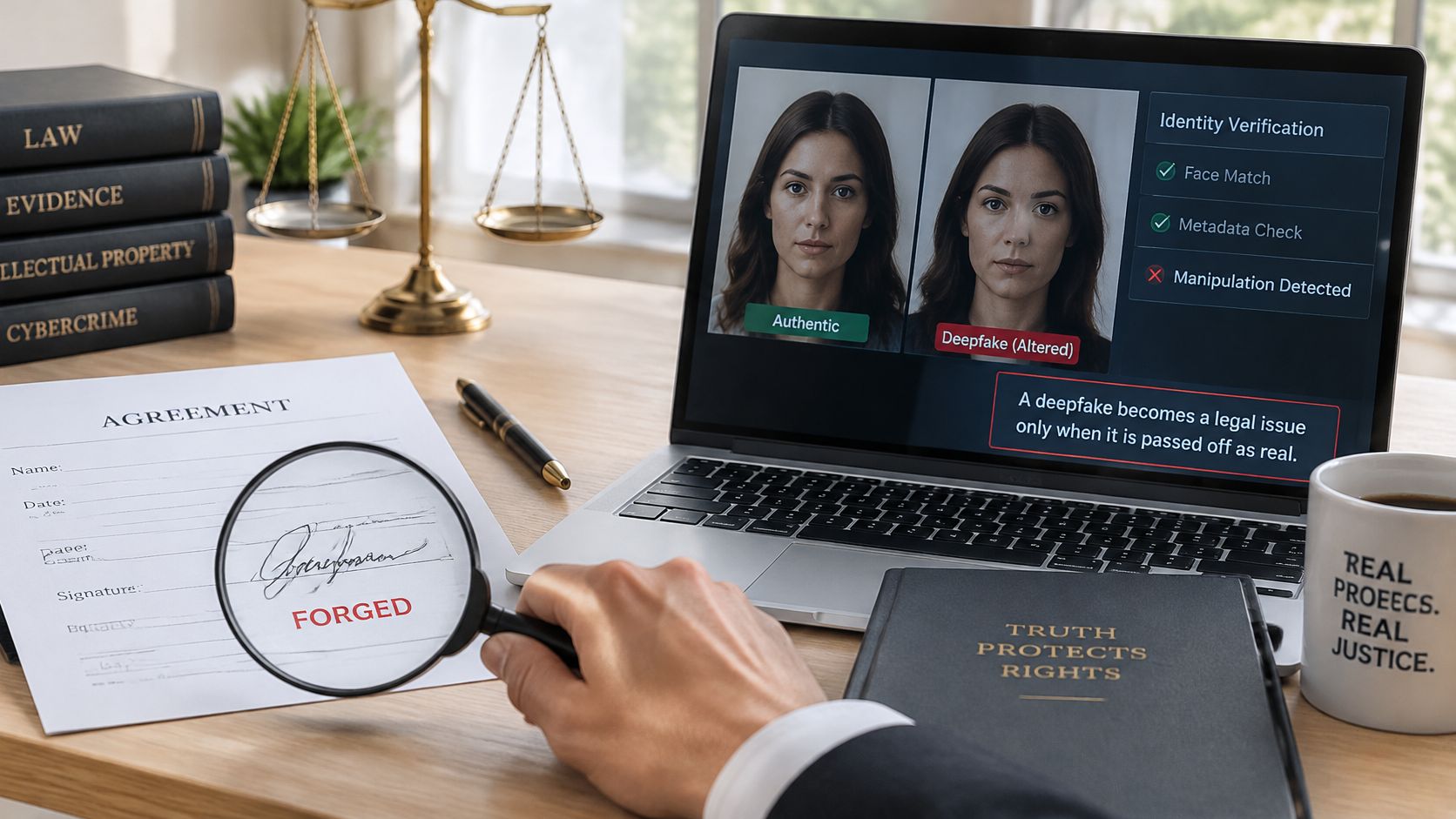
A forged signature is only a legal problem when someone passes it off as real. Synthetic media works the same way. The tool you used matters less than what a viewer is invited to believe. Laws now split that belief across borders, and a single on-screen label rarely closes every file.
Table of Contents
- What Counts as a Deepfake Under the Law
- Deepfake Laws by Jurisdiction at a Glance
- EU Labeling and Machine-Readable Provenance Rules
- China's Consent and Security Review Model
- US Federal Takedown Duty and the State Patchwork
- Enforcement Gaps and Key Dates to Watch
- Where Disclosure Is Not Enough for Satire and Politics
- Confirm Your Exposure Before You Publish
<a id="what-counts-as-a-deepfake-under-the-law"></a>
What Counts as a Deepfake Under the Law
Sort the asset before you sort the statute. Most creator workflows fall into three buckets.
- Clearly fictional content. An animated character, a cartoon host, or a scene that no reasonable person would treat as a news clip.
- Altered footage of a real person. A real interview, ad, or photo that you restyle, translate, or extend.
- Impersonation of a specific face or voice. A likeness that looks or sounds like someone who exists, doing or saying something they did not do.
The legal trigger is resemblance plus false authenticity, not the brand name on the generator. Under the European Commission's guidance on Article 50, a deployer-produced output is a legally relevant deepfake when it resembles an existing person, object, place, entity, or event and would falsely appear authentic or truthful. Intent to deceive is not required. A polished product demo can qualify even when nobody meant to trick anyone.
China's rules use a wider net. Deep synthesis covers generative algorithms, including deep learning and virtual reality, that create or alter text, images, audio, video, or virtual scenes. The U.S. federal statute is narrower still. It targets computer-generated digital forgeries of intimate images, not every synthetic ad.
Say you start from a single photo and build motion with a picture to video workflow. If the result looks like that person walking into a room they never entered, you are in the impersonation bucket, even though you began with a still. If the figure is an obvious cartoon, you are closer to fiction, though a recognizable celebrity face can pull you back.
Would a reasonable viewer believe this footage shows a real person doing or saying something they did not do or say?
If the answer is yes, treat labeling, consent, and takedown as live duties. Teams that stage crisis or interview-style clips should also run ethical checks before crisis interviews so the edit does not invent a quote a source never gave.
<a id="deepfake-laws-by-jurisdiction-at-a-glance"></a>
Deepfake Laws by Jurisdiction at a Glance
One face-edited clip can be made in one country, stored on a host in a second, and watched in a third. Each stop can carry its own duty. A visible AI label works like a packing slip: it tells the viewer what is in the file. It does not close consent at creation, a security review before export, or a removal duty after a report or a re-upload.
| Jurisdiction | Main instrument | In force | Core duty | Penalty exposure |
|---|---|---|---|---|
| European Union | AI Act, Article 50 | Entered into force 1 Aug 2024; transparency duties from 2 Aug 2026 | Machine-readable marking by providers; visible disclosure by deployers | Administrative fines for transparency breaches once those duties are enforceable |
| China | Administrative Provisions on Deep Synthesis | Effective 10 Jan 2023 | Labeling; specific consent before editing a face, voice, or other biometric data; security assessment for higher-risk tools | Binding provider duties; enforcement follows China's existing internet administration rules |
| United States (federal) | TAKE IT DOWN Act | Enacted 28 Apr 2025 | Notice-and-removal of nonconsensual intimate images, including digital forgeries | Criminal penalties for covered publication or threats |
| United States (states) | State deepfake statutes | In force state by state since 2019, beside the federal act | Political deepfakes and sexual deepfakes are the common targets | Criminal or civil penalties set inside each statute |
| United Kingdom | Proposed intimate-image removal rules | A proposal, not a finished removal clock | Fast removal of reported intimate images | Revenue-based platform penalties are under discussion |
<a id="how-to-read-the-european-row"></a>
How to read the European row
The European Commission's AI regulatory framework shows a staged calendar, not one switch: the Act entered into force on 1 August 2024, general provisions and prohibited-practice rules began on 2 February 2025, governance and general-purpose AI obligations began on 2 August 2025, and most remaining obligations, including the main transparency rules, are scheduled for 2 August 2026. Provenance, labeling, and user disclosure are operational requirements for realistic avatars, voices, face edits, and synthetic scenes. There is no confirmed euro figure for an Article 50 transparency breach on that framework page, so do not budget from a headline fine you cannot trace.
<a id="how-the-other-rows-change-the-file"></a>
How the other rows change the file
China's row is already live, and it hits at creation. Specific consent before you edit a face, voice, or other biometric data, and a security assessment for higher-risk tools, can apply before export, not only after a complaint. Hosting is the separate job of keeping the file online. Distribution is showing it to an audience, which is why an EU viewer can pull the transparency row even when the edit happened elsewhere. Re-uploading starts the U.S. federal duty again. That row is notice-and-removal for nonconsensual intimate images, including digital forgeries, so a caption on the first post does not replace a takedown path. State statutes, in force state by state since 2019 beside the federal act, commonly target political or sexual synthetic media, with criminal or civil penalties written inside each code. The UK row is still a proposal for fast removal of reported intimate images, and revenue-based platform penalties remain under discussion.
If one viewer is in the EU and another upload is a U.S. intimate-image risk, apply the strictest row that reaches that file.
<a id="eu-labeling-and-machine-readable-provenance-rules"></a>
EU Labeling and Machine-Readable Provenance Rules
Two roles carry the EU transparency job, and product teams often collapse them into one checkbox.
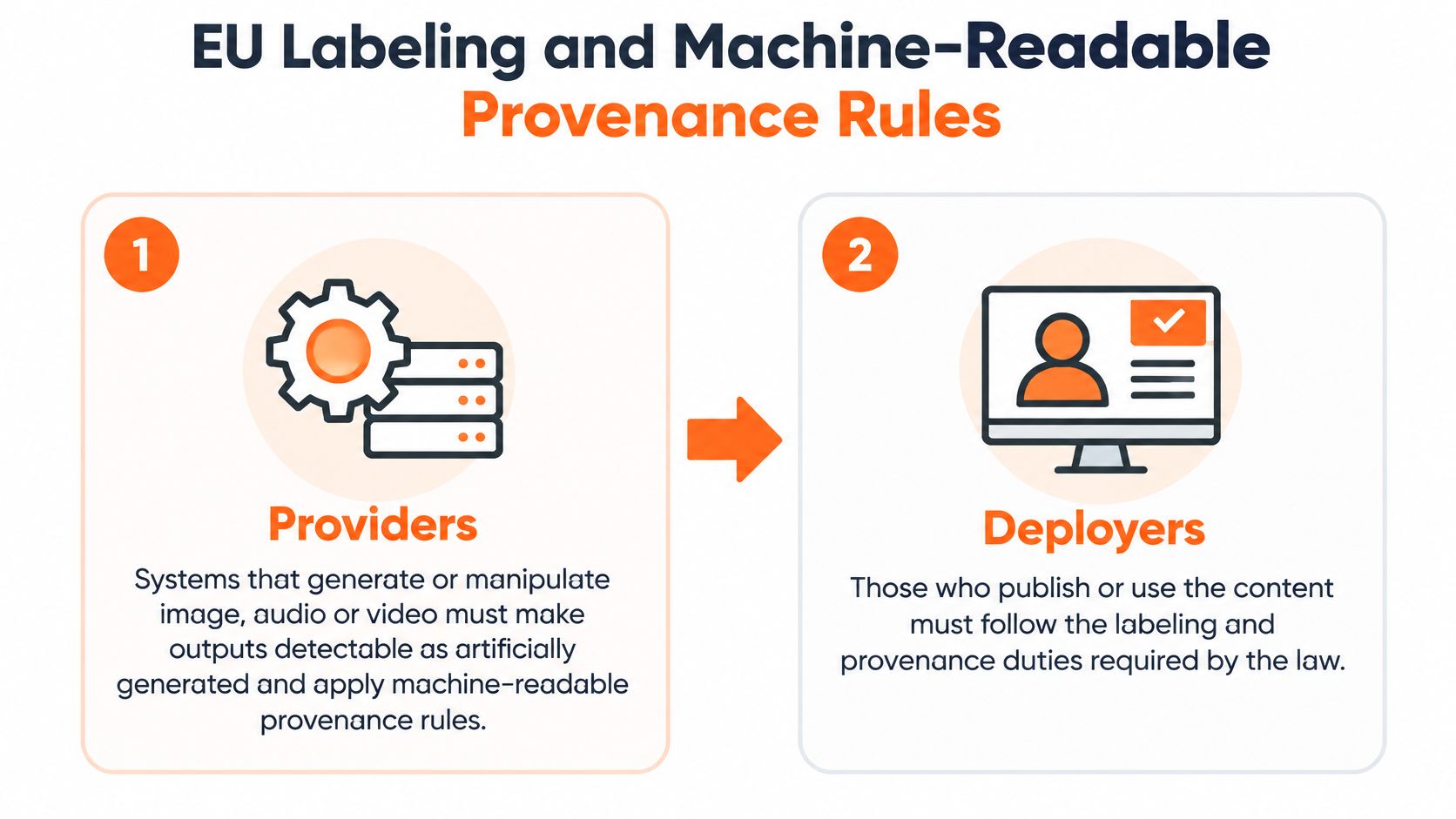
Providers build the system that generates or manipulates image, audio, or video. From 2 August 2026, the Commission FAQ on Article 50 transparency requires them to design outputs so they can be detected as artificially generated or manipulated, and to apply machine-readable markings. There is a limited exception for assistive editing that does not substantially alter input data or semantics. A color grade or a crop can sit in that exception. A new face, a new voice, or a new event usually cannot.
Deployers are the people who put the output in front of an audience. They must disclose the manipulation clearly and accessibly no later than a viewer's first exposure. The label has to be visible or audible without a special tool. A buried metadata field that only a forensic lab can read does not meet the viewer-facing duty.
<a id="an-export-pipeline-that-survives-recompression"></a>
An export pipeline that survives recompression
Social apps recompress files and strip metadata. Embedded provenance without a visible label fails in the wild. Visible text without a machine-readable mark fails the provider duty. Use both.
- Preserve generation metadata for every output, including model, prompt, and source assets, before anyone downloads a cut.
- Attach a machine-readable mark at export, not as an optional toggle a hurried editor can skip.
- Resist metadata stripping where the format allows it, and do not “clean” the file in a way that deletes the mark.
- Show a human-readable “AI-generated/manipulated” label on every rendered aspect ratio, including 9:16, 1:1, and 16:9, and on every dubbed language version.
- Classify higher-risk templates separately when they involve real people, public-interest subjects, avatars, or voice likenesses. The trigger is resemblance and a falsely authentic look, not merely the fact that a model ran.
Plan new products against 2 August 2026, not the later transition. Systems already placed on the EU market before that date have extra time only for certain marking duties, and a new template launched after the deadline should not borrow that grace period.
A short walkthrough of how marking and on-screen disclosure sit on the same export is worth watching before you lock the pipeline.
<iframe width="100%" style="aspect-ratio: 16 / 9;" src="https://www.youtube.com/embed/6gmNoAnNdWw" frameborder="0" allow="autoplay; encrypted-media" allowfullscreen></iframe>If your studio both builds the generator and publishes the clip, you hold both roles. Shipping the mark and forgetting the on-screen line, or the reverse, leaves one duty open.
<a id="chinas-consent-and-security-review-model"></a>
China's Consent and Security Review Model
A studio finishes a voice clone for a brand ad, stamps “AI-generated” on the end card, and treats the file as cleared to host. The on-screen line is one duty. China's Administrative Provisions on Deep Synthesis in Internet-Based Information Services still split the rest of the work across who builds the tool, who hosts the output, who distributes it, and who re-uploads a cut later.
The Cyberspace Administration of China, the Ministry of Industry and Information Technology, and the Ministry of Public Security issued those provisions on 25 November 2022, and they took effect on 10 January 2023, as the Library of Congress global legal monitor records. The rules are not limited to election lies or non-consensual sexual images. They run across the service lifecycle.
Providers must address data security, personal-information protection, content governance, technical security, and labeling. Providers and technical supporters must also regularly review, evaluate, and validate their generative algorithms. A visible label does not close the creation duty, the hosting duty, or a later distribution duty. Re-uploading the same clip onto another account starts those checks again for the new publisher.
<a id="the-consent-prompt"></a>
The consent prompt
The sharpest day-to-day rule is biometric. When a service edits a person's face, voice, or other biometric information, the provider must prompt the user to notify the individual and obtain that person's specific consent. A checkbox that says “I have rights to this upload” is weaker than a record that names the person, the feature, and the use.
That record works like a signed release on a film set: it names the person and the use, rather than sitting as a generic upload tick. Say a team offers voice cloning for ads aimed at users in China. Each voice owner needs a stored consent record tied to the project, not a Slack message that disappears. The prompt should fire before render. If another editor reuses the voice next month, the record should travel with the file, because the new use is a new distribution step.
<a id="when-review-becomes-a-security-assessment"></a>
When review becomes a security assessment
Specific consent is the biometric rule. A security assessment is a different gate. It applies when the content may involve national security, the national image, national interests, or social and public interests. The provider must conduct that assessment or arrange one through a professional institution. Generating or editing a face or a voice does not, by itself, trigger the assessment.
| Feature offered in China | Consent prompt | Full security assessment |
|---|---|---|
| Edit of a private individual's face for a consented ad | Yes, a specific consent prompt before the face edit | No, unless the ad also touches national security, the national image, national interests, or social and public interests |
| Voice clone of a spokesperson | Yes, specific consent for that voice | No from the voice edit alone; yes if the script touches those public-interest subjects |
| Stylized scene with no real person's biometrics and no public-interest subject | No biometric prompt | Only if the topic touches national image, national interests, or social and public interests |
| Template about a public institution or a matter of social interest | Depends on whether a real face or voice is edited | Yes |
Practical rule: In China, a visible AI label is the floor, not a release from liability. A face or voice edit needs a named person's specific consent. A security assessment applies only when the content touches national security, the national image, national interests, or social and public interests, and you either run that review or commission it. Hosting or re-uploading the file does not retire the consent record or that assessment.
<a id="us-federal-takedown-duty-and-the-state-patchwork"></a>
US Federal Takedown Duty and the State Patchwork
A synthetic intimate image can trigger a federal takedown duty even if no original nude photograph exists. The Congressional Research Service summary of the TAKE IT DOWN Act says the law was signed into law in May 2025. In specified circumstances, it criminalizes the nonconsensual publication or threatened publication of intimate images, including computer-generated digital forgeries. Cornell Law School's summary states that penalties can include fines and imprisonment.
Covered online platforms must provide a plainly accessible process for reporting and removing covered images. A visible AI label does not replace removal after notice, and it does not by itself settle who may be liable.
<a id="controls-to-build-before-the-first-complaint"></a>
Controls to build before the first complaint
Creation, hosting, and distribution are separate stages, with different possible duties. A generator can reduce risk before a file is made; a host needs a clear reporting and removal process; and a person who posts the file may face separate consequences. Face swaps, lip-sync, or synthetic voices can make an image appear authentic without an original intimate photograph.
- Consent and safety gates. Block likeness-based intimate renders until a documented consent check passes.
- File matching. Fingerprint reported files and close variants so that re-encoding does not make a reported image harder to identify.
- Plain reporting path. Make the abuse-report form easy to find. If a victim cannot locate it, the removal process is difficult to use.
- Timestamps and audit logs. Record when a file was made, who exported it, and when a notice arrived.
- Human review. Give credible notices expedited review instead of relying only on a bot that reads the caption.
These controls address different points in the file's path. A creator's consent check cannot replace a host's removal process, and removing one upload does not automatically address copies posted elsewhere.
<a id="what-the-states-added-and-how-fast"></a>
What the states added, and how fast
Federal removal rules sit alongside state laws. In 2024, 24 U.S. states had passed regulations targeting deepfakes, according to Stanford's 2025 AI Index. Many states have proposed deepfake bills since 2019. State rules can define different offenses, defenses, and penalties, so a California political ad and a Texas intimate-image post may raise different legal questions.
A platform or publisher serving more than one jurisdiction may need different controls for different uses. A single AI label does not satisfy every obligation: the legal question may concern the creation of an image, its hosting after notice, its distribution, or a later re-upload.
<a id="enforcement-gaps-and-key-dates-to-watch"></a>
Enforcement Gaps and Key Dates to Watch
A statute on paper is not a remedy a person can use on a Tuesday afternoon. Most explainers list crimes and skip the path a victim takes.
Who receives the complaint, the platform, the police, or both? Must the victim name the creator, or is the URL enough? How fast must copies come down? What happens when the same clip is reposted from another country overnight? Those four questions decide whether the law protects anyone.
Recent UK reporting shows the gap in practice. The Bureau of Investigative Journalism describes police who struggled to identify and charge people requesting deepfake images, despite recent legal changes. The UK is moving toward a 48-hour removal obligation for reported intimate images, with potential penalties reaching 10% of a platform's global revenue. Whether that clock helps depends on notice standards, identity checks, preservation of evidence, and cooperation between platforms and police.
<a id="creation-hosting-distribution-and-re-uploading"></a>
Creation, hosting, distribution, and re-uploading
These are different jobs, and deepfake laws often pin different duties on each.
- Creation. The person or tool that makes the synthetic file. Consent gates and generation logs live here.
- Hosting. The service that stores it. Notice-and-removal, hashes, and audit logs live here.
- Distribution. The account that posts it to an audience. Disclosure timing and geographic routing live here.
- Re-uploading. The next account, mirror, or search result. Taking down the original does not, by itself, stop screenshots, mirrors, indexing, or a new synthetic variant.
Tougher criminal text can sit beside weak protection when nobody can attribute the file or reach the next host. For a studio, the operational question is whether you keep consent records, a fast takedown channel, audit logs, and a procedure for impersonation claims about voices, faces, or intimate imagery.
<a id="dates-worth-putting-on-a-calendar"></a>
Dates worth putting on a calendar
| Date | Milestone | Who it affects |
|---|---|---|
| 10 January 2023 | China's Deep Synthesis Provisions take effect | Service providers and users in China |
| 1 August 2024 | EU AI Act enters into force | Providers and deployers placing AI systems on the EU market |
| 2 February 2025 | EU general and prohibited-practice rules begin applying | EU AI system operators |
| 28 April 2025 | US TAKE IT DOWN Act enacted | Covered platforms and people who post intimate deepfakes |
| 2 August 2026 | EU transparency obligations under Article 50 become enforceable | Generators and distributors of synthetic media in the EU |
| 2 December 2026 | Transition ends for certain marking duties on systems already on the EU market | Providers that placed those systems on the market before 2 August 2026 |
Mark 2 August 2026 first if you ship new synthetic video into the EU. The December date is a transition for certain older systems, not a reason to delay a product you have not launched yet.
<a id="where-disclosure-is-not-enough-for-satire-and-politics"></a>
Where Disclosure Is Not Enough for Satire and Politics
A campaign team posts a 15-second clip of a rival “admitting” a scandal, puts “AI-generated” in the corner, and treats the caption as the whole legal file. Creating that clip, hosting it, paying to distribute it, and letting a supporter re-upload it are four different acts. A visible label can meet a transparency rule and still leave each act exposed.
Ballotpedia's July 2026 roundup records that 49 states had enacted at least one deepfake-related law since 2019, 33 had political-deepfake laws, and 48 had laws on pornographic deepfakes. That split sits inside one country. A disclaimer that a clip is unauthorized, or that it does not show the person's actual conduct, is not an off switch everywhere. The words “this is not real” can sit on the frame and still leave a claim open.
Speech limits run the other way. Courts have sometimes paused political-deepfake laws on First Amendment grounds. A label a statute demands can itself be challenged when it burdens political speech. The working question is which text, where it appears, how early the viewer sees it, and which claim survives anyway.
<a id="what-each-use-still-needs"></a>
What each use still needs
| Case | Label needed? | Consent needed? | Main exposure |
|---|---|---|---|
| AI host in a commercial ad using a real person's face | Yes, a visible label | Yes, specific consent | Likeness and publicity claims |
| Voice clone of a real person | Yes, a visible or audible label | Yes, specific consent | Voice likeness, plus consumer and privacy claims |
| Clearly fictional or obvious satire | Advised when viewers might treat it as real footage | Yes if a real person's likeness is recognizable | Defamation or deception if viewers mistake it for real |
| Political ad featuring a candidate | Often required under state political-deepfake statutes | No, consent does not clear election-law duties | Election-law limits, and First Amendment challenges that have paused some of those statutes |
| Intimate or sexual likeness | No, a label does not cure the harm | Yes, before any render | Removal after notice, and criminal liability |
Separate deceptive impersonation from work that is clearly fictional or satirical. Separate paid political advertising from ordinary commentary. Provenance metadata and an on-screen label can support a transparency duty. They do not erase rights-of-publicity, privacy, defamation, election-law, or consumer-protection exposure.
A label works like a packing slip on a shipment. It tells the next person what is in the box. It does not decide whether the creator had a right to use the face, whether the host had to keep the file up, whether a paid placement was a lawful political ad, or whether a fresh upload starts distribution again.
A talking avatar is a host built from a script and a reference voice, not a way to show a real living person or make anyone appear to say something they did not say. Point that host at a candidate's voice, or borrow a customer's face for a translated testimonial, and the clip starts in the impersonation row even when the script is a joke in the studio. The label opens the analysis for satire and politics. Liability still depends on who made the file, who hosted it, who paid to spread it, and who put it back online.
<a id="confirm-your-exposure-before-you-publish"></a>
Confirm Your Exposure Before You Publish
Run this pass on the file you are about to upload, then repeat it for each 9:16, 1:1, and 16:9 export. A vertical cut with no label is a different publication from the widescreen master.
- Classify the asset. Clearly fictional, altered footage of a real person, or impersonation of a specific face or voice. Use resemblance plus a falsely authentic look, not the menu name of the model.
- Store specific consent with the project if you edit a real face, voice, or other biometric. That record is what a China-facing consent prompt and a U.S. intimate-image review both expect to find later.
- Keep generation metadata, attach a machine-readable mark, and show a visible or audible AI label on every aspect ratio and language version. New EU-facing products should be ready for 2 August 2026. Do not treat the 2 December 2026 transition as cover for a system you place on the market after the August date.
- Confirm a plainly accessible notice-and-removal path. Hash reported files, keep timestamps, and name a human reviewer. For nonconsensual intimate digital forgeries, the federal duty enacted on 28 April 2025 is removal, not a caption.
- Treat politics, satire, and commercial likenesses as unfinished after the label. Check publicity, defamation, election-law, and consumer-protection exposure. Montana is the reminder that a political-deepfake statute can be paused on First Amendment grounds.
- Choose publish, revise, or hold for legal review. Then watch the cut. On YouTube, turn on the altered or synthetic content label when realistic scenes could be taken for real footage. We do not use the tool to show real living people or to make anyone appear to say something they did not say. Real historical figures, when a story needs them, are characters created in period costume, not portrait likenesses. AI can still get a date, a name, or a detail wrong, so check the facts and watch the video before posting.
Before you clear a face you did not shoot yourself, run a search by image so you know whether that likeness already belongs to a real person online. The same close applies to a longer cut from an AI movie maker. Would a reasonable viewer believe it is real? If yes, you are not finished until consent, marks, labels, and a takedown path match the markets that clip will reach.
ClipNova is an AI studio for short-form video and images, with scripting, voiceover, captions, and multi-ratio export in one workspace. If you are publishing synthetic scenes, use that workflow with the labels, consent records, and review steps this guide maps to deepfake laws. Visit ClipNova when you are ready to build the next cut with those checks in mind.
Ready to ship your own?
Start creating viral videos with AI in under twenty minutes, no credit card required.