
You've posted a video, rewritten the caption for another app, and checked a dashboard that still doesn't tell you whether the effort helped your business. Your team wants more content. You want to know which channel deserves the next hour of work.
That's the useful starting point for a channel social media strategy: not where everyone else is posting, but where your content can reach the right people, support a specific decision, and produce results you can evaluate.
Table of Contents
- What a Social Media Channel Actually Is in 2026
- The Core Mechanics Behind Every Channel
- How Channels Evolved Into Video-First Ecosystems
- Comparing the Major Channel Families
- Content Types and Distribution Tactics per Channel
- KPIs That Actually Tell You a Channel Is Working
- Why the Most Popular Channel May Not Be the Right One
- Putting Your Channel Strategy to Work This Week
<a id="what-a-social-media-channel-actually-is-in-2026"></a>
What a Social Media Channel Actually Is in 2026
A creator might open Instagram to publish a Reel, answer messages, and review profile visits. Those activities happen inside the same app, but they involve different audience expectations. Someone watching a recommended video isn't necessarily ready for the conversation someone starts in a private message.
The juggling problem looks familiar, even before you open the analytics.
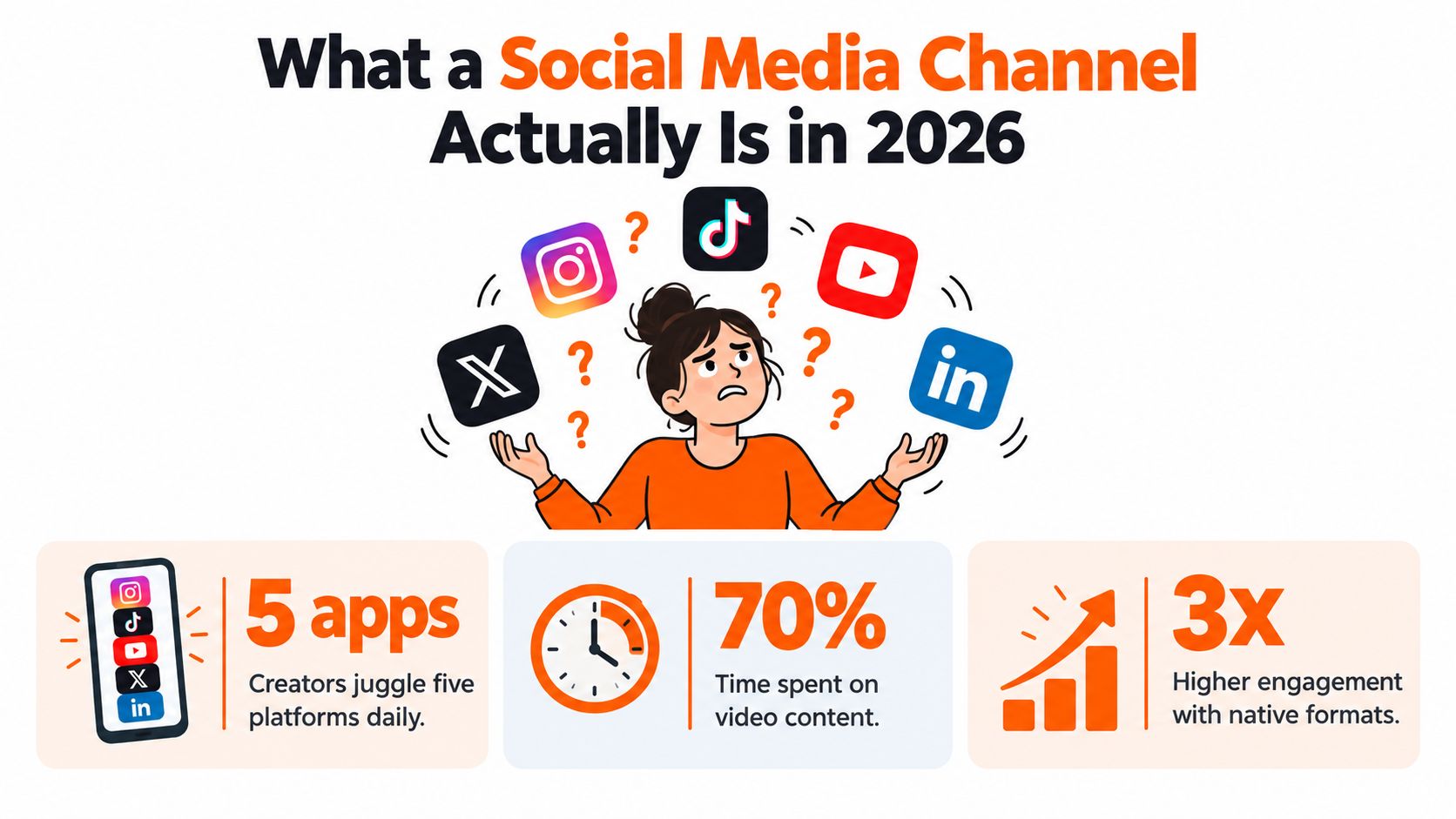
Treat this illustration as a conceptual depiction of workload, not a performance benchmark.
<a id="platform-channel-and-profile-are-different"></a>
Platform, channel, and profile are different
A platform is the service, such as YouTube or Instagram. A profile is your account or public identity within that service. A channel, for strategy purposes, is a distribution environment where people encounter your content.
That means YouTube search and the Shorts feed can function as different channels within the same platform. A tutorial answering an explicit question needs different packaging from a clip shown to someone who wasn't looking for you.
Social media operates at infrastructure scale: DataReportal's Digital 2026 Global Overview estimated 5.66 billion social-media user identities, equivalent to 68.7% of the global population, in October 2025, and reported the usage averages below. These identities aren't a verified headcount of unique people, because individuals can operate multiple accounts and some accounts may be inactive.
Platforms Used per User vs Weekly Time
| Metric | Value | Strategic Implication |
|---|---|---|
| Platforms actively used or visited monthly | Average of 6.5 | Plan for different audience contexts, not an exclusive relationship with one app |
| Weekly social-media use, including online video | Approximately 18 hours and 36 minutes | Your content competes with entertainment, conversation, and other viewing habits |
The strategic implication isn't that you should publish everywhere. It's that your customer's attention may move across several environments while your production capacity remains limited.
Working definition: A channel is where your content meets someone else's attention. Choose it by the audience behavior you need, not the app icon you recognize.
<a id="the-core-mechanics-behind-every-channel"></a>
The Core Mechanics Behind Every Channel
Think of distribution as a publishing pipeline, not a guaranteed delivery service. You submit content; the platform determines where it can appear; viewers decide whether it deserves their attention.
Use the following workflow as a planning model, rather than a claim about any platform's proprietary ranking formula.

<a id="follow-the-publishing-pipeline"></a>
Follow the publishing pipeline
- Intake: Identify the surface you're publishing for. A searchable tutorial needs a clear topic and useful title; a feed video needs an opening that makes sense without prior context.
- Evaluation: Examine how viewers respond. Watch time, completion, shares, and saves can help you diagnose whether the content fulfilled its promise, but don't assume every platform interprets them identically.
- Distribution: Observe where exposure comes from. Separate followers, recommendations, search, shares, and paid placements when the available analytics allow it.
The opening hook matters because viewers need a reason to continue. But a hook that attracts the wrong audience can produce attention without qualified demand. Follower count is similarly incomplete: it describes an existing relationship, not the business value of every future post.
For example, a product video might earn saves because viewers want to revisit its instructions. A provocative opinion might earn comments because people disagree. Those responses aren't interchangeable, even if a dashboard labels both as engagement.
Use the video below as a discussion prompt while mapping your own publishing workflow.
<iframe width="100%" style="aspect-ratio: 16 / 9;" src="https://www.youtube.com/embed/fEndUkCsIbQ" frameborder="0" allow="autoplay; encrypted-media" allowfullscreen></iframe><a id="separate-account-control-from-audience-access"></a>
Separate account control from audience access
Your team can control what it publishes on a social profile, but that doesn't make the distribution fully owned. The platform still mediates access to viewers and governs the account.
An email list or website gives you a more direct relationship, although those channels have their own delivery and consent constraints. Earned distribution includes voluntary sharing and unpaid discovery; paid distribution involves purchasing exposure.
Keep these categories separate when setting expectations. Publishing to an account is an action your team controls. Reaching the intended audience is an outcome you must verify.
<a id="how-channels-evolved-into-video-first-ecosystems"></a>
How Channels Evolved Into Video-First Ecosystems
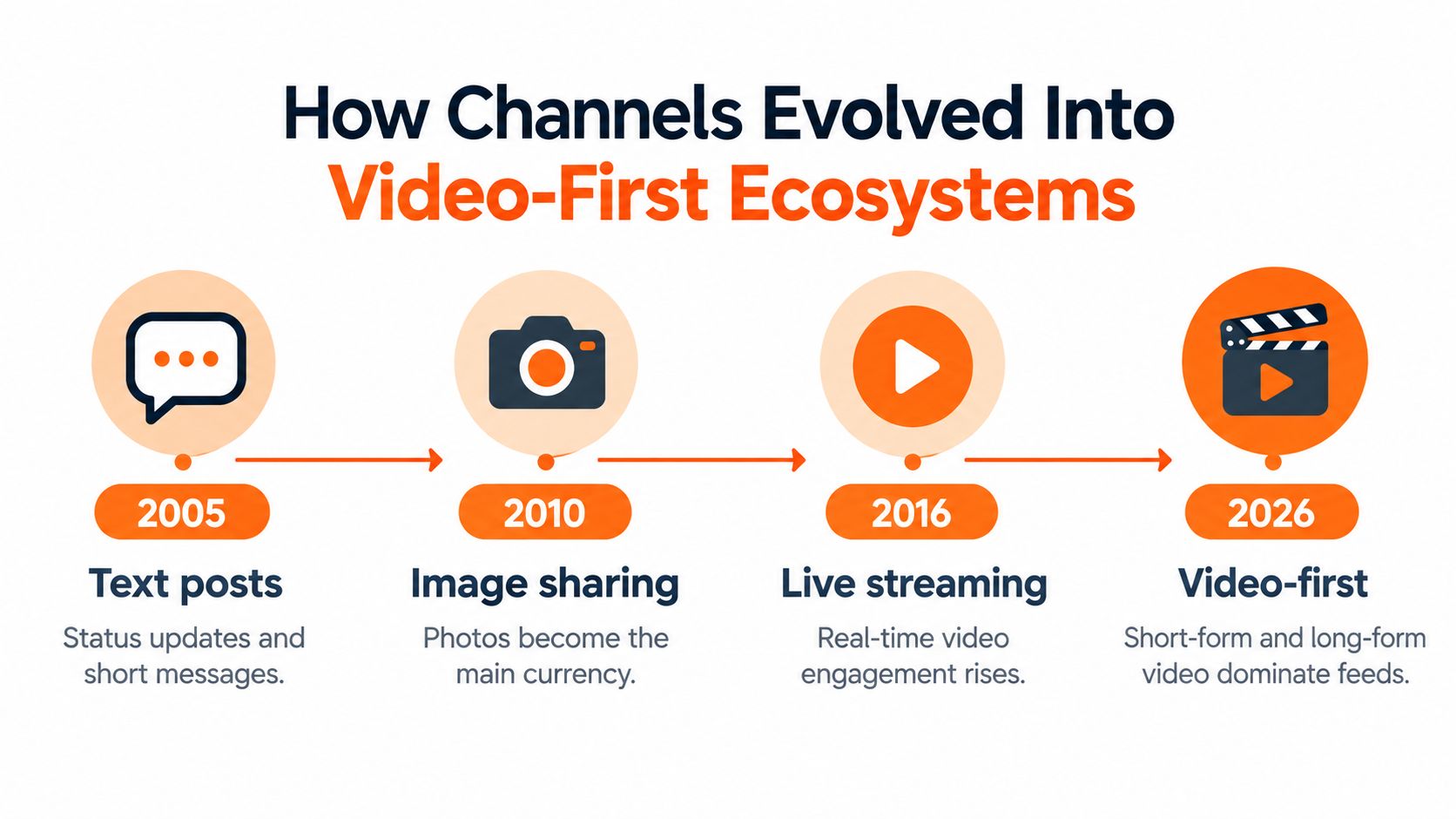
The current mix of feeds, search, creator videos, and private conversations didn't emerge from a single publishing model. Social platforms developed around different activities, then expanded the ways people could create and discover media.
The supplied timeline illustrates that broad shift. It's a simplified visual, not a literal chronology of when each format began.
<a id="from-maintaining-connections-to-encountering-content"></a>
From maintaining connections to encountering content
The historical anchors are useful: YouTube launched in 2005, Facebook expanded beyond its original college audience in 2006, and Instagram launched in 2010; Pew Research Center's social-media overview provides the historical and audience context for these established platforms.
For strategists, the important change is the unit of publishing. A status update assumes some existing interest in the person posting. A recommended video must establish relevance for someone who may know nothing about the creator.
That changes the creative brief. Instead of assuming viewers recognize your brand, you need to show the problem, establish the speaker's relevance, and deliver useful information within the asset itself.
A feed video should make sense to someone who has never visited your profile.
<a id="video-first-doesnt-mean-video-only"></a>
Video-first doesn't mean video-only
Don't turn this history into a rule that every idea must become a short clip. A complex explanation may need a searchable long-form video, an accompanying article, and a concise social introduction.
Likewise, video infrastructure doesn't eliminate the value of text, images, or direct conversation. A viewer may discover a creator through video, evaluate their thinking through written posts, and ask a buying question through messaging.
A practical response is to assign different jobs to those formats. Use video when demonstration, movement, or a presenter's explanation adds value. Use text when readers need precision or a skimmable argument. Use images when comparison and visual detail matter.
The mistake isn't choosing an older format. It's publishing a format that doesn't help the audience complete the task you've assigned to the channel.
<a id="comparing-the-major-channel-families"></a>
Comparing the Major Channel Families
Choose a channel family before choosing a platform. This forces your team to discuss audience intent rather than personal preferences about apps.
The categories below are a planning framework, not mutually exclusive platform labels. Instagram, for example, can support visual discovery, short-form video, and messaging.
<a id="match-the-environment-to-the-customers-task"></a>
Match the environment to the customer's task
Channel Family Comparison
| Channel Family | Dominant Content | Discovery Model | Best Fit |
|---|---|---|---|
| Short-form vertical video | Demonstrations, concise explanations, creator clips | Recommended feeds and sharing | Introducing a problem or showing a product in use |
| Long-form video | Tutorials, walkthroughs, interviews | Search, recommendations, subscriptions | Detailed evaluation and education |
| Identity-based networking | Professional commentary, text posts, discussions | Connections, followers, resharing | Expertise, professional relevance, relationship building |
| Visual discovery | Images, carousels, visual demonstrations | Browsing, recommendations, saves | Inspiration and comparison |
| Messaging | Replies, broadcasts, private exchanges | Opt-in relationships and direct contact | Follow-up, support, retention |
| Creator publishing | Recurring host-led content and series | Audience relationships and cross-channel discovery | Sustained trust around a recognizable perspective |
Consider an illustrative skincare business. A short demonstration can show how a product fits into a routine, while a longer explanation can address ingredients and suitability. A private conversation can handle a customer's specific question, but it's a poor substitute for scalable public education.
A marketing consultant has a different task. Professional commentary may help prospective clients evaluate judgment, while a detailed video can demonstrate a method. Copying the skincare business's distribution mix would ignore the difference in purchase context.
<a id="understand-where-each-family-can-disappoint"></a>
Understand where each family can disappoint
Short-form content can leave too little room for necessary qualifications. Long-form production can become wasteful if the audience doesn't need the depth. Visual discovery can attract appreciation without buying intent, and messaging requires someone to manage the relationship responsibly.
Creator publishing also needs a consistent editorial perspective. A recurring presenter isn't a strategy if every post promotes an unrelated idea.
- For education-led journeys: Connect social discovery to a deeper resource. This guide to using video for blog content is a relevant follow-up when an explanation needs both viewing and reading options.
- For paid acquisition: Separate creative appeal from the offer and destination. Wojo Media's resource on tracking and offers in paid ads is a useful companion when planning that connection.
- For retention: Ask whether the audience needs another public post or a clear answer in an existing conversation.
Don't select a family because it can host your preferred asset. Select it because its audience context supports the next customer action. Then check whether your team can produce and maintain the required content without neglecting the relationships it creates.
<a id="content-types-and-distribution-tactics-per-channel"></a>
Content Types and Distribution Tactics per Channel
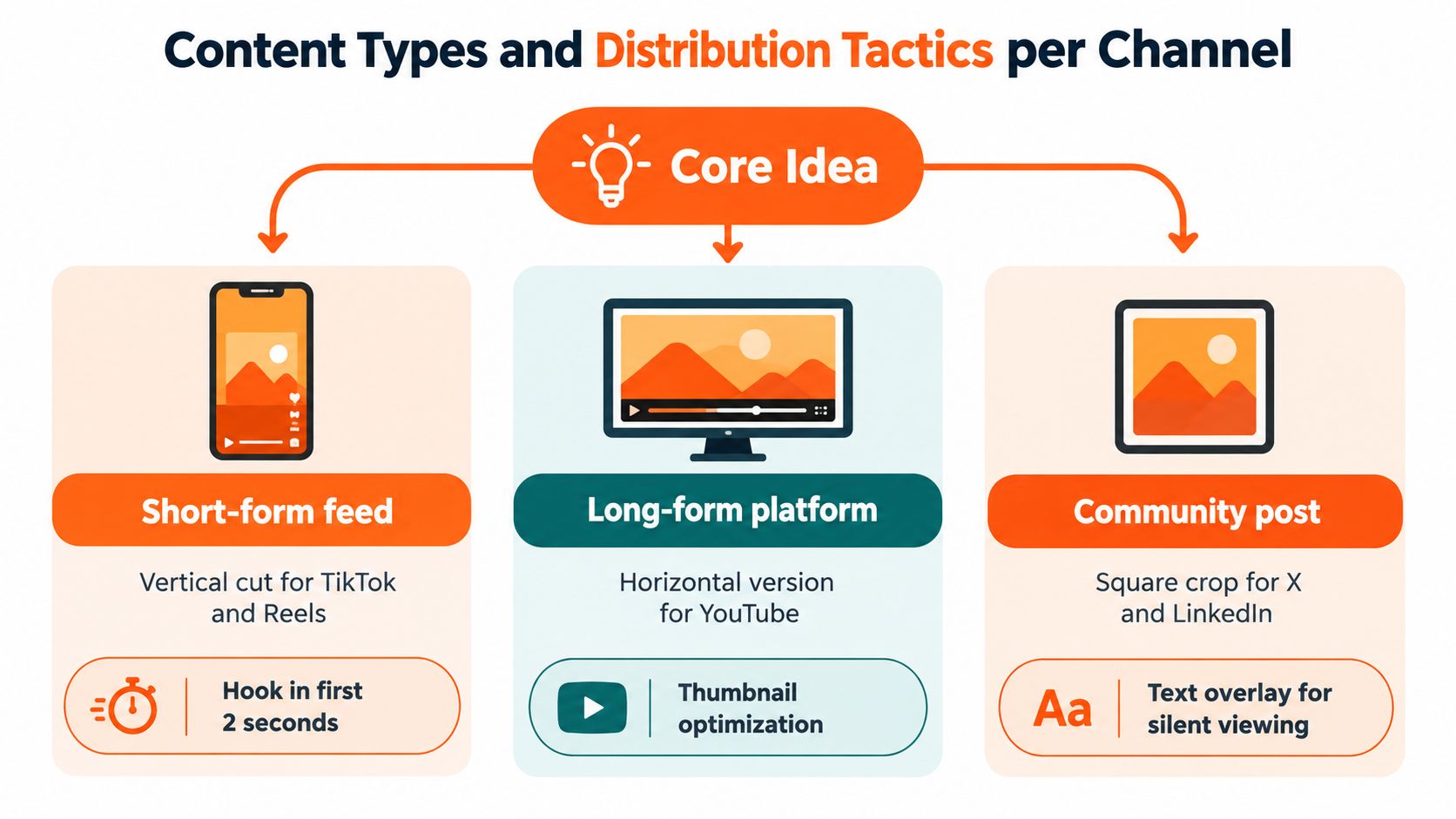
Start with a claim you can support, then write a separate creative brief for each destination. For an illustrative home-storage product, the core idea might be that a particular organizer makes frequently used items easier to access.
The branches should preserve that claim while changing how viewers encounter it.
<a id="adapt-the-explanation-not-just-the-frame"></a>
Adapt the explanation, not just the frame
A vertical feed version could open with the frustrating cupboard, then show the change. A horizontal tutorial could explain installation and limitations. A square carousel could compare placement options, while a professional text post might discuss the design principle behind the product.
The private broadcast should have a different purpose again: answer a recurring customer question or point subscribers toward relevant instructions. It shouldn't repeat the public caption.
AI-assisted tools can support scripting, captioning, multilingual voiceover, and 9:16, 1:1, and 16:9 exports, alongside deliberate hook and pacing variants, as outlined in the workflow discussion accompanying Sprout Social's content benchmarks. Treat those outputs as production materials that still need editorial review, not automatic evidence of channel fit.
Production rule: Change the packaging to fit the viewing context. Keep the underlying promise consistent enough that you can still evaluate the idea.
<a id="build-variants-you-can-interpret"></a>
Build variants you can interpret
Write the hypothesis before generating alternatives. For example, test whether opening with a visible problem attracts more relevant viewers than opening with the presenter explaining that problem.
- Hold the essentials steady: Keep the topic, offer, intended audience, and destination consistent.
- Change a major creative factor: Test the opening, narration pace, or caption treatment separately rather than rebuilding everything.
- Label the assets clearly: Record the hypothesis and destination so the editor and analyst can identify what changed.
- Check the final viewing experience: Review cropping, text placement, audio, and the call to action in the exported asset.
Captioning needs its own quality check. Use this guide to adding subtitles to a video to support the workflow, then manually inspect names, technical terms, timing, and readability.
Localization requires more than translated words. Ask a native-language reviewer to check humor, cultural context, pronunciation, and whether the promise still feels appropriate. For accessibility, review speaker identification and whether essential visual information needs an audio explanation.
<a id="kpis-that-actually-tell-you-a-channel-is-working"></a>
KPIs That Actually Tell You a Channel Is Working
A busy dashboard can hide an ineffective channel. Likes describe a response to content; they don't establish whether the audience was qualified, whether viewers progressed, or whether the business benefited.
The engagement gap illustrates why output alone is a weak target: Sprout Social's industry benchmark analysis reported average inbound engagements rising from 70 per day in 2023 to 83 in 2024, while outbound engagements remained at about 2 per day, and brands averaged approximately 9.5 posts daily across networks in 2024. These are dataset averages, not posting quotas or targets for your team.
<a id="separate-attention-intent-and-outcomes"></a>
Separate attention, intent, and outcomes
Build a dashboard with a distinct question behind each metric.
| Measurement Layer | Useful Signals | Question to Answer |
|---|---|---|
| Attention quality | Retention, average watch percentage, completion | Did viewers stay for the explanation? |
| Useful interest | Shares, saves, relevant replies | Did the content prompt a meaningful response? |
| Commercial intent | Qualified clicks, profile actions, inquiries | Did suitable prospects take a next step? |
| Business outcome | Qualified conversions, customer quality, retention | Did the channel support the intended result? |
Normalize comparisons for impressions, posting frequency, audience size, and format. A channel with more exposure will often generate more raw actions, so compare rates alongside totals and inspect the audience behind them.
Also check metric definitions. A view, impression, or completion may not mean the same thing in different dashboards; combining them without qualification creates false precision.
<a id="connect-content-analytics-to-business-records"></a>
Connect content analytics to business records
Use tagged destination links, consistent campaign names, and a clear definition of a qualified action. If a sales inquiry counts as success, specify what makes it relevant before the campaign launches.
The BAMF guide to social media ROI is a useful companion for organizing the connection between social activity, costs, and business returns. Include production and community-management effort in your own assessment, not just media spend.
Finally, inspect unanswered questions and negative feedback. A channel can generate attractive content metrics while leaving customers confused. Healthy performance includes the team's ability to respond, learn, and maintain trust, not merely publish the next asset.
<a id="why-the-most-popular-channel-may-not-be-the-right-one"></a>
Why the Most Popular Channel May Not Be the Right One
Popularity tells you where attention exists. It doesn't tell you whether your business can serve that audience profitably or whether the audience needs what you offer.
That distinction matters when measurement is already difficult: Digiday's creator-marketing research reported impressions as the leading success metric for 28% of marketers, conversions for 27%, and insufficient performance data as the largest challenge for 30%. A channel-selection process built around reach alone won't resolve that uncertainty.
<a id="test-a-business-hypothesis"></a>
Test a business hypothesis
Suppose an agency wants qualified consultation requests. A widely shared entertainment clip and a narrowly targeted explanation might produce very different prospects, even if the entertainment clip attracts more attention.
- Define the outcome: Specify the customer action and what makes it valuable.
- Make the comparison fair: Use comparable offers and creative promises, adapted to each environment.
- Set an attribution window: Choose a period consistent with the purchase process before reviewing results.
- Inspect customer quality: Compare suitability, sales progression, and retention where records allow it.
For a broader planning reference, Netco Design channel strategy can accompany the discussion about how individual channels fit the overall marketing mix.
<a id="distinguish-attribution-from-incrementality"></a>
Distinguish attribution from incrementality
Attribution asks which touchpoints receive credit. Incrementality asks whether the activity caused an outcome that wouldn't otherwise have happened.
Tagged links help identify visits, but they can't settle that second question. Someone might discover you through a video, return through search, and purchase later; alternatively, an existing customer might click a social post before making a purchase they already intended.
More credited conversions don't automatically mean more additional customers.
Where practical, compare a test audience or geography with a similar holdout that doesn't receive the intervention. Account for differences in exposure, seasonality, and other campaigns, and acknowledge the limitations of organic tests.
Use assisted conversions and customer feedback as supporting evidence, not proof of causation. A recurring review of labeled creative variants can make the process manageable, provided the team doesn't mistake faster production for a cleaner experiment.
<a id="putting-your-channel-strategy-to-work-this-week"></a>
Putting Your Channel Strategy to Work This Week
On Monday, write a decision brief before opening an editor. Assign an owner to the test and another person to review the measurement setup, even if your team shares those responsibilities.
<a id="your-launch-checklist"></a>
Your launch checklist
- Choose a discovery channel and a follow-up channel: Match them to how your audience learns and evaluates.
- Name the business outcome: Define the qualified action that would justify continued investment.
- Prepare a controlled creative batch: Use the production method above rather than unrelated assets.
- Record the decision criteria: Specify the signals that support continuing, revising, or stopping the test.
Use this guide to automating video editing to reduce repetitive production work. Keep human review focused on claims, audience relevance, accessibility, and the final export.
<a id="questions-to-settle-before-expanding"></a>
Questions to settle before expanding
How often should we audit performance? Review operational issues regularly, but make investment decisions only after allowing enough time for the intended customer action. Don't confuse a scheduling review with a strategic verdict.
When should we drop a channel? Pause when a fair test repeatedly fails to produce qualified outcomes, or when the maintenance burden exceeds its demonstrated contribution. First check whether the problem is the audience, creative, offer, or measurement.
How should we balance authenticity and polish? Preserve the speaker's actual perspective and remove distractions rather than manufacturing a personality. Human reviewers should check translated versions, synthetic voices, and claims before publication.
ClipNova offers AI-assisted scripting, voiceover, visuals, captions, and multi-format exports for building channel-specific creative variants. Visit ClipNova to turn a supported idea into a controlled test batch, then evaluate each version against the business outcome you've chosen.
Ready to ship your own?
Start creating viral videos with AI in under twenty minutes, no credit card required.