
Usually yes, if the generator's paid plan grants commercial rights and the image contains no real person, trademark or copied style problem, but permission is not the same as ownership.
The counterintuitive part is that you can have permission to run an image in a paid campaign without owning exclusive copyright in it. That distinction should change how you clear campaign visuals, promise rights to clients and choose assets for a permanent brand identity.
Treat the decision as separate checks: platform permission, copyright ownership and third-party risk. A subscription receipt answers only part of the question.
Table of Contents
- When AI Generated Images Are Safe for Commercial Use
- Permission Is Not Ownership
- How Training Data Affects Commercial Risk
- Country Rules That Change the Answer
- How to Verify Commercial Rights Step by Step
- Reduce Risk Through Indemnity, Attribution and Records
- Examples of Commercial Use Gone Right and Wrong
- Confirm Your Rights Before You Publish
<a id="when-ai-generated-images-are-safe-for-commercial-use"></a>
When AI Generated Images Are Safe for Commercial Use
In most cases, commercial use is workable when the applicable license covers your intended use and the finished image passes a rights review. Advertising, packaging, client deliverables and monetized content deserve the same scrutiny you'd give purchased photography.
On January 29, 2025, the U.S. Copyright Office concluded that AI output can receive copyright protection when a human determines sufficient expressive elements, but merely writing prompts generally doesn't provide enough control. It also confirmed that using AI as an assistive tool doesn't automatically disqualify a larger human-authored work from protection.
That's a reason to build a documented creative workflow, not a reason to avoid AI.
<a id="commercial-use-verdict-by-scenario"></a>
Commercial Use Verdict by Scenario
| Use case | Commercial use usually OK? | Main condition |
|---|---|---|
| Social post or blog header, prompt-only image, paid plan | Usually yes | Terms must grant commercial rights; clear recognizable people and third-party marks |
| Ad creative with human layout, retouching and edits | Usually yes | Keep edit records and check people, products and brands in frame |
| Logo or brand mark generated directly | Risky | Copyright protection may be limited; run a trademark search before adoption |
| Image of a recognizable real person | Only after likeness clearance | Obtain written consent covering the commercial use |
| Submission to a stock library | Only if both licenses allow it | The library must accept AI content and the generator must permit submission |
| Free-tier output under non-commercial terms | No | Those terms exclude revenue-generating use |
| Output closely resembling a famous artist's work or character | Risky | Check for copied expression, not just a similar general aesthetic |
Don't mistake technical polish for clearance. An image can look professional and still contain an unauthorized logo or a recognizable likeness. An AI image upscaling workflow can improve presentation, but enlarging an image doesn't fix its rights.
Most decisions turn on these conditions:
- Plan terms: Does the agreement cover this output and this intended use?
- Human contribution: What expressive work did your team create?
- People and marks: Does anything require consent, removal or further investigation?
- Distribution market: Where will the image appear, and what local duties apply?
Assign a practical verdict before production proceeds: safe, safe with checks or do not use. Reserve “safe” for assets whose relevant checks are complete, not assets that merely look harmless.
<a id="permission-is-not-ownership"></a>
Permission Is Not Ownership
A short prompt alone generally isn't enough to establish human authorship. Original sketches that remain perceptible, creative arrangement, compositing, substantial retouching, typography and layout can support protection for the human-created contribution. Selecting a favorite output isn't automatically the same as creating a protectable arrangement.
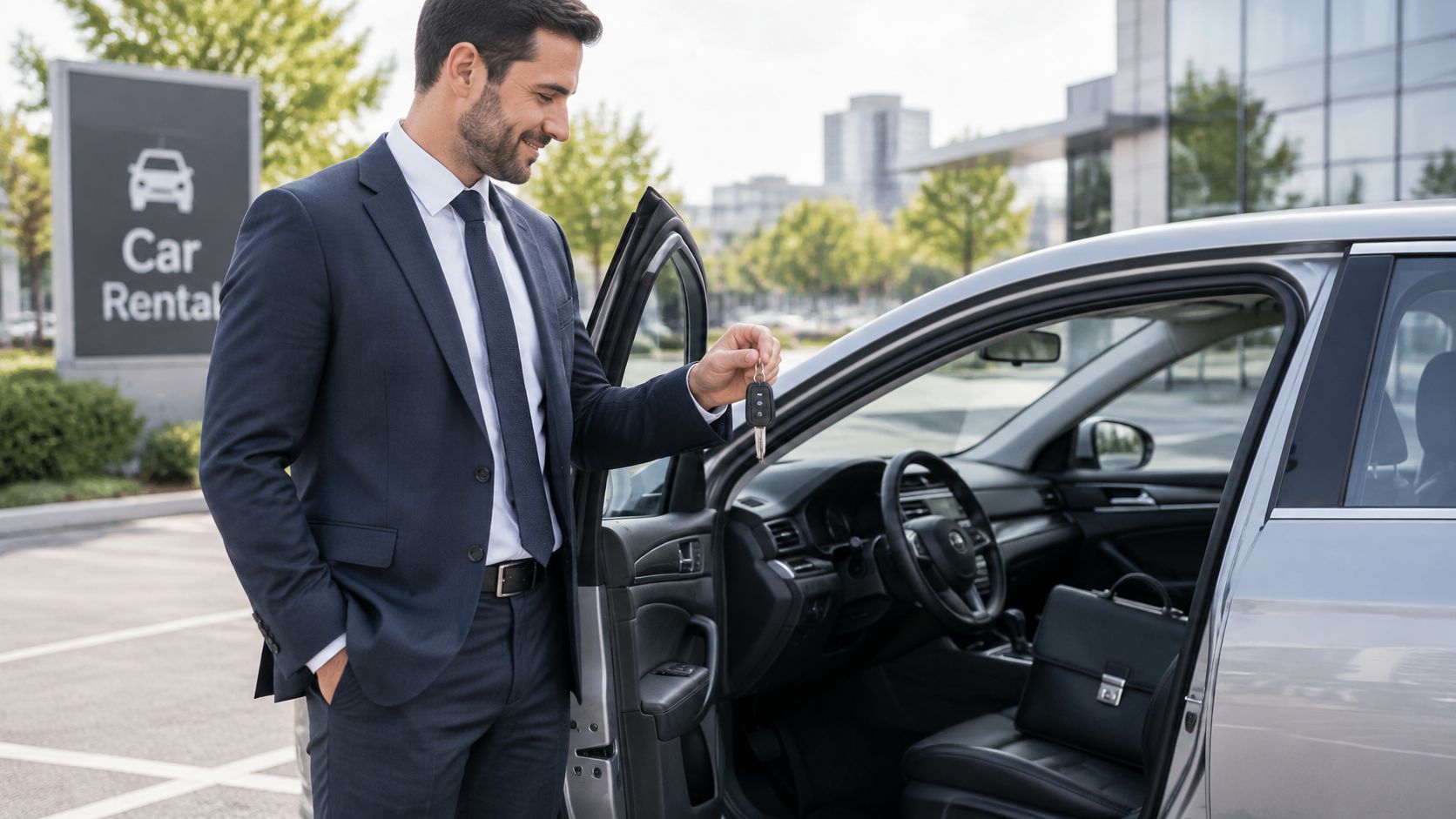
Think of permission as a car rental: you can drive the vehicle on a business trip without becoming its owner.
On March 18, 2025, the D.C. Circuit held in Thaler v. Perlmutter that eligible works under the Copyright Act require a human author. A purely generated image may therefore be commercially usable without being registrable as an independently copyrighted work in the United States.
<a id="license-sources-and-what-to-check"></a>
License Sources and What to Check
Treat these as contract-reading categories, not promises about every service.
| License source | Typical commercial rights | Common limits to investigate | Clause to check |
|---|---|---|---|
| Free or trial tier | Only rights expressly granted | Non-commercial restrictions, watermarks or limited uses | Plan terms for generated output |
| Paid subscription | Commercial use where expressly granted | Raw-output resale, prohibited content or transfer restrictions | Output ownership and commercial use |
| Enterprise or API contract | Rights defined by the signed agreement | Conditions on claims coverage, data handling and approvals | Indemnity and liability |
| Open-weight model under its own license | Rights specified by the model license | Attribution, acceptable use or commercial conditions | Model card and full license |
| Stock platform submission | Rights accepted under contributor rules | AI declarations and submission eligibility | Generative-AI contributor guidelines |
A commercial license doesn't automatically supply copyright ownership, exclusivity against competitors or protection against third-party claims. Don't promise a client exclusive ownership of raw output merely because your subscription permits client work.
Transparency is another independent obligation. The EU AI Act's Article 50 addresses synthetic-content marking and disclosure, rather than granting ownership in the material.
For additional context on the permission-versus-ownership question, this video offers a useful discussion.
<iframe width="100%" style="aspect-ratio: 16 / 9;" src="https://www.youtube.com/embed/w_KpGNnDdcc" frameborder="0" allow="autoplay; encrypted-media" allowfullscreen></iframe>Read the actual language under output, commercial use, restrictions and indemnity. Record the terms in force when you generate the asset and retain the applicable publication-date version too.
Your core creative records should include prompt history, selected variants and the edit log. They show what happened, but they don't turn prompting alone into authorship.
<a id="how-training-data-affects-commercial-risk"></a>
How Training Data Affects Commercial Risk
A cook can learn from many recipes and prepare a new dish. But presenting someone else's recipe text as an original creation raises a different question. The useful distinction for AI images is between how the system learned and what your finished asset reproduces.
Don't try to resolve a provider's entire training history by inspecting a downloaded image. Ask narrower questions that your team can investigate and document.
<a id="training-data-disputes"></a>
Training-Data Disputes
Training-source questions concern the material used to develop the model and the provider's authority to use it. Don't assume either that all training material was licensed or that every generated output infringes because its training history is disputed.
For purchasing decisions, request clear information about training sources and claims coverage. Prefer a provider that explains its position and offers meaningful contractual protection over one that relies on a broad “commercially safe” slogan.
The practical contract question is straightforward: who handles a qualifying claim, under what conditions, and at whose expense? Don't describe training-data disputes as exclusively the provider's problem without reading that answer.
<a id="output-similarity"></a>
Output Similarity
Your team can inspect the actual output. Look for a recognizable character, distinctive illustration, photographic composition, logo, signature or watermark that suggests the image needs further review.
A reverse image search is useful screening, not a legal clearance certificate. Search suspicious crops as well as the complete image, and investigate close matches instead of assuming a new filename means a new work.
An unfamiliar source isn't proof of originality. Review what the image contains, not just what you remember asking for.
<a id="artist-style-prompts"></a>
Artist-Style Prompts
Separate a general aesthetic from recognizable copied expression. Don't treat a style reference and reproduction of a particular artwork as the same issue, or assume that avoiding an artist's name makes the resulting image safe.
For commercial briefs, describe the visual properties you need: muted colors, geometric forms, paper texture, directional lighting or a particular composition. That's more controllable than asking for an imitation of a living artist.
If an output looks familiar, pause. Replace suspicious elements, generate a substantially different direction or commission original work. For hero creative and permanent packaging, the cost of replacement before launch is easier to manage than a disputed asset after distribution.
<a id="country-rules-that-change-the-answer"></a>
Country Rules That Change the Answer
The same image can have different legal status across markets. A global campaign needs a distribution map, not a single “commercial rights included” checkbox.
Separate ownership analysis from publication duties. Your ability to claim copyright doesn't determine whether a realistic synthetic depiction needs a disclosure, and a disclosure doesn't establish permission to use someone's likeness.
<a id="how-key-markets-treat-ai-images-for-commercial-use"></a>
How Key Markets Treat AI Images for Commercial Use
| Jurisdiction | Copyright for AI-only images | Labelling or disclosure | Practical note |
|---|---|---|---|
| United States | Human authorship is required; prompts alone are generally insufficient | Check applicable laws and channel policies | Commercial permission can exist without exclusive copyright |
| United Kingdom | A statutory category covers qualifying computer-generated works without a human author | Check advertising and platform requirements | Don't extend the UK approach to other markets |
| European Union | Assess applicable copyright law and the human creative contribution | Synthetic-output marking and deepfake disclosure duties have distinct scopes | Assign provider and deployer responsibilities |
| Other markets | Obtain a local assessment | Review local advertising, synthetic-media and platform rules | Don't assume an English-language license answers local-law questions |
For U.S. campaigns, don't promise exclusive rights in an untouched generated background. For UK distribution, investigate whether the computer-generated-work category applies to the particular asset instead of assuming that every AI image qualifies.
The operational change for EU campaigns concerns transparency. The European Commission's transparency guidance states that the obligations apply from 2 August 2026, including machine-readable marking by providers of synthetic-content systems and disclosure by deployers of image or video deepfakes.
<a id="preserve-provenance-through-delivery"></a>
Preserve Provenance Through Delivery
Ask whoever handles export, compression and publishing to test whether provenance information survives the workflow. A source file containing metadata isn't enough if the final advertising asset loses it during processing.
- Assign responsibility: Name the person checking each market and channel.
- Preserve the manifest: Record the model, source inputs, edits, consent status and destinations.
- Review realistic depictions: Decide whether the planned use needs visible disclosure.
- Check the final file: Inspect the published version, not only the production master.
Labelling isn't a substitute for licensing. If a campaign depicts a person without appropriate clearance or includes a disputed brand element, adding an AI label doesn't resolve that underlying problem.
<a id="how-to-verify-commercial-rights-step-by-step"></a>
How to Verify Commercial Rights Step by Step
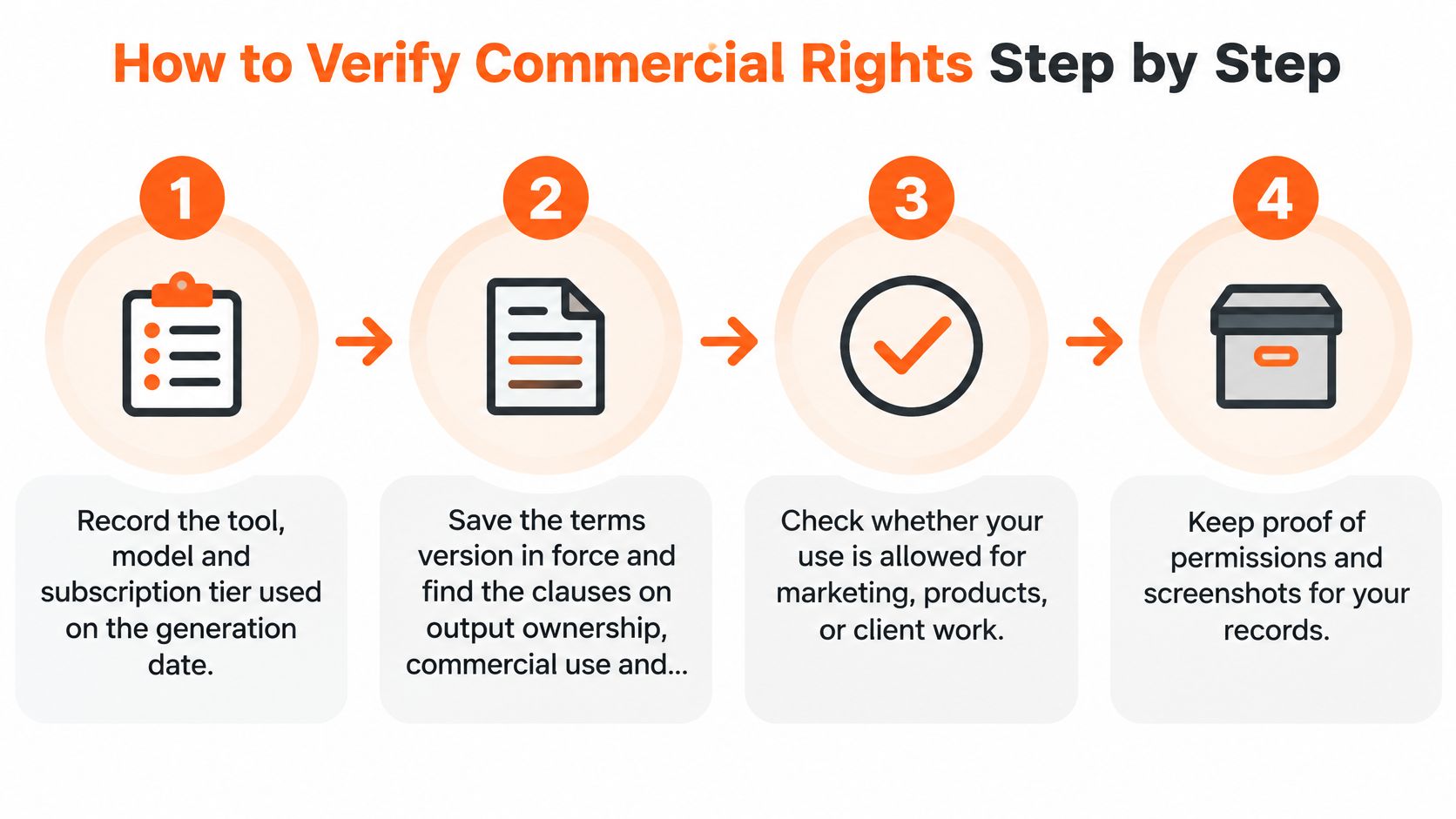
Make clearance part of production, before the image reaches a designer's final layout or a client's approval deck. Give each asset a stable identifier so its permissions remain attached when filenames and formats change.
Use this workflow as the basis for a reusable clearance checklist.
<a id="build-the-asset-record"></a>
Build the Asset Record
-
Record the generation environment. Save the tool, model, subscription tier and generation date. Don't record only the application name, because different models or account arrangements can have different terms.
-
Archive the applicable agreement. Save a readable copy of the terms and locate output ownership, commercial use and restrictions. A screenshot of a pricing-page headline isn't a substitute for the agreement.
-
Match the permission to the generation. Confirm that the relevant account entitlement covered this particular output and intended use. Don't assume upgrading later retroactively changes the rights attached to an earlier generation.
-
Keep the production trail. Log prompts, settings, selected variants, creation dates and edits, with layered files where available. A flattened export won't explain which elements your designer created or replaced.
<a id="inspect-and-clear-the-final-asset"></a>
Inspect and Clear the Final Asset
-
Screen recognizable content. Inspect faces, logos, characters, signatures and suspiciously familiar compositions, then investigate potential matches. AI Video Detector's guide to reverse image search for copyright can help structure that screening, but an empty search result isn't proof of clearance.
-
Obtain appropriate permissions. For an identifiable person, obtain written likeness consent covering the proposed commercial placement; assess location, product and other property permissions where relevant. Don't assume access to a photograph authorizes using its subject in an endorsement-style advertisement.
-
Apply channel and market requirements. Add required disclosures and preserve applicable provenance signals through export. The common mistake is approving the master file while overlooking the cropped, compressed or animated version that runs.
-
Store and recheck before reuse. Keep an asset manifest containing permissions, source inputs, edits, approvals and distribution channels. Reconfirm entitlement and inspect the content again when moving it into a different campaign, market or format.
Moving an image into an AI movie-making workflow should trigger a new review of the finished sequence. Motion, narration and surrounding scenes can make a previously neutral image imply an endorsement or event that the still image didn't.
Release gate: No asset should enter the publishing queue without a named reviewer and a retrievable clearance record.
<a id="reduce-risk-through-indemnity-attribution-and-records"></a>
Reduce Risk Through Indemnity, Attribution and Records
Clearance doesn't eliminate every possible dispute. Your remaining safeguards should explain who responds to a claim, what notices accompany the asset and how your team retrieves the production history.
<a id="read-indemnity-as-a-procedure"></a>
Read Indemnity as a Procedure
If a contract offers indemnity, examine the conditions rather than stopping at the heading. Check which claims qualify, what exclusions apply, when you must notify the provider and who controls the defense.
Don't assume a consumer subscription, enterprise agreement and API contract offer identical protection. For high-value campaigns, have counsel review the actual signed agreement before your team relies on it.
Indemnity also isn't consent. It doesn't authorize an otherwise unauthorized likeness or trademark use.
<a id="make-attribution-and-records-deliverable"></a>
Make Attribution and Records Deliverable
Treat required credits, model references and AI declarations as production instructions. Put the exact wording and placement in the manifest so a designer doesn't have to reconstruct the requirement at export.
For physical campaigns, review the printer's agreement as well as the generator's license. The Print Warehouse Ltd.'s page lets teams review digital printing terms alongside their production paperwork without assuming that accepting a print order confirms image clearance.
Keep the material needed to answer a complaint:
- Permission evidence: License versions, account entitlement and consent forms.
- Creative evidence: Source inputs, selected outputs and layered edits.
- Delivery evidence: Final files, required notices, approvals and distribution channels.
Set a retention policy covering the campaign and an appropriate period afterward, agreed with your legal or records team.
Consider a hypothetical retailer that receives a complaint about a background resembling a competitor's photograph. The manifest identifies the exact variant, source inputs and edits, allowing the team to isolate the affected placements and replace the background promptly.
Those records don't prove the complaint is unfounded. They let the retailer respond accurately instead of guessing, preserve relevant evidence and avoid withdrawing unrelated creative.
<a id="examples-of-commercial-use-gone-right-and-wrong"></a>
Examples of Commercial Use Gone Right and Wrong
These are hypothetical scenarios, not reported client cases. Each shows how a missing check changes a commercially useful image into a preventable problem.
<a id="a-skincare-backdrop-cleared-for-advertising"></a>
A Skincare Backdrop Cleared for Advertising
A direct-to-consumer skincare team generates a generic bathroom backdrop under terms that permit advertising. Its designer adds an original product photograph, rewrites the label details accurately and builds the final typography and layout.
The team archives the source photograph and layered composition. It can publish with a documented basis for permission and a clear account of its human-created elements, without claiming exclusive ownership of every generated tile and towel.
If the team later uses a picture-to-video workflow, it reviews the animation for invented product details or misleading effects before approval.
<a id="a-generated-face-resembles-a-real-person"></a>
A Generated Face Resembles a Real Person
An agency selects a synthetic face for an endorsement-style advertisement. During review, someone recognizes a strong resemblance to an actual person, but the agency has no consent.
The sensible response isn't to argue that the model invented the face. The agency should obtain appropriate written permission or replace the asset with a cleared alternative.
A generic synthetic face doesn't automatically require a release from a nonexistent person. The concern here is the identifiable likeness and commercial implication.
<a id="a-startup-adopts-a-conflicting-logo"></a>
A Startup Adopts a Conflicting Logo
A founder generates a polished mark, orders packaging and only afterward discovers a similar mark used in the same category. The generator's commercial license doesn't answer whether that brand identity is available.
The better sequence is to shortlist concepts, conduct trademark screening and commission appropriate refinement before rollout. For a permanent identity, prioritize defensibility over the convenience of the first acceptable generation.
<a id="a-creator-skips-stock-submission-rules"></a>
A Creator Skips Stock Submission Rules
A creator uploads prompt-only images without checking the library's AI policy or the generator's redistribution terms. The upload is commercially motivated, but that alone doesn't establish eligibility.
Adobe Stock's generative-AI contributor guidelines require contributors to confirm that their generator's license permits commercial stock submission. The creator should verify both agreements and make the required declarations before submitting.
The common failure isn't that AI images are unusable. It's that someone treated permission for one activity as permission for a different one.
<a id="confirm-your-rights-before-you-publish"></a>
Confirm Your Rights Before You Publish
Publish when the applicable terms cover the generation and intended use, the creative record is complete, and relevant third-party and disclosure checks are resolved. Hold when any of those points remains unclear. If exclusive ownership matters to the commission, resolve that separately before promising it.
So, can you use AI generated images commercially? Yes, when you can explain the permission behind the asset and the clearance decisions behind its publication. Don't replace that explanation with “we paid for the tool.”
<a id="apply-the-final-approval"></a>
Apply the Final Approval
At ClipNova, every export is watermark-free and comes with full commercial rights. Check our current plan information and applicable terms when documenting your project, but don't confuse those commercial rights with automatic copyright ownership or clearance of third-party material.
AI can still get a date, a name or a detail wrong. Check facts, inspect visible text and watch the finished video before posting, including any product claims, labels or scenes that could mislead viewers.
On YouTube, turn on the altered or synthetic content label when realistic scenes could be mistaken for real footage. Make the disclosure decision on the actual finished asset, not just the prompt used to create it.
Approve the file people will see, not merely the file your team generated.
Before release, complete this check:
- Confirm the plan terms: Match permission to the output, account and proposed commercial use.
- Save the asset manifest: Attach production history, approvals and any required consents.
- Review channel labels: Apply the disclosures and provenance requirements relevant to each destination.
If a check fails, replace the problematic component or obtain the missing permission before publishing.
ClipNova brings image and video creation into one studio, with watermark-free exports and full commercial rights. Visit the platform to build your next campaign asset, then pair your export with a saved clearance record and the disclosures your publishing channels require.
Ready to ship your own?
Start creating viral videos with AI in under twenty minutes, no credit card required.