
AOP most commonly means Annual Operating Plan, a 12-month execution model, but it can also mean Adjusted Operating Profit. The correct expansion depends entirely on the surrounding financial context.
You're preparing for a review and open a spreadsheet labeled “AOP variance.” A few minutes later, a planning document refers to “AOP targets” for the coming fiscal year. Both references sound financial, yet they may describe completely different things: one could be a company-wide operating roadmap, while the other could be a profitability measure.
That ambiguity matters. Misreading the acronym can lead you to compare the wrong figures, misunderstand management's expectations, or treat a planning document as though it were a line in the income statement. A reliable interpretation starts with the words around AOP, not with the acronym alone.
Table of Contents
- Encountering the AOP Ambiguity
- How to Decode the Meaning from Context
- Understanding the Annual Operating Plan
- Exploring Adjusted Operating Profit
- AOP in Practice - Managing Performance
- Advanced Considerations for Global Planning
- Key Takeaways for Financial Clarity
<a id="encountering-the-aop-ambiguity"></a>
Encountering the AOP Ambiguity
Consider a business owner reviewing a finance pack with a department head. The first page shows planned hiring, marketing spend, revenue assumptions, and cash requirements under the heading “AOP.” The next page shows operating income and a reconciliation from reported profit, also using the abbreviation AOP.
The owner asks a reasonable question: “Which AOP are we discussing?” The answer depends on intent. In one document, it means Annual Operating Plan. In another, it may mean Adjusted Operating Profit. Business and finance abbreviation references list both meanings, so expanding AOP automatically is unsafe. The broader abbreviation reference for business and finance terms confirms why the surrounding language deserves attention.
The confusion often persists because organizations don't use terminology consistently. Some teams use “AOP,” “annual budget,” and “operating plan” interchangeably. Others treat the operating plan as the broader execution roadmap and the budget as the financial allocation inside it. A reader who moves between companies, departments, or reporting systems may encounter both conventions in the same week.
Practical rule: Never interpret AOP from the abbreviation alone. First identify whether the document looks forward toward commitments or backward toward measured profitability.
A planning spreadsheet usually contains assumptions, owners, resources, milestones, and targets. A performance report usually contains actual results, margins, earnings, and reconciliations. If you're building a personal reference library for finance terminology, a resource such as browse the concepts glossary can help you organize related terms without treating one abbreviation as universally fixed.
The simplest mental model is this: Annual Operating Plan tells the business what it intends to do, while Adjusted Operating Profit helps describe how the business performed after selected adjustments. Once you separate planning language from performance language, the acronym becomes much easier to read.
<a id="how-to-decode-the-meaning-from-context"></a>
How to Decode the Meaning from Context
Read AOP like a financial detective. Don't begin by asking what the letters stand for. Begin by scanning the nouns and verbs that appear beside them.

<a id="start-with-the-documents-direction"></a>
Start with the document's direction
Ask whether the document is forward-looking or performance-focused.
If it discusses the fiscal year, budgets, headcount, cash flow, hiring, or resource allocation, AOP usually means Annual Operating Plan. Those terms describe choices the company expects to make and resources it expects to commit. The plan might assign owners to revenue targets, staffing decisions, operational milestones, and spending limits.
If the document discusses margin, earnings, operating income, or a reconciliation from reported profit, AOP usually means Adjusted Operating Profit. Those terms describe a financial result rather than a roadmap. The reader is likely evaluating the quality or sustainability of operating performance.
| Surrounding language | Likely meaning | Why it points there |
|---|---|---|
| Fiscal year, budget, headcount | Annual Operating Plan | These are planning inputs and commitments |
| Cash flow, resource allocation, milestones | Annual Operating Plan | These describe execution capacity |
| Margin, earnings, operating income | Adjusted Operating Profit | These are performance and profitability terms |
| Reconciliation from reported profit | Adjusted Operating Profit | The document is explaining a metric |
<a id="check-the-nearby-verbs"></a>
Check the nearby verbs
Verbs provide another useful clue. “Approve,” “allocate,” “forecast,” “hire,” and “deliver” normally belong to an Annual Operating Plan. “Reported,” “adjusted,” “reconciled,” “excluded,” and “earned” generally belong to an operating-profit discussion.
The reason this works is structural. An Annual Operating Plan connects strategy to future actions. Adjusted Operating Profit modifies a result that has already been calculated. One is a management process and operating contract. The other is a metric used in analysis and reporting.
This short video can reinforce the distinction visually:
<iframe width="100%" style="aspect-ratio: 16 / 9;" src="https://www.youtube.com/embed/Jr3qQyZ7BnI" frameborder="0" allow="autoplay; encrypted-media" allowfullscreen></iframe>If the language remains unclear, inspect the definitions section, financial footnotes, or reconciliation schedule. Ask the document owner whether AOP represents a plan or a profit measure. That question is more useful than assuming the most familiar expansion.
<a id="understanding-the-annual-operating-plan"></a>
Understanding the Annual Operating Plan
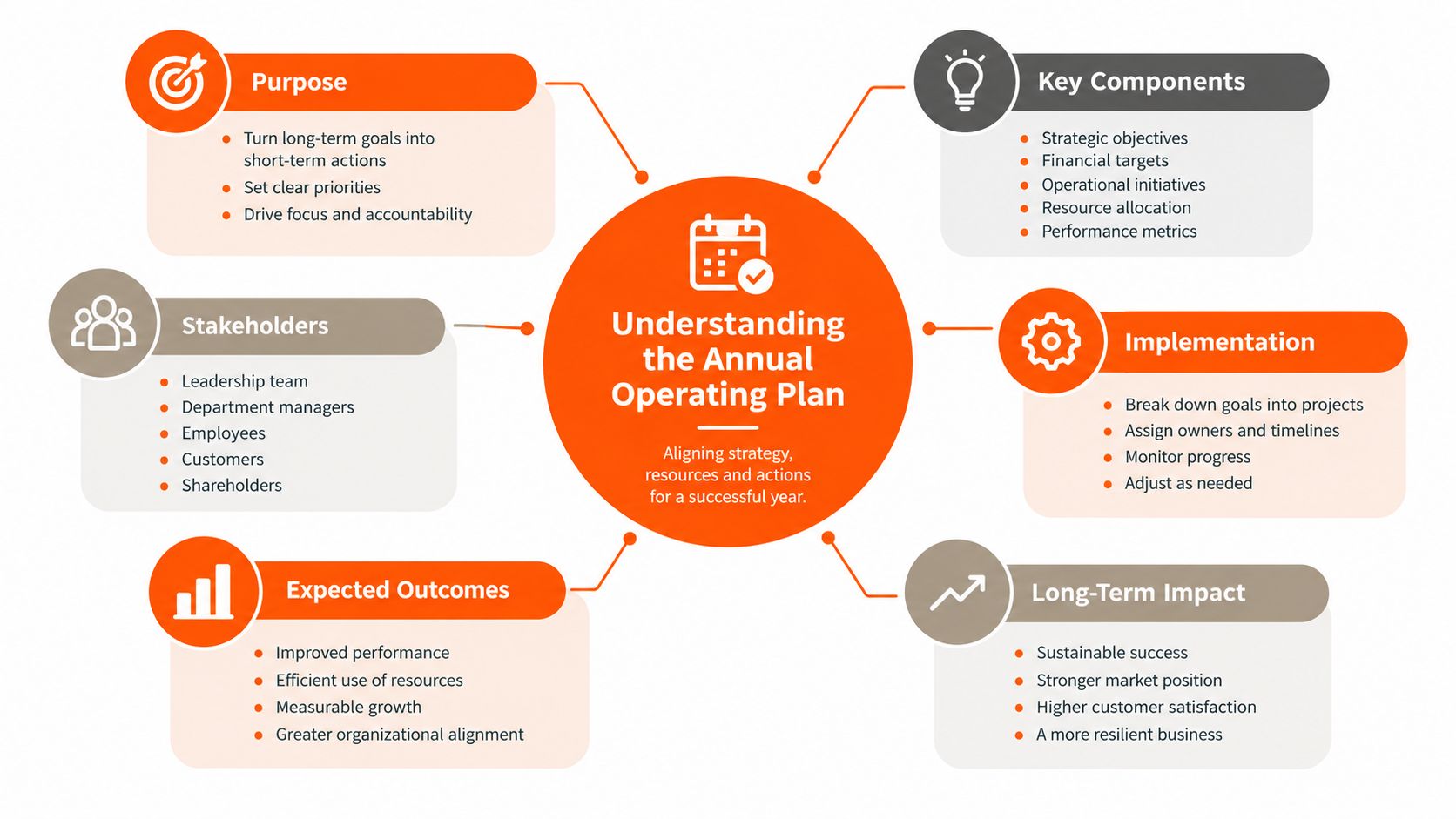
When AOP means Annual Operating Plan, it is the company's detailed execution model for the coming fiscal year. The plan translates strategy into measurable commitments for revenue, costs, profitability, cash flow, staffing, and operational activity. The finance explanation of an Annual Operating Plan describes this distinction and notes that an AOP concentrates on the next year rather than the wider horizon of a long-range strategic plan.
A long-range strategy might define the markets a company wants to enter or the capabilities it wants to build over several years. The AOP narrows that ambition into practical commitments. It asks what the organization will deliver during the upcoming fiscal period, what resources those commitments require, and who is accountable for each outcome.
<a id="what-belongs-inside-the-plan"></a>
What belongs inside the plan
A sound AOP normally connects several layers of the business:
- Revenue: Forecast sales, bookings, subscriptions, or other sources of income.
- Costs: Model cost of goods sold, operating expenses, vendor commitments, and service delivery.
- Profitability: Show gross margin, operating income, and net income assumptions.
- Cash: Translate revenue timing, expenses, investments, and working-capital needs into cash-flow expectations.
- Capacity: Document headcount, hiring timing, equipment, technology, and operational constraints.
- Execution: Assign milestones, owners, and measures to strategic initiatives.
The financial model can include revenue, cost of goods sold, operating expenses, gross margin, net income, and cash flow. Yet the AOP is broader than a spreadsheet of allocations. A budget tells a department how much it can spend. The operating plan explains what the department will do with that capacity and how its work supports the company's priorities.
<a id="why-owners-and-drivers-matter"></a>
Why owners and drivers matter
For a subscription business, the plan might connect customer acquisition, paid conversion, churn, average revenue per account, usage, infrastructure expense, support cost, and hiring. A driver-based model makes the logic visible. Revenue can be represented as opening recurring revenue plus new bookings minus churned revenue. Gross profit then reflects revenue minus hosting, model-inference, payment, and service-delivery costs.
This structure gives managers something more useful than a single target. If revenue misses, they can investigate whether demand, conversion, retention, pricing, or capacity caused the gap. For a practical framework for building a plan of operations, finance and operations leaders can also think in terms of activities, owners, dependencies, and measurable outcomes.
The AOP therefore works as an operating contract. Leadership commits resources, department heads accept responsibilities, and finance establishes the baseline used for later performance reviews.
<a id="exploring-adjusted-operating-profit"></a>
Exploring Adjusted Operating Profit
When the surrounding language shifts from planning to analysis, AOP may mean Adjusted Operating Profit. This is an operating-profit measure modified to remove selected items that management or analysts consider unusual, non-recurring, or unrepresentative of ongoing operations.
The word “adjusted” is the important part. The metric starts with an operating-profit figure and then applies stated modifications. Those modifications aren't universal. One company may exclude a restructuring charge, while another may treat a different item as exceptional under its reporting policy. The exact definition must come from the company's accounting explanation, reconciliation, or footnotes.
<a id="what-the-metric-is-trying-to-show"></a>
What the metric is trying to show
Adjusted Operating Profit is intended to help readers focus on the performance of continuing operations. A one-off event can affect reported profit without reflecting the economics of the business's normal activities. Management may therefore present an adjusted measure to separate recurring operating performance from selected unusual items.
That doesn't make the adjusted figure automatically superior. Removing an item requires judgment, and repeated “one-time” adjustments may deserve closer scrutiny. A careful reader should compare the reported result with the adjusted result and identify every modification rather than accepting the adjusted number as a neutral fact.
A useful review sequence looks like this:
- Find the starting figure. Identify the reported operating profit or operating income.
- Read the reconciliation. Determine which items management removed or added.
- Test recurrence. Ask whether the adjustment has appeared repeatedly in prior reporting periods.
- Compare definitions. Check whether the company has changed its adjustment policy.
- Use the metric consistently. Compare like-for-like measures across periods or businesses.
The distinction from Annual Operating Plan is fundamental. An Annual Operating Plan is forward-looking and coordinates targets, budgets, resources, and ownership. Adjusted Operating Profit is a backward-looking or current-period performance metric used to interpret operating results.
A report that says “AOP margin” is probably discussing the profit measure. A planning deck that says “AOP headcount” is almost certainly discussing the annual plan. If a document uses both expressions, ask the author to spell out the term at first use. Clear definitions prevent a reporting metric from being mistaken for an approved operating commitment.
<a id="aop-in-practice-managing-performance"></a>
AOP in Practice - Managing Performance
An Annual Operating Plan becomes useful only when finance compares it with actual results. The approved plan should remain a controlled baseline, while monthly accounting actuals come from the ERP or designated financial system. Management can then investigate the gap rather than replacing the original target whenever performance changes.
The basic calculation is:
Variance = actual minus plan
Variance percentage can be calculated as the difference between actual and plan divided by plan. The direction of good performance depends on the metric. Revenue above plan is generally favorable, while hosting expense above plan is generally unfavorable. A finance team should state the direction explicitly so that a positive variance doesn't create confusion.
<a id="aop-variance-analysis-logic"></a>
AOP variance analysis logic
| Metric Type | Above Plan | Below Plan |
|---|---|---|
| Revenue | Generally favorable, because realized income exceeds the target | Generally unfavorable, because realized income trails the target |
| Operating expense | Generally unfavorable, because spending exceeds the allocation | Generally favorable, provided essential work hasn't been delayed |
| Gross profit | Generally favorable, subject to quality and sustainability of revenue | Generally unfavorable, requiring review of price, volume, and delivery costs |
| Headcount cost | Generally unfavorable if caused by unplanned hiring or compensation | Not automatically favorable, because delayed hiring may reduce capacity |
A useful review doesn't stop at “over” or “under.” For subscription revenue, finance can separate customer-count variance, average-price variance, and churn variance. For gross margin, it can examine usage volume, cost per generation, and model mix. For personnel expense, it can distinguish hiring timing, compensation, and contractor substitution.
<a id="protect-the-baseline-and-update-the-outlook"></a>
Protect the baseline and update the outlook
The control cycle should include monthly close, owner-level commentary, root-cause classification, and a rolling forecast. The rolling forecast shows the latest expected result, but it shouldn't overwrite the approved AOP. Keeping both views preserves accountability while giving leadership a realistic outlook.
This distinction also helps finance decide what action to take. A demand problem may require a sales response. A capacity problem may require hiring or prioritization. A cost-per-generation problem may require vendor, pricing, or product decisions. For teams connecting financial objectives with operational outcomes, resources such as OKR con Spark can help frame ownership and measurable progress.
The aim isn't to explain history for its own sake. Managers need to identify a root cause early enough to change the outcome. A monthly variance report that contains only commentary but no decision, owner, or revised expectation becomes a record of failure rather than a management tool.
<a id="advanced-considerations-for-global-planning"></a>
Advanced Considerations for Global Planning
A global company can't always use one uniform AOP without modification. Different entities may operate with different fiscal calendars, currencies, tax structures, payroll systems, pricing models, and seasonal patterns. The planning question isn't just whether to centralize or decentralize. It is how to preserve comparability without forcing every market into unrealistic assumptions.
<a id="use-a-common-core-with-local-drivers"></a>
Use a common core with local drivers
A practical structure is a hybrid model:
- Corporate layer: Define common drivers for revenue recognition, gross margin, cash, headcount, and strategic initiatives.
- Local layer: Allow each market to model local pricing, tax, payroll, foreign exchange, seasonality, and operating constraints.
- Consolidation layer: Translate local plans into a consistent reporting currency and shared corporate view.
This approach gives leadership a comparable group-level picture while retaining the detail needed for credible local forecasts. A single global plan may be too blunt. Fully separate local plans may make consolidation and accountability difficult. The hybrid model connects both needs.
<a id="phase-the-year-realistically"></a>
Phase the year realistically
Annual targets shouldn't be divided evenly across months unless the business operates that way. Sales cycles, renewals, product launches, holidays, staffing dates, and vendor commitments can create meaningful timing differences. Finance should test whether monthly phasing reflects operational reality and whether recurring costs have been omitted.
Timing also matters before the plan begins. Organizations commonly start preparing an AOP several months before the fiscal year ends, but the appropriate timetable depends on close schedules, sales-cycle length, and the reliability of operational data. The global planning guidance from Farseer highlights the need to account for differing fiscal years, currencies, operating models, and realistic monthly phasing.
A multinational should document its exchange-rate assumptions, consolidation rules, local ownership, and approval path. Without those definitions, a variance may reflect translation or calendar differences rather than execution. Clear planning architecture lets leadership distinguish a real operating problem from a reporting artifact.
<a id="key-takeaways-for-financial-clarity"></a>
Key Takeaways for Financial Clarity
The aop finance acronym has two primary meanings, and neither should be selected by habit. Annual Operating Plan refers to a forward-looking management process that connects strategy with targets, resources, owners, and operational commitments. Adjusted Operating Profit refers to a profitability measure that modifies operating profit by excluding selected items according to a company's stated policy.
The surrounding language usually resolves the ambiguity:
- Planning signals: Fiscal year, budget, headcount, cash flow, milestones, and resource allocation point toward Annual Operating Plan.
- Performance signals: Margin, earnings, operating income, and reconciliation from reported profit point toward Adjusted Operating Profit.
- Document direction: Approvals and forecasts suggest a future commitment. Actuals and adjustments suggest performance analysis.
- Definition quality: Footnotes, reconciliation schedules, and glossary entries should confirm the organization's intended meaning.
The Annual Operating Plan deserves separate attention because it isn't merely a spending schedule. It links financial outputs to the operational drivers that produce them. A useful plan identifies what the company will accomplish, what capacity it will commit, how monthly activity will be phased, and which owners will respond when actual results diverge.
Performance management then adds discipline. Keep the approved AOP as the baseline, compare it with accounting actuals, classify the variance, and maintain a separate rolling forecast. This prevents teams from hiding execution problems by repeatedly rewriting the target.
For business owners, the most practical habit is simple: pause whenever you see AOP and read the surrounding sentence. If the words describe plans and resources, think Annual Operating Plan. If they describe margins and adjusted earnings, think Adjusted Operating Profit. That small check can prevent substantial confusion in board packs, management meetings, and financial reviews.
ClipNova helps teams turn finance and business topics into publish-ready short-form videos and images from prompts, links, or topics, with scripting, voiceover, visuals, captions, music, and multiple export formats in one workspace. Visit ClipNova to create clear educational content that explains complex terms such as AOP without building a separate production workflow.
Ready to ship your own?
Start creating viral videos with AI in under twenty minutes, no credit card required.