

A performance marketer may need a product ad for TikTok, Meta, and YouTube by the end of the day, with several hooks, captions, voiceovers, aspect ratios, and localized versions. Traditionally, that means moving between a script tool, stock library, voice platform, editor, subtitle tool, and export workflow. An AI video generator for ads can reduce that friction, but only if it solves the right bottleneck.
The strongest choice depends on your production priority. Do you need automated ad assembly, cinematic product visuals, avatar-led messaging, template speed, or browser-based editing control? This comparison evaluates each platform by its generation workflow, ad formats, localization, collaboration options, credit or subscription model, output requirements, and best-fit scenario. ClipNova's AI Ads toolkit is the end-to-end benchmark, while the other tools specialize in particular stages of ad production.
The category is moving quickly. The global AI video generator market was estimated at US$761.6 million in 2025 and is projected to reach US$2.9 billion by 2032, a projected compound annual growth rate of 21.1%, according to this AI video generator market forecast. The practical question isn't whether AI video belongs in advertising. It's which workflow gives your team enough speed without sacrificing accuracy, brand control, or media accountability.
Table of Contents
- 1. AI Video Ad Generator | ClipNova
- 2. Synthesia
- 3. Runway
- 4. HeyGen
- 5. InVideo AI
- 6. VEED
- 7. Colossyan
- Top 7 AI Video Ad Generators Comparison
- Build a Shortlist Around Your Ad Bottleneck
<a id="1-ai-video-ad-generator-clipnova"></a>
1. AI Video Ad Generator | ClipNova
ClipNova's AI Video Ad Generator is built for the marketer who starts with a product brief, not a finished storyboard. Add the product, audience, offer, and campaign direction, and the workflow can assemble the hook, script, visuals, voiceover, captions, music, B-roll, and CTA into a short-form ad. That makes it the strongest match for teams whose bottleneck is coordinating several production steps.
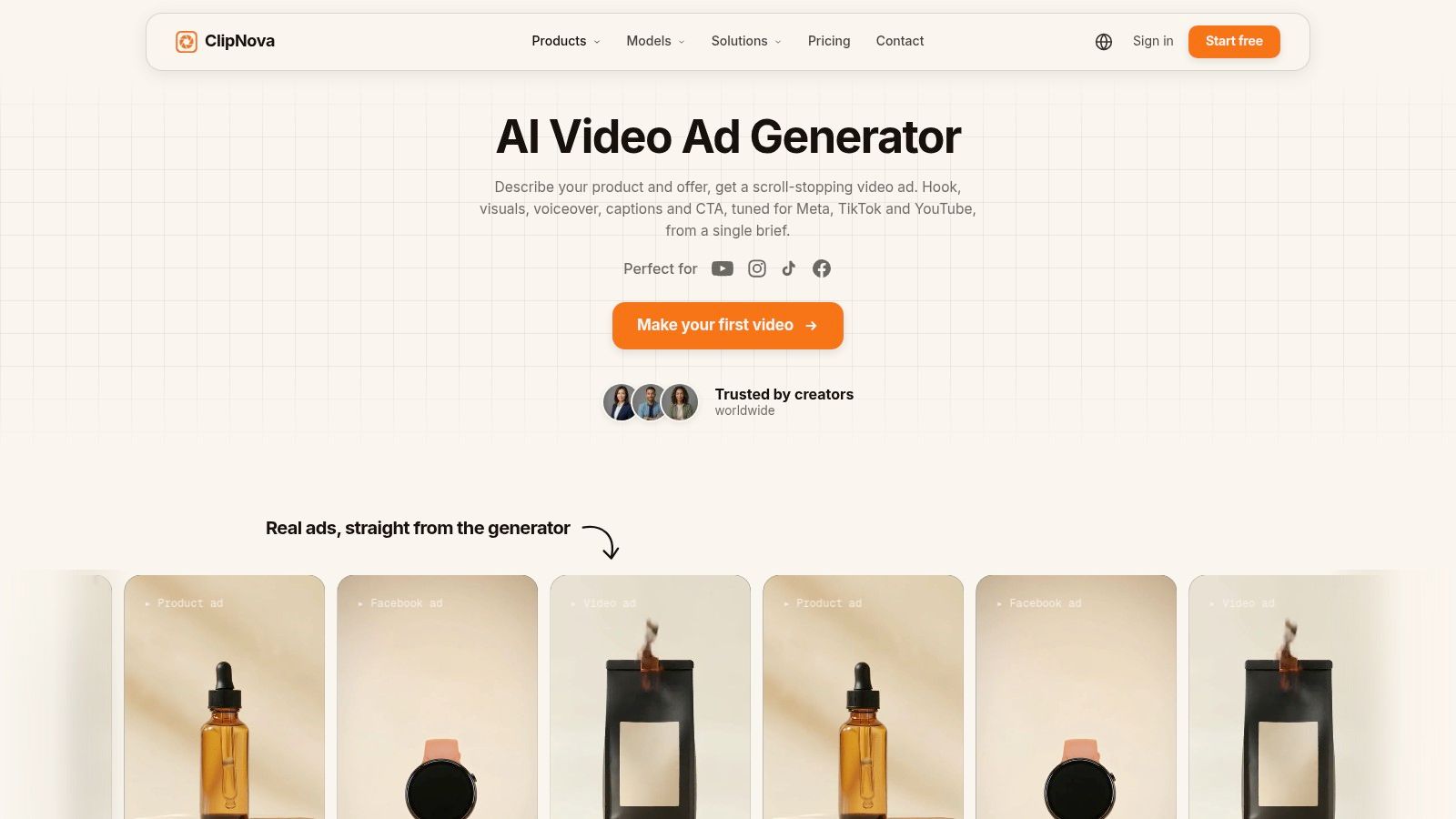
Ad-specific presets are useful because they start from familiar performance structures rather than a blank video canvas. UGC, TikTok, problem-solution, cinematic, lifestyle, and explainer formats give a campaign manager a practical starting point. Built-in A/B variant generation also supports the core advertising task, which is not producing one attractive video, but creating several credible alternatives for testing.
<a id="best-for-end-to-end-variant-creation"></a>
Best for end-to-end variant creation
ClipNova exports one creative into 9:16, 1:1, and 16:9 formats for channels such as TikTok, Meta, and YouTube. Renders typically take 2 to 4 minutes, and the platform provides curated voiceovers in 32 languages, auto-subtitles, and translation tools. Paid plans add watermark-free 1080p and 4K exports and full commercial rights.
That combination makes ClipNova particularly relevant to e-commerce brands, agencies, creators, and growth teams that need to turn one brief into a campaign-ready set of assets. It also means the output still needs human review. Check product names, promotional claims, tone, visual accuracy, subtitles, and the CTA before spending media budget.
Practical rule: Use AI to multiply creative directions, but keep a person responsible for every claim the ad makes.
The trade-off is subscription access for unrestricted commercial production. Free or trial output may have limits, while paid plans are needed for watermark-free exports and commercial rights. For teams looking for brand video strategy tips, ClipNova's advantage is less about one isolated visual and more about replacing a fragmented ad-production pipeline with one workspace.
<a id="2-synthesia"></a>
2. Synthesia
Synthesia solves a different problem. Its strength is the avatar-led spokesperson ad, where a presenter needs to explain a product, introduce an offer, or deliver a structured message without a traditional shoot. The platform offers 300+ stock avatars, custom avatar and voice options, script-to-video production, dubbing, translation, brand kits, workspaces, and enterprise controls.
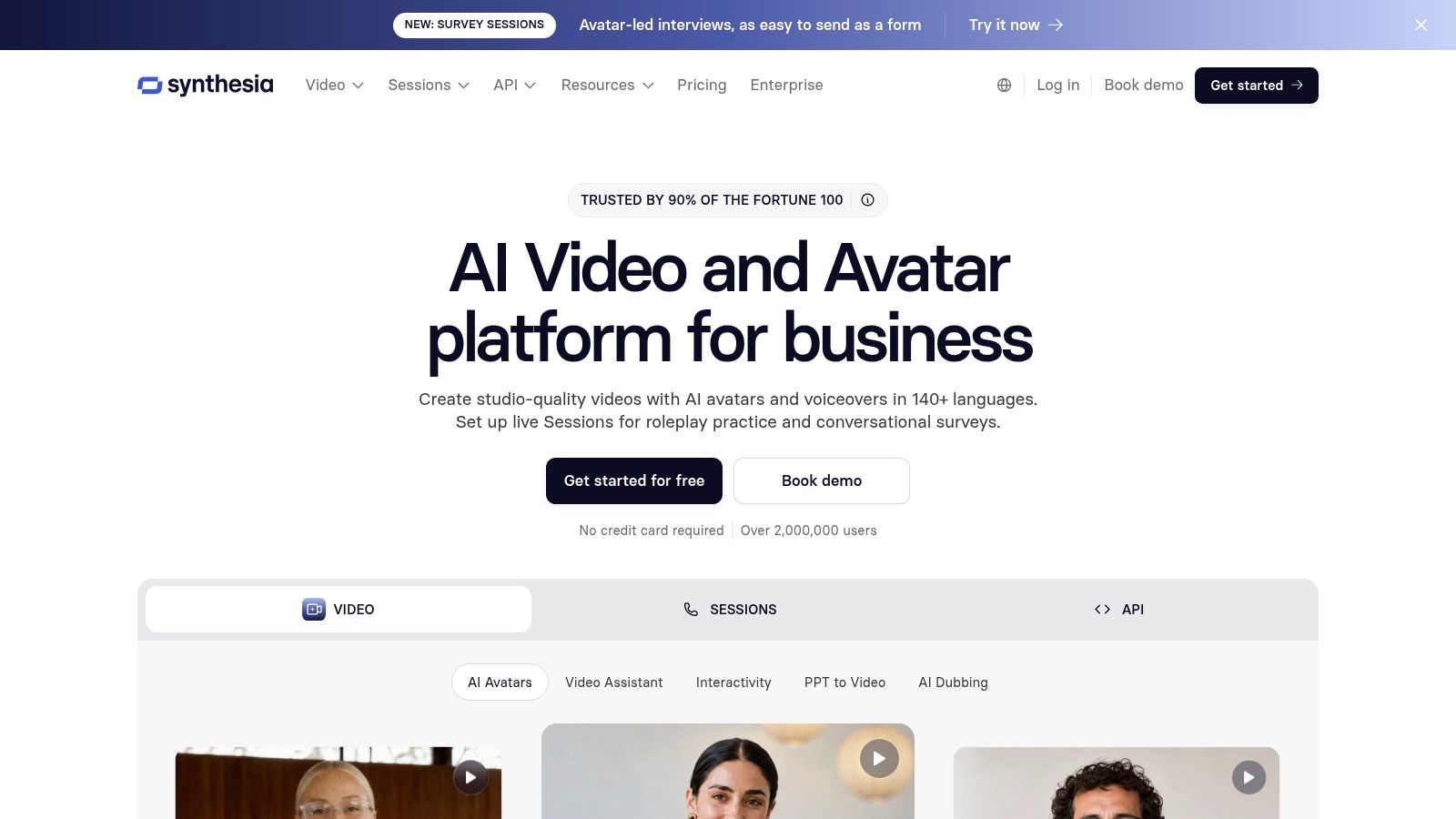
This workflow suits B2B advertisers, software companies, and brands that need a polished presenter more than a fast-moving UGC aesthetic. A marketer can write the approved script, select an avatar, apply brand settings, and create localized versions without booking actors or arranging repeated recording sessions. Team workspaces and governance features also matter when several people review copy and approve creative.
<a id="best-for-spokesperson-localization"></a>
Best for spokesperson localization
Synthesia's credit-based usage covers video creation, dubbing, and interactive elements, so teams should evaluate the whole production pattern rather than looking only at an entry subscription. A campaign that needs many language versions or frequent script changes may consume credits differently from a single-market explainer.
The platform's main limitation is creative style. Avatar presentation can feel too formal for brands that depend on casual creator energy, handheld product demonstrations, or highly cinematic scenes. It also won't replace a generative visual tool when the ad depends on unusual environments, product motion, or art-directed imagery.
For marketers comparing avatar workflows, talking avatar AI is a useful adjacent consideration. Synthesia is the better fit when clarity, consistency, and controlled delivery matter more than visual experimentation. It belongs on a shortlist for localized explainers and professional spokesperson ads, not as the universal answer for every social creative.
<a id="3-runway"></a>
3. Runway
Runway addresses the bottleneck that general-purpose ad generators often leave behind: producing distinctive, cinematic motion. Its text-to-video and image-to-video workflow is suited to stylized product shots, atmospheric scenes, visual transitions, and short clips where visual fidelity and direction carry more weight than automated copy assembly.
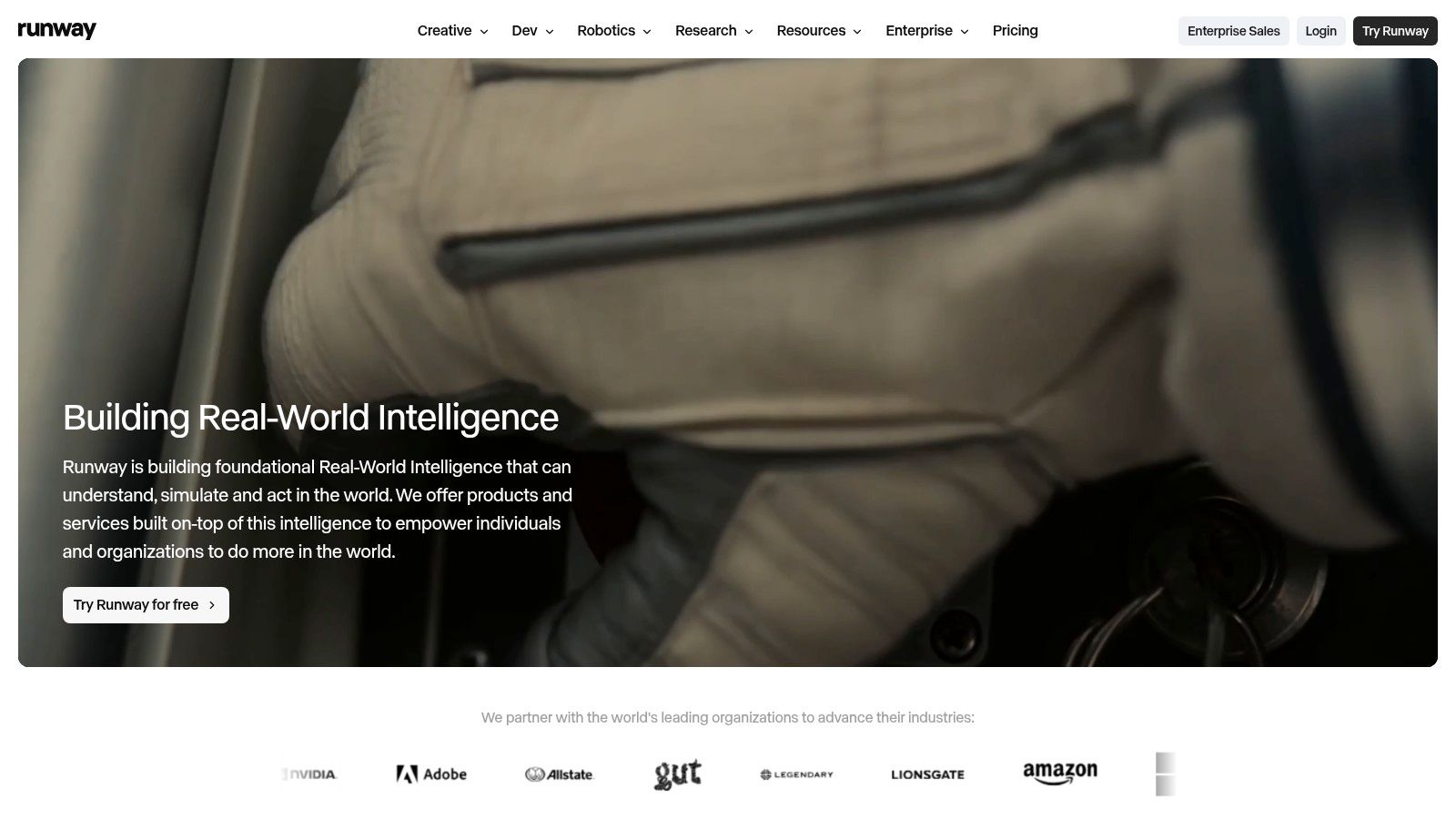
A creative team can use Runway to generate a hero visual, experiment with several treatments, or build a premium opening for a longer ad assembled elsewhere. Newer generations support native audio, and the platform supports multiple aspect ratios, including 9:16, 1:1, and 16:9. Upscaling to 4K and a developer API make it relevant both to individual creators and to teams integrating generative video into internal workflows.
<a id="best-for-cinematic-product-visuals"></a>
Best for cinematic product visuals
Runway's credit-based plans require careful planning. Usage is tied to the model, duration, and resolution, so longer or higher-resolution outputs can consume more credits. That matters when a performance team wants dozens of variants, especially if each version requires several regeneration attempts before approval.
The learning curve is also steeper than a template-first editor. Runway gives creative users more room to direct motion and composition, but that flexibility shifts more responsibility onto the operator. Someone still needs to write strong prompts, evaluate continuity, select usable clips, and assemble the final ad with copy and CTA elements.
For teams learning how to structure generative scenes, this guide to a text-to-video prompt offers useful context. Runway is the right choice when the ad's competitive advantage is a memorable visual treatment. It is less efficient when the primary requirement is a complete, localized, captioned ad from one short product brief.
<a id="4-heygen"></a>
4. HeyGen
HeyGen is designed around the avatar-led ad, with particular strength in rapid localization. Its library includes 500+ stock video avatars, custom avatar creation, lip-sync, voice and language translation, and business workflows for teams. A performance marketer can create one spokesperson concept, adapt it for different markets, and test the localized versions without arranging new shoots.
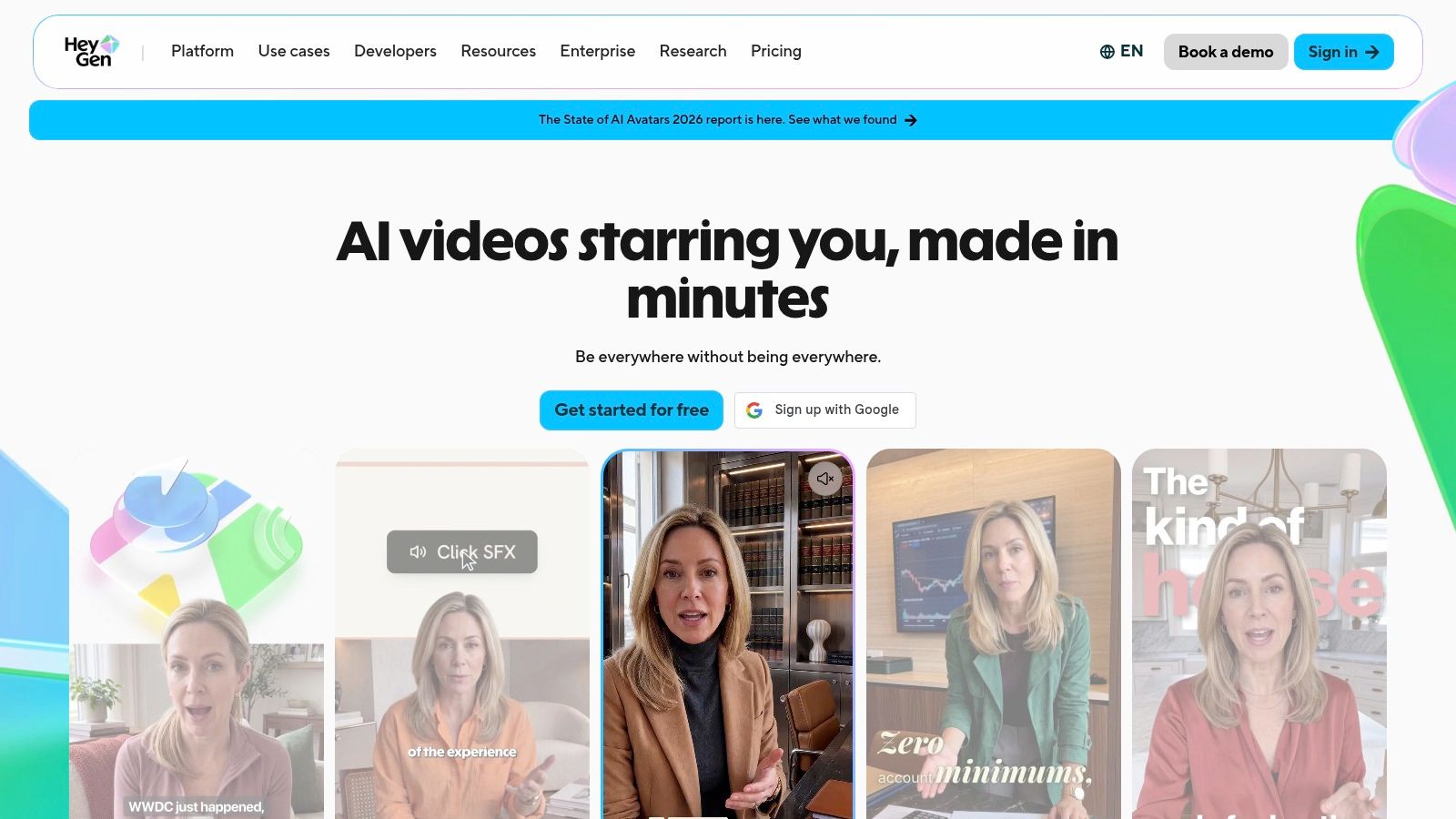
The distinction between HeyGen and a cinematic generator is important. HeyGen helps a person speak directly to the audience. That makes it useful for product explainers, offer announcements, testimonial-style scripts, and direct-response concepts where the presenter carries the message. Advanced lip-sync and translated mouth movements can make localization feel more coherent than just replacing a voice track.
<a id="best-for-multilingual-spokesperson-testing"></a>
Best for multilingual spokesperson testing
HeyGen uses credit-based subscriptions, with rollover and pay-as-you-go API options. That structure can suit teams that want to automate production or connect avatar creation to a larger campaign system, but the economics should be checked against the number of markets, revisions, and versions planned.
The limitation is format range. Avatar-centric creative won't naturally solve a campaign built around detailed product cinematography, complex scenes, or a visual story with no presenter. It can also require careful brand direction to avoid a generic synthetic spokesperson style.
Use HeyGen when the brief is, “Make this person deliver the message in several markets.” Use an end-to-end ad generator when the brief is, “Turn this product and offer into multiple platform-ready concepts.” Those are different jobs, even though both produce video. HeyGen is strongest when localization and delivery consistency matter more than scene-level visual invention.
<a id="5-invideo-ai"></a>
5. InVideo AI
InVideo AI is a template-forward option for teams that want to move from a prompt, script, or product description to a usable social ad without learning a complex editor. It combines prompt-to-video assembly with stock assets, captions, voiceover, ad-oriented templates, and common social aspect ratios.
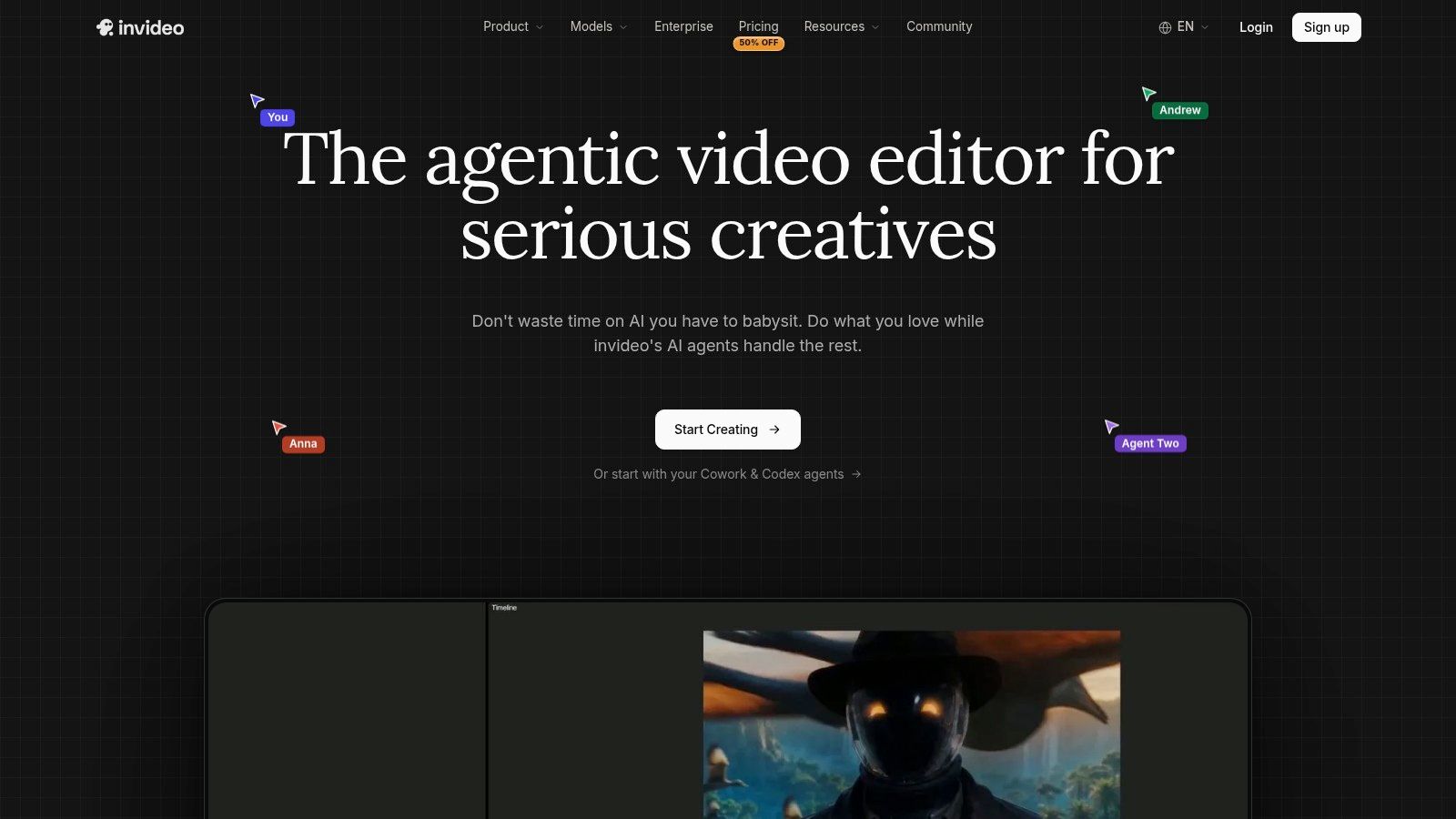
Its advantage is speed at the draft stage. A creator or small marketing team can select a familiar format, add a script, and receive an assembled video with enough structure to review the hook, pacing, visuals, and CTA. The platform also offers free usage options, which gives a team a way to test the workflow before committing to higher production volume.
<a id="best-for-template-speed"></a>
Best for template speed
InVideo AI's credit-based usage helps standardize access across models and features, but teams should still inspect how generation, revisions, and exports affect consumption. A cheap first draft isn't necessarily a cheap campaign if every approved variant needs repeated edits or a large asset library.
The main creative compromise is control. Stock-led templates can make an ad feel familiar, which is useful for fast ideation but less suitable for a premium brand that needs a distinctive visual system. Users may need to replace stock footage, refine typography, adjust pacing, and add stronger brand elements before publishing.
InVideo AI is a practical choice for creators, small teams, and businesses that value low-friction production over deep visual direction. It can produce a broad range of social drafts quickly, but it isn't the best fit when a campaign depends on highly specific product shots or a tightly controlled cinematic identity.
<a id="6-veed"></a>
6. VEED
VEED combines an AI ad generator with a browser-based editor, making it useful for teams whose bottleneck isn't only generation. Marketers can start with text, product images, or existing footage, then move directly into editing for subtitles, brand kits, voiceover, avatars, stock assets, and social exports.
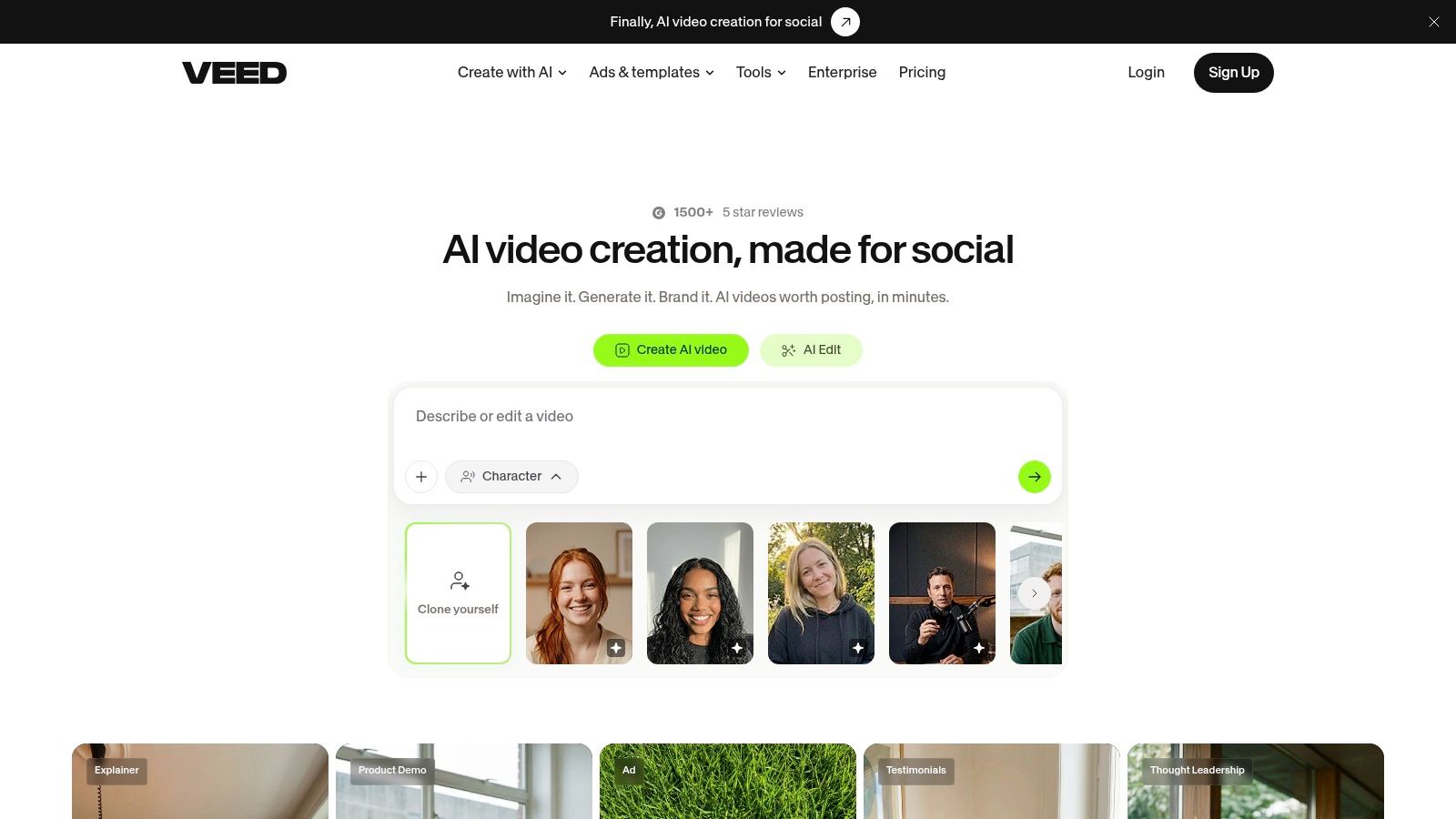
That browser-first setup matters for distributed teams and quick approvals. A social manager can create a draft, an editor can adjust the opening, and a brand reviewer can check captions or colors without requiring a specialist desktop workflow. Presets for TikTok, Instagram, Facebook, and YouTube also make it easier to prepare variations for different placements.
<a id="best-for-browser-based-editing"></a>
Best for browser-based editing
VEED is particularly practical for UGC-style clips, caption-heavy ads, and campaigns that begin with real footage rather than fully generated scenes. Its AI tools can help assemble the first cut, but the full editor gives users a place to correct timing, replace media, adjust subtitles, and apply brand details.
For teams refining short-form content, this guide on how to add subtitles to a video reflects the kind of final-mile work VEED keeps inside the same app. The platform is not a pure high-end generative system like Runway, so it isn't the natural choice for complex cinematic motion. Advanced brand controls may also require a paid tier.
Choose VEED when editing access and collaboration matter as much as generation. It is a strong operational tool for recurring social production, especially when the team wants one web app for rough assembly and hands-on finishing.
<a id="7-colossyan"></a>
7. Colossyan
Colossyan combines polished avatars with structured text-to-video production. Its 300+ avatars, scene assembly, script assistance, translation, and multi-editor collaboration make it suitable for product explainers and localized campaigns that need a clear presenter and an organized production process.
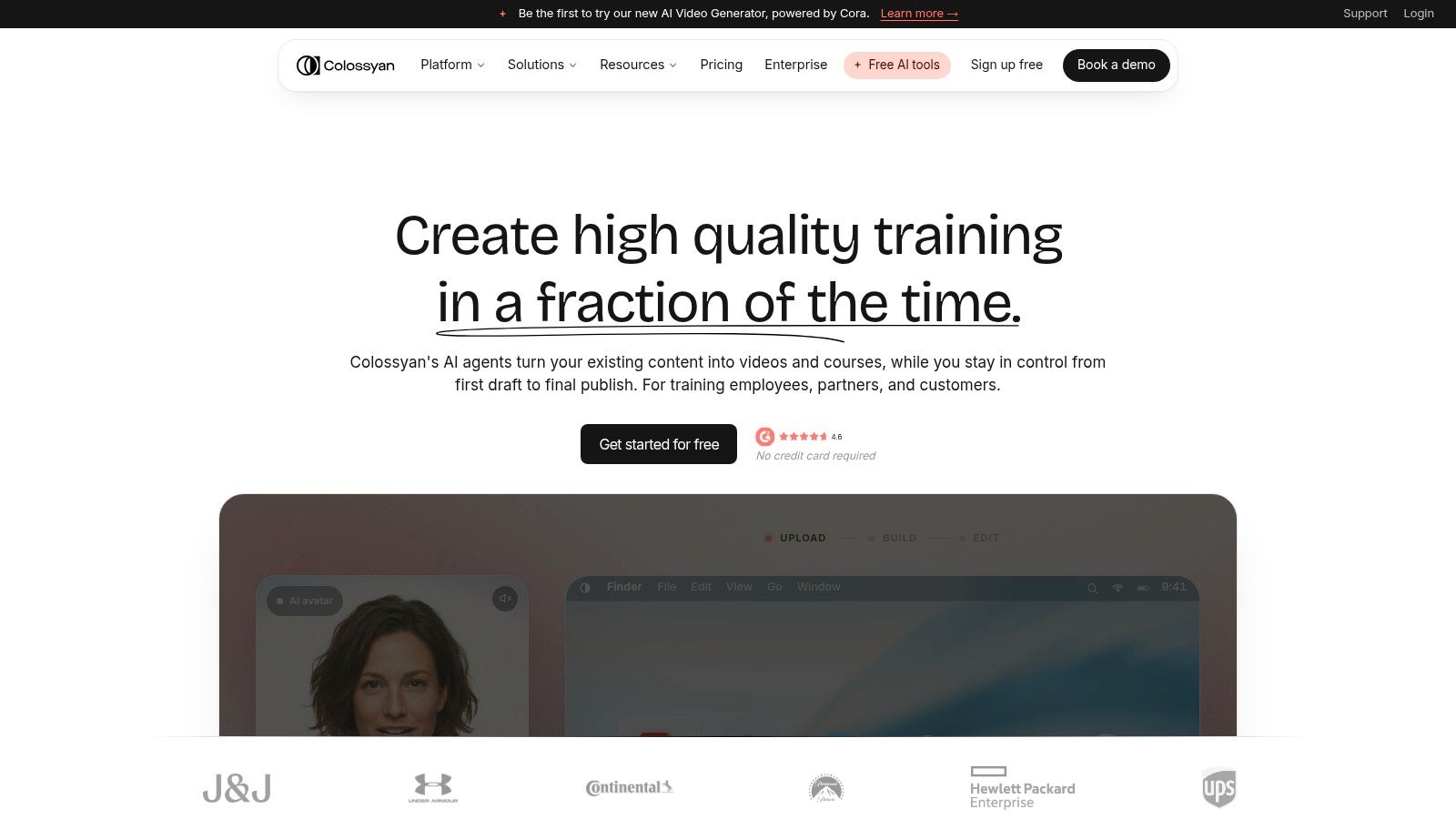
The platform is especially relevant to organizations that already use video for training, enablement, or internal communication and want to adapt that capability for advertising. A product marketer can structure scenes from text, select an avatar, translate the script, and collaborate with reviewers in one project. Enterprise options and governance features can matter when multiple stakeholders need oversight.
<a id="best-for-governed-avatar-explainers"></a>
Best for governed avatar explainers
Colossyan uses generation minutes on paid plans and offers a free plan for evaluation. The practical decision depends on whether the team needs occasional test videos or a repeatable production system with collaboration and localization. Higher-tier features may be necessary for organizations that need more advanced controls.
Its limitation is the same category boundary seen with other avatar platforms. Colossyan is not designed primarily for cinematic product worlds, fast UGC experimentation, or an end-to-end ad workflow that automatically generates every advertising component from a brief. Its avatars can deliver the explanation, but the campaign may still need separate work for distinctive B-roll, visual hooks, and variant construction.
For brands that want a controlled, professional presenter format, Colossyan is a credible option. For a social performance team that needs many hooks, formats, and complete ad versions quickly, ClipNova offers a closer match to the full production requirement.
<a id="top-7-ai-video-ad-generators-comparison"></a>
Top 7 AI Video Ad Generators Comparison
| Product | Implementation Complexity 🔄 | Resource Requirements ⚡ | Expected Outcomes ⭐📊 | Ideal Use Cases 💡 | Key Advantages ⭐ |
|---|---|---|---|---|---|
| AI Video Ad Generator (ClipNova) | Low, end-to-end brief-to-ad workflow; minimal setup | Low–Medium, web app; paid plan for watermark-free 1080p/4K | High, publish-ready, multi-aspect ad variants with built-in localization and A/B variants | E‑commerce, agencies, creators needing many targeted ad variants fast | End-to-end automation; one-click multi-aspect export; fast 2–4 min renders; auto A/B generation |
| Synthesia | Medium, script-to-avatar with brand setup and avatar selection | Medium, credit-based usage; team/enterprise controls | Medium–High, polished spokesperson videos and scalable dubbing/translation | On‑brand spokesperson content, explainers, multi-market campaigns | 300+ avatars, strong localization, enterprise governance and collaboration |
| Runway | High, prompt engineering and model tuning; steeper learning curve | High, per-second credits for high-res models; API access tiers | Very High, cinematic visuals and motion; top visual fidelity for short clips | High-fidelity cinematic ads, stylized product shots, API-driven pipelines | State-of-the-art video models; 4K upscaling; developer API for integration |
| HeyGen | Medium, avatar workflow, easy script input; straightforward UI | Medium, credit-based subscriptions with API and rollover options | High (for spokespersons), polished lip-synced and localized clips | Spokesperson ads, rapid multi-language ad testing | Advanced lip-sync and mouth sync; strong localization; flexible credit plans |
| InVideo AI | Low, template-forward, minimal learning curve | Low, free tier available; credit-based scaling for advanced features | Medium, fast draft ads; template aesthetic that may need brand tuning | Creators and small teams wanting quick social ad drafts | Large template library; very fast ideation-to-draft; competitive entry pricing |
| VEED | Low–Medium, simple AI generator plus full browser editor | Low–Medium, browser-based; paid tiers for advanced branding/features | Medium, UGC-style, captioned social clips ready to publish | UGC-style creatives, caption-heavy ads, teams wanting one web app | Integrated generation + editor; strong subtitle/caption tools; social presets |
| Colossyan | Medium, avatar-focused text/URL/doc-to-video with scene structuring | Medium, free plan; paid NEO/NEO2 for faster generation and enterprise options | Medium–High, natural-looking avatars suited to explainers and localized variants | Product explainers, training/enablement, localized ad variants | Polished avatars, multi-language support, collaboration features and SCORM export |
<a id="build-a-shortlist-around-your-ad-bottleneck"></a>
Build a Shortlist Around Your Ad Bottleneck
There isn't one universal winner because an advertising team can be blocked at different points. If the problem is turning one product brief into complete, localized, multi-format variants, ClipNova is the most direct fit. Its workflow connects ideation, scripting, visuals, narration, captions, CTAs, resizing, and variant creation instead of leaving the team to assemble those pieces across separate tools.
Choose Runway when visual experimentation leads the brief. It makes sense for cinematic motion, stylized product scenes, and distinctive hero assets that need more creative direction than a template workflow provides. Choose Synthesia, HeyGen, or Colossyan when an avatar must carry the message, especially for explainers, spokesperson concepts, and localized delivery. InVideo AI and VEED are better matches when template speed, browser access, and approachable editing are the deciding factors.
The wider market shows why this specialization matters. A 2025 digital video advertising report found that 22% of video ad creative in 2024 was built or enhanced with generative AI, with a projection of 39% by 2026, while 86% of digital video buyers already use or plan to use generative AI for video advertisements, according to this digital video advertising industry report. IAB separately reports that buyers expect AI-generated creative to represent 40% of all video ads by 2026, as detailed in its Digital Video Ad Spend and Strategy Report.
Test the workflow before choosing a long-term subscription. Start with one product brief, create several hooks and formats, review the first frames and captions, check every product claim manually, then compare credit consumption, export restrictions, commercial rights, collaboration, and revision effort. The best tool is the one that lets your team repeat that cycle without rebuilding the process each time.
Performance evidence also needs context. Independent benchmark work reports that AI ad creatives performed within 5% to 15% of human-produced ads on click-through rate across Meta and TikTok while reducing production costs by 60% to 90% per asset, with AI video ads averaging roughly 1.2% to 1.8% CTR on cold Meta traffic, as described in these AI ad creative benchmarks. Those figures don't guarantee results for your product. They support a narrower conclusion, rapid variant production can be a practical testing lever when people still review the message, audience fit, placement, and claims.
The final bottleneck may not be generation at all. A 2026 IAB-linked report found that 62% of digital video ad buyers already use generative AI for creative production, up from 51% in 2025, and buyers expect AI-made or AI-adjusted assets to reach 33% of digital video creative in 2026 and 43% in 2027. The same coverage reports that 43% of CTV buyers doubt placement transparency, which shifts the strategic question from “Can we make more ads?” to “Can we verify where each version ran?” Read the report on CTV placement transparency before treating creative volume as a substitute for media accountability.
ClipNova brings scripting, hooks, visuals, voiceover, captions, music, CTA creation, localization, variant generation, and multi-aspect exports into one AI-powered studio for short-form ads. If your team needs to turn product briefs into testable creative without managing a fragmented production pipeline, visit ClipNova and build your first ad workflow around the bottleneck that matters most.
Ready to ship your own?
Start creating viral videos with AI in under twenty minutes, no credit card required.