
AI advertising isn't one tactic, and it isn't a synonym for handing campaign strategy to a chatbot. The useful applications range from producing platform-native video and personalized variants to localizing scripts, adapting formats, testing hooks, and learning which creative elements deserve more budget. The production method changes, but the marketer still owns the audience definition, offer, claims, consent, brand judgment, and final approval.
That distinction matters because adoption has moved beyond isolated experiments. In 2024, 91% of respondents in reporting from IAB Europe and Microsoft Advertising were already using or experimenting with generative AI in digital advertising, while 78% identified operational efficiency as a key driver. AI in advertising examples therefore need to be judged as workflows, not flashy outputs.
The analysis below uses four questions for every approach: What does AI change? Which campaign problem does it solve? What human judgment remains necessary? How could a team execute it with ClipNova or a comparable production system? The strongest workflow is usually the one that removes a bottleneck without weakening relevance or trust. That's the practical direction behind the broader AI marketing trends discussed by Crescade.
Table of Contents
- 1. AI-Powered Personalized Video Ads
- 2. User-Generated Content Ads at Scale
- 3. Platform-Specific Ad Format Generation
- 4. AI-Generated Product Demo Videos for E-Commerce
- 5. Dynamic Retargeting Video Ads
- 6. Multilingual Ad Localization and Translation
- 7. AI Talking Avatars for Brand Spokesperson Ads
- 8. Music-to-Video Ads with Beat-Synced Visuals
- 9. Style-Specific Video Ads
- 10. A/B Testing and Creative Optimization at Scale
- Comparison of 10 AI Advertising Examples
- Turn These Examples Into a Testing System
<a id="1-ai-powered-personalized-video-ads"></a>
1. AI-Powered Personalized Video Ads
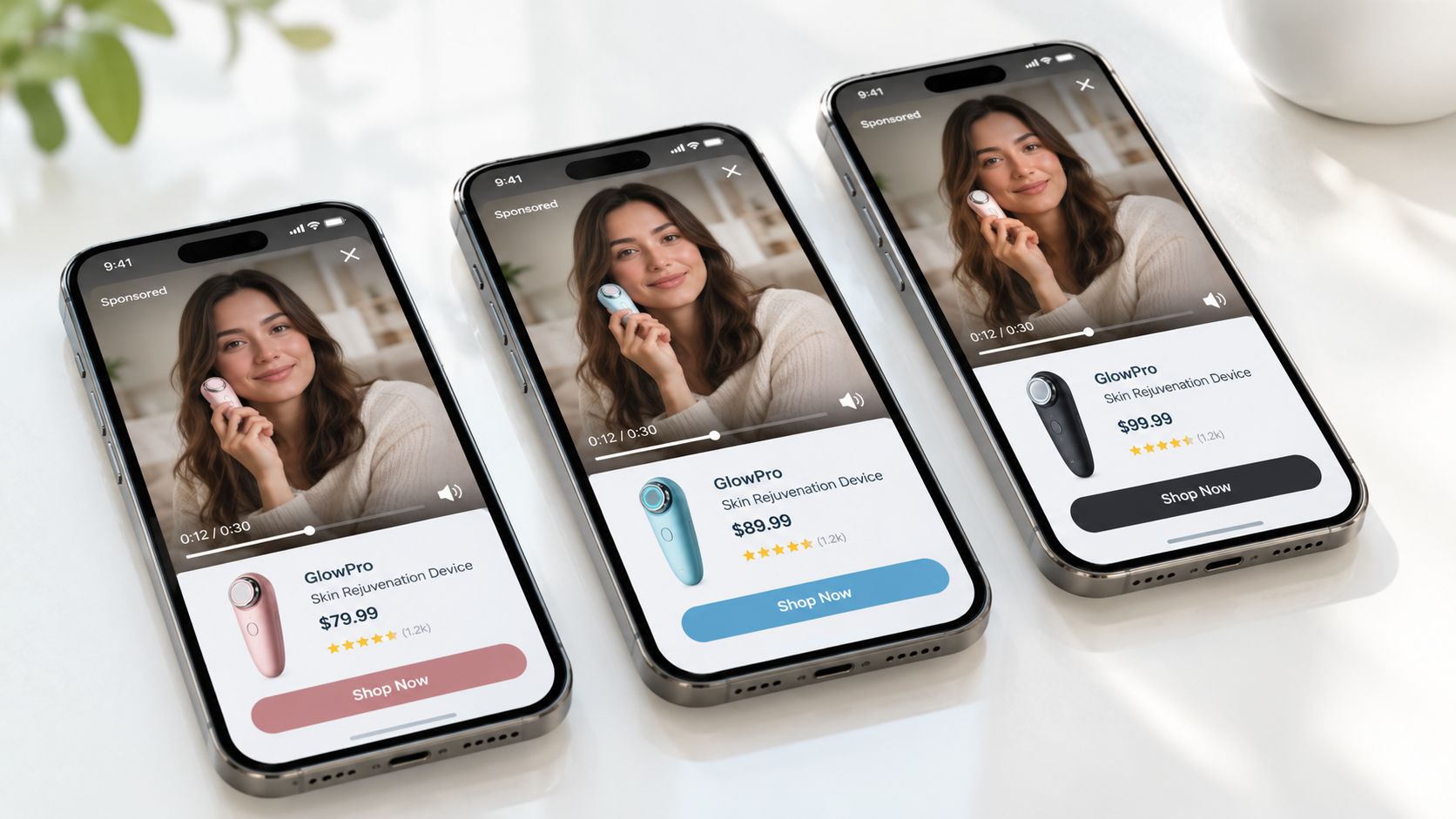
Personalized video changes the creative itself, not only the media buy. One campaign concept can generate different openings, product references, benefits, voiceovers, and calls to action for defined audience groups. The operational gain comes from managing a controlled set of relevant variants instead of forcing one universal video to serve every viewer.
The workflow fits between consideration and conversion, when the audience has a recognizable need and the message can address it directly. A skincare brand could frame the same product differently for a new customer, a returning visitor, and someone who viewed a specific product. Each variation needs a clear segmentation rule, accurate data, and a defensible reason to exist.
<a id="production-decisions-that-matter"></a>
Production decisions that matter
ClipNova can generate variants from one brief and export short-form assets in formats suited to paid social campaigns. Begin with hypotheses rather than cosmetic changes. Alter the audience problem, proof point, or CTA while keeping enough of the structure consistent to identify which change influenced performance.
- Audience logic: Build segments around intent or context, not every available attribute.
- Dynamic elements: Add product names, benefits, or CTAs only when the underlying data is accurate and permitted.
- Testing discipline: Compare a limited set of meaningfully different variants before expanding the matrix.
- Trust controls: Avoid wording that exposes sensitive inferences or makes viewers feel monitored.
The 2024 IAB Europe and Microsoft Advertising report identifies operational efficiency as a major adoption driver. That finding supports a production-first use of AI: create and iterate assets faster, then evaluate which messages deserve further testing. Personalization may improve relevance, but poor data and excessive targeting raise the risk of irrelevant or invasive ads.
Practical rule: Personalize the problem and the proof before personalizing the person. Relevance should feel useful, not invasive.
<a id="2-user-generated-content-ads-at-scale"></a>
2. User-Generated Content Ads at Scale
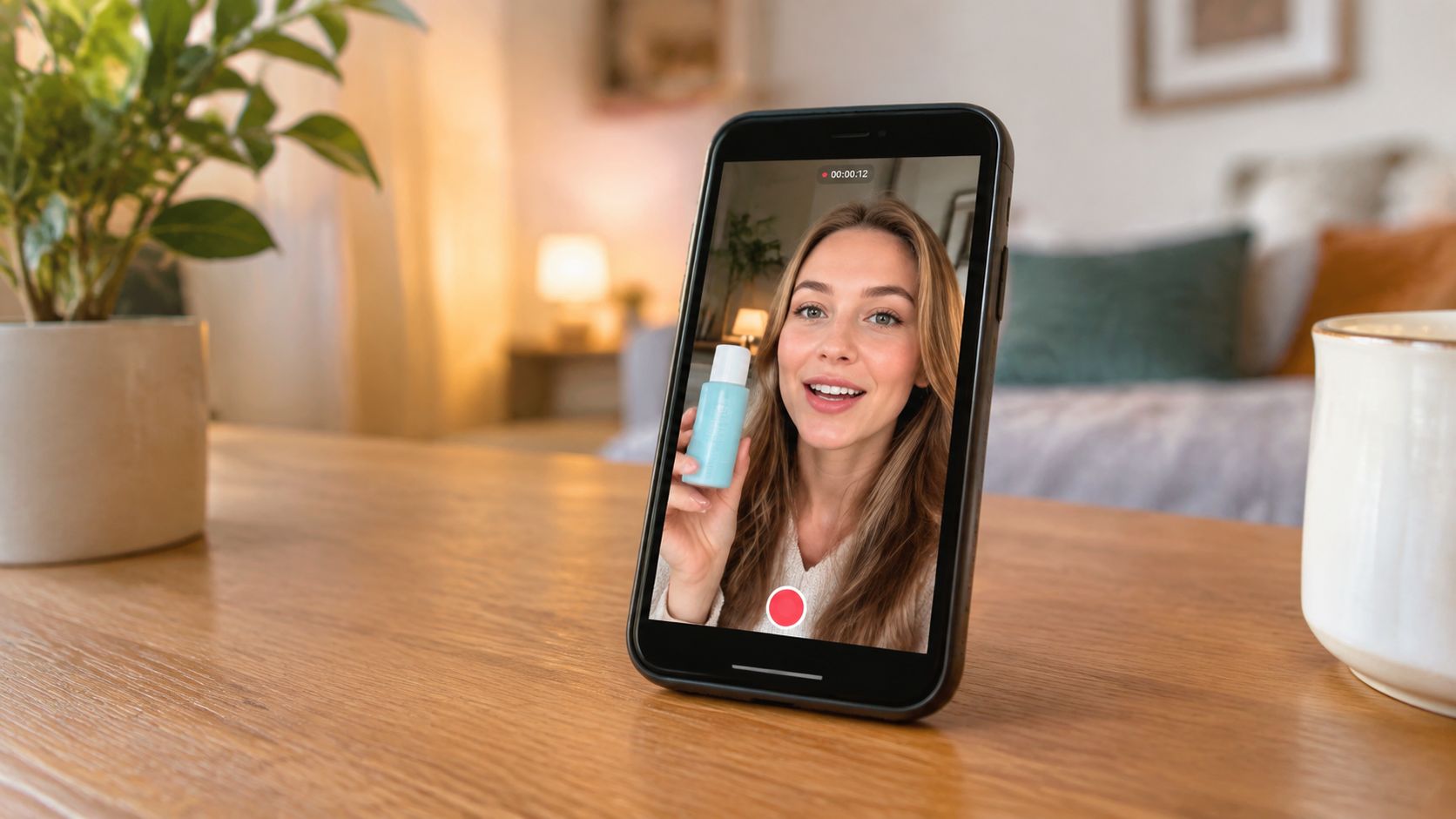
UGC-style ads succeed through recognizable production cues, not automatic authenticity. Direct-to-camera delivery, vertical framing, quick cuts, conversational scripts, and product-centered storytelling can make an ad fit a creator-led feed. AI can generate scripts, assemble scenes, create avatar presentations, and produce variations without scheduling a new creator for every message.
The workflow fits the top and middle of the funnel. A short opening can interrupt scrolling, frame a problem, and introduce a product before the viewer commits to deeper evaluation. Marketers can test frustration-first, demonstration-first, and objection-first structures, then compare attention with downstream behavior. A synthetic presenter delivers a claim, not evidence of customer experience. Brands still need substantiation and clear disclosure.
<a id="separate-production-scale-from-trust"></a>
Separate production scale from trust
Volume is the practical advantage. ClipNova's ad and UGC workflows can turn one product brief into multiple hooks, scripts, captions, voiceovers, and platform-ready edits. Paid plans provide commercial rights and watermark-free exports according to the publisher's stated product information. This reduces dependence on creator availability, while leaving credibility and claim support as separate marketing decisions.
The trust trade-off shapes the workflow. A 2025 consumer finding cited by IAB reported that 21% trust ads made entirely by AI, while 73% are open to AI-assisted ads when the result feels relevant. The IAB analysis of the widening AI gap supports a more useful choice than treating production as solely AI or human.
Use AI for hooks, editing, scene variation, captions, background elements, and structured product explanations. Use real people for customer experience, sensitive testimonials, founder credibility, and claims based on lived use. Before launch, review disclosure language, demonstrations, implied outcomes, and each platform's synthetic-media rules.
Run a controlled comparison between synthetic UGC and real creator footage with the same offer and audience. Evaluate clicks alongside comment sentiment, landing-page behavior, conversion quality, and complaints. A synthetic version that wins attention but loses trust after the click has optimized the opening, not the campaign.
<a id="3-platform-specific-ad-format-generation"></a>
3. Platform-Specific Ad Format Generation
A platform-native ad is a production decision, not a resizing task. A video built for TikTok may need a different opening, caption position, pacing, and visual density before it fits Instagram Reels, Facebook, YouTube, or LinkedIn. The core message can stay consistent, while the delivery responds to how people encounter it.
Start by defining the distribution requirements alongside the creative brief. ClipNova supports exports in 9:16, 1:1, and 16:9, so teams can plan format adaptation before editing is complete. This addresses a common distribution bottleneck: one approved master asset exists, but no one has time to rebuild it for each placement.
A modular edit makes adaptation testable. Keep the hook, product explanation, proof, CTA, captions, and supporting visuals as separate components. Reassemble them for each channel instead of applying a crop and hoping the original composition survives.
| Placement | Production choice to test |
|---|---|
| TikTok or Reels | Open with the problem, action, or visual interruption. |
| Add context for slower, sound-off viewing. | |
| YouTube | State the opening promise and value before the viewer skips. |
| Lead with the business problem and credible outcome. |
These are hypotheses, not fixed algorithm rules. Review performance within the relevant advertising account, because platform preferences and audience conventions change. Automated adaptation can also flatten community-specific language or cultural cues when templates replace editorial review.
Test the packaging separately from the concept. Keep the offer, audience, and core claim stable, then compare opening structure, caption treatment, and edit rhythm by platform. Track attention and downstream actions, not only views. If a concept fails with unreadable captions or a weak first frame, the result identifies a format problem, not necessarily a creative one. Create native versions before testing, so each experiment measures the intended variable.
<a id="4-ai-generated-product-demo-videos-for-e-commerce"></a>
4. AI-Generated Product Demo Videos for E-Commerce
A product demo earns its place in e-commerce when a shopper still asks, “How does this work?” Rather than treating AI as a substitute for product knowledge, teams can use it to convert an approved brief, product page, or image set into a script, narrated explanation, animated feature callout, and scenario-based demonstration. The workflow suits catalogs with many SKUs, frequent inventory updates, or markets requiring localized creative.
Its clearest funnel role is consideration. A useful demo connects the shopper's problem to one feature, shows that feature in context, and ends with a relevant next step. That can reduce reliance on a studio shoot for every SKU. ClipNova's Product Video Generator is described as supporting scripting, visuals, voiceover, captions, music, and export formats for this brief-to-video process.
Accuracy determines whether the asset supports conversion or creates risk. Generated scenes may misstate dimensions, materials, compatibility, setup, or performance when the source information is incomplete. A reviewer should check each visible action and spoken claim against approved product data before publication.
Build the production brief around four decisions:
- Product truth: List features, exclusions, approved claims, warranty language, and intended use.
- Reference quality: Supply accurate product images and authentic footage when texture, scale, or physical handling matters.
- Scenario choice: Demonstrate the use case most likely to resolve the shopper's hesitation.
- Conversion role: Match the CTA to the stage, whether the goal is learning more, comparing options, or buying.
Testing should isolate the creative variable. Keep the product, claim, audience, and CTA stable while comparing a feature-led demonstration with a problem-led scenario. Review click-through and purchase behavior alongside view completion, since a visually engaging demo can still fail to explain the product.
Teams can animate approved imagery through ClipNova's guide to picture-to-video AI. That speeds production without transferring merchandising or compliance decisions to the generator. Real demonstrations remain preferable when buyers must judge texture, fit, finish, scale, or physical interaction.
<a id="5-dynamic-retargeting-video-ads"></a>
5. Dynamic Retargeting Video Ads
Retargeting video should respond to the viewer's latest action, not repeat the first ad. A person who watched an explainer needs a comparison or proof point. Someone who abandoned a cart needs a purchase reminder, while a recent customer should be excluded from first-purchase messaging. AI can select or assemble the relevant hook, product emphasis, CTA, and offer for each funnel state.
The workflow fits mainly in consideration and conversion, where behavioral signals can guide the next message. A campaign might shift viewers from education to comparison, then from comparison to purchase recovery. Creative rotation can also reduce fatigue when repeated exposure makes one message less effective.
<a id="build-the-event-logic-before-the-creative-system"></a>
Build the event logic before the creative system
Dynamic retargeting depends on accurate signals for page views, product views, cart actions, purchases, exclusions, and consent status. If those events are incomplete, the system may optimize for the wrong action or continue showing an offer after conversion.
Start with a compact decision table:
- Map funnel events: Identify the action that changes the message.
- Assign a creative rule: Connect each event to one promise and one CTA.
- Set exclusions: Remove purchasers and audiences who should no longer receive the ad.
- Control frequency: Refresh or pause variants as exposure rises.
- Measure downstream value: Review conversion quality, repeat purchase, and wasted spend alongside clicks.
The production decision is how much variation the evidence can support. A small set of event-based branches is easier to audit than a large personalization tree. Keep the product, offer, and audience logic stable while testing the hook or CTA, then compare purchase behavior with view completion and click-through.
Privacy changes and device restrictions can reduce individual-level signals. Consent handling and first-party data governance therefore affect both targeting and creative operations. ClipNova can help assemble and refresh variants, while marketers define meaningful events, approved claims, exclusions, and acceptable persuasion. AI coordinates delivery. It does not determine whether the underlying behavior justifies the message.
<a id="6-multilingual-ad-localization-and-translation"></a>
6. Multilingual Ad Localization and Translation
A translated ad can be grammatically correct and still fail commercially. Localization changes the message's cultural fit, tone, and implied promise. AI can transcribe a source video, translate its script, generate voiceovers, add captions, and export language variants without a separate shoot for every market. ClipNova states that its voiceover and localization tools support 32 languages, which suits teams extending an existing campaign across regions.
Treat localization as a creative adaptation workflow across the full funnel. Awareness ads may depend on humor or cultural references, consideration ads on precise product explanations, and conversion ads on urgency, social proof, or outcome claims. Literal translation often preserves words while weakening persuasion. It can also make a legally approved claim sound broader in the target language.
<a id="review-the-decisions-ai-cannot-validate"></a>
Review the decisions AI cannot validate
Use AI for transcription, first-pass translation, voice generation, caption timing, and version management. A fluent reviewer should then check the market-specific meaning before launch:
- Voice and tone: Does the delivery suit the category and audience?
- Cultural references: Would the metaphor, visual, or joke make sense locally?
- Commercial details: Are prices, currencies, units, dates, and legal terms correct?
- Claims: Does the translated wording create a stronger promise than the approved source?
- Captions: Do timing, line breaks, and text density remain readable?
The production choice is how much of the original creative to preserve. Keep the offer, product facts, and approved claims stable. Adapt phrasing, examples, pacing, and voice direction when the source has no natural equivalent. Cultural adaptation should improve comprehension, not create new claims.
Test a translated master against a locally reviewed variant. Hold the audience, placement, offer, and CTA constant, then compare completion, clicks, and conversion quality. This isolates whether localization improves understanding or merely changes delivery. ClipNova can assemble language versions and refresh exports, while marketers set translation briefs, reviewer gates, and market-specific approval rules. Faster market entry matters only when the ad remains credible.
<a id="7-ai-talking-avatars-for-brand-spokesperson-ads"></a>
7. AI Talking Avatars for Brand Spokesperson Ads
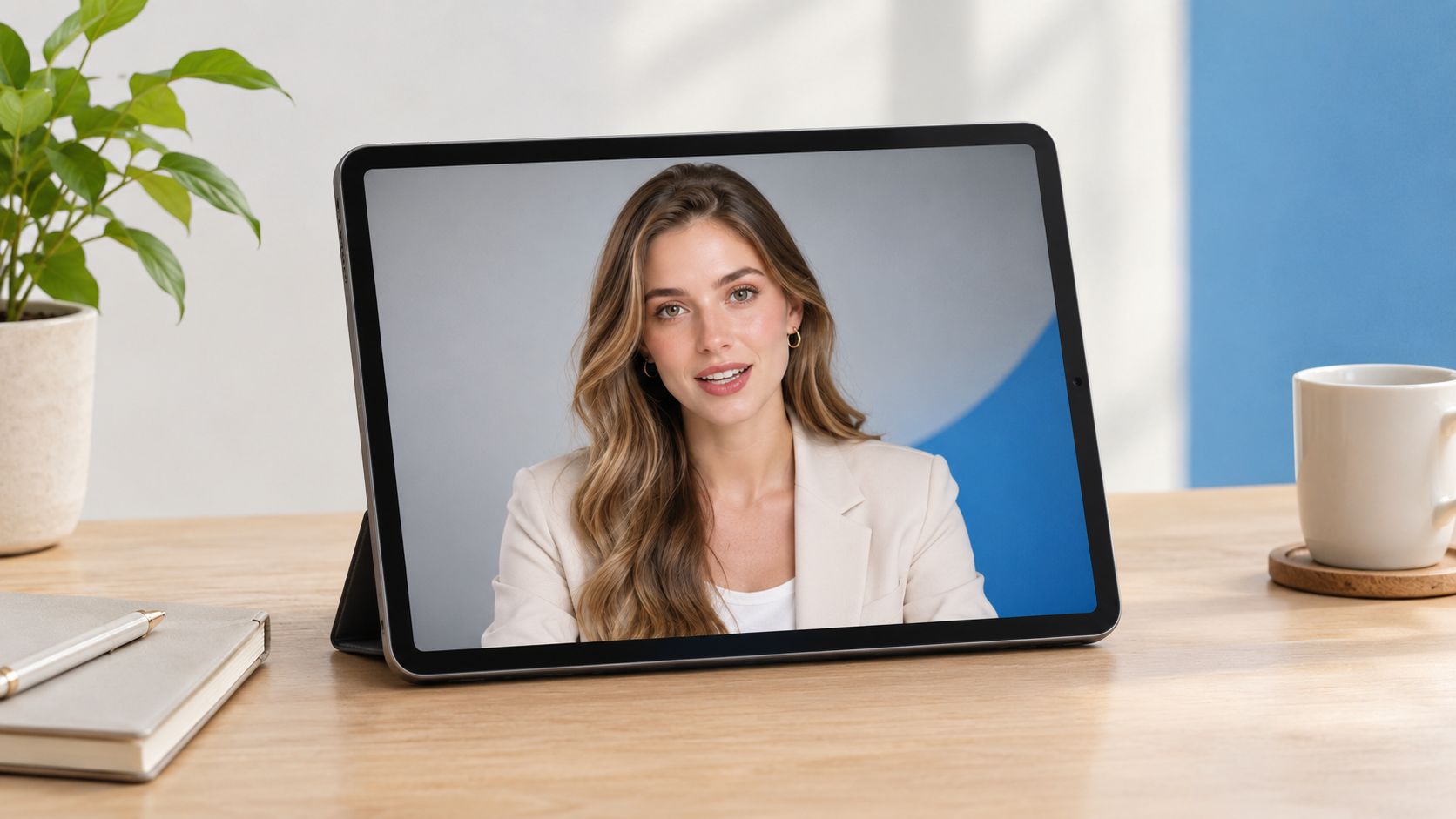
AI talking avatars are production systems for repeatable spokesperson creative. They turn approved scripts into presenter-led videos for tutorials, product explainers, FAQs, and localized messages, while keeping appearance and delivery consistent across versions. ClipNova includes a Talking Avatar workflow, and its guide to talking avatar AI outlines the category and its production use cases.
The format fits the consideration and education stages when the presenter's task is clarity. An avatar can explain a software feature, demonstrate a product benefit, or organize common questions into a short answer. It carries more risk when the ad depends on genuine experience, such as a founder statement, medical reassurance, customer testimony, or emotionally vulnerable story.
<a id="assign-the-avatar-a-narrow-role"></a>
Assign the avatar a narrow role
Before production, define what the presenter may represent. The avatar should not impersonate a real person or suggest firsthand experience. A real person's likeness or voice requires documented authorization, along with a clear scope for use.
Analysts in the American Impact Review discussion of AI advertising trust describe a conditional trust effect. Disclosure may reduce trust and purchase intent, while trust can recover when AI handles tangible production tasks and a real human remains visible. The implication for testing is practical: evaluate the category, perceived stakes, human involvement, and disclosure together rather than treating the avatar itself as the only variable.
Use this fit guide:
- Strong fit: Tutorials, onboarding, feature education, internal campaign variants, and direct product explanations.
- Cautious fit: Financial services, healthcare, personal services, and high-consideration purchases.
- Weak fit: Fabricated testimonials, unauthorized likenesses, and claims based on personal experience.
Test the avatar against voiceover, a real presenter, and product-only creative. Hold the script, offer, placement, and CTA steady, then compare attention and conversion while reviewing comments and customer questions. The key trade-off is output against perceived honesty. A lower-cost presenter may increase production capacity while weakening credibility, a shift that early click results may not reveal.
<a id="8-music-to-video-ads-with-beat-synced-visuals"></a>
8. Music-to-Video Ads with Beat-Synced Visuals
Beat-synced advertising makes the soundtrack part of the edit plan. AI analyzes rhythm and places cuts, transitions, text reveals, product appearances, and motion effects against the track. That structure can make short-form creative feel intentional rather than assembled from unrelated clips.
The workflow fits awareness and engagement campaigns where viewers can understand the product visually and attention must come before detailed explanation. ClipNova's Music to Video tool supports beat matching, and its music video ideas resource can help teams develop concepts around audio and visual movement.
<a id="build-the-edit-around-emphasis"></a>
Build the edit around emphasis
A beat should mark a communication priority, not merely trigger another effect. Reserve stronger musical changes for the product, core benefit, proof, or CTA. Quieter passages can give viewers time to read or inspect the offer.
Start with one product concept and produce controlled variations. Keep the footage, offer, placement, and CTA stable while changing the variables that affect comprehension:
- Tempo: Does the pace fit the product's personality and buying context?
- Reveal timing: Does the product appear before viewers lose interest?
- Text rhythm: Can viewers finish reading each claim before the next visual?
- Sound-off resilience: Do captions, framing, and composition preserve the message without audio?
- Licensing: Does the team have commercial permission for the track across intended placements?
The workflow becomes less suitable for dialogue-heavy, trust-sensitive, or highly technical messages. Those formats depend on steady explanation, while rapid synchronization can prioritize visual energy over meaning. It may also make a weak concept feel lively without improving persuasion.
Evaluate the creative on two separate levels: attention and understanding. Watch-through behavior indicates whether the edit sustains interest. Landing-page actions, product-page engagement, and audience questions provide stronger evidence that the music-led structure communicated a reason to buy. If attention rises but comprehension or conversion does not, simplify the edit before changing the soundtrack.
<a id="9-style-specific-video-ads"></a>
9. Style-Specific Video Ads
Stylized video can create a campaign identity that standard product footage does not provide. Anime, cartoon, and related treatments let teams test characters, scenes, animation directions, and image transformations before committing to traditional production. ClipNova includes an Anime Video Generator and AI Cartoon Video Generator for this workflow.
The strongest fit is awareness and community-led campaigns where the audience already values the aesthetic. Gaming products, entertainment, collectibles, creative software, and youth-oriented accessories can use a distinctive visual language to attract qualified attention. Professional services and premium products may require more restrained treatment, because an expressive style can reduce perceived seriousness or distract from the offer.
<a id="test-the-visual-system-not-just-the-look"></a>
Test the visual system, not just the look
A prompt does not define a campaign system. Art direction must specify character continuity, color rules, movement, typography, product visibility, and the emotional role of the style. Without those constraints, individually appealing scenes can produce an inconsistent ad and make the product difficult to recognize.
Build the first test around one strategic question at a time:
- Audience fit: Does the aesthetic attract the intended community, or only create novelty?
- Brand fit: Does the treatment reinforce the brand's position and category expectations?
- Product clarity: Can viewers identify the product and understand its benefit?
- Serial potential: Can the visual rules support multiple ads without exhausting the concept?
- Accessibility: Do captions, contrast, and motion remain usable across placements?
ClipNova can support the production loop by generating style-specific variants, while the marketing team controls continuity and product details. Keep the offer and CTA consistent when comparing treatments. A simple product-led control gives the comparison a reference point and helps separate visual appeal from persuasive value.
The defensible benefit here is production flexibility and creative exploration, not a guaranteed performance lift or cost reduction. The main risk is optimizing for shares or novelty while qualified actions remain unchanged.
Judge the ads on attention and product understanding. If the stylized version earns attention but weakens product recall, add clearer demonstrations, stronger product framing, or a more direct CTA before expanding the visual system.
<a id="10-ab-testing-and-creative-optimization-at-scale"></a>
10. A/B Testing and Creative Optimization at Scale
AI-powered optimization is useful only when each variant answers a defined marketing question. ClipNova can generate controlled changes to hooks, claims, visuals, presenters, pacing, captions, and CTAs, while the team preserves a clear control. The production decision is therefore tied to measurement: identify the creative variable, define the funnel event, then compare outcomes under similar audience and offer conditions.
Start with the bottleneck rather than the asset count. Awareness tests can examine qualified attention, message recall, or comprehension. Lower-funnel tests require a dependable downstream event, because clicks alone may reward curiosity without showing purchase intent. A short testing brief should record:
- Bottleneck: attention, comprehension, trust, or conversion.
- Hypothesis: the reason one treatment should outperform the control.
- Variable: one strategic change, such as a demonstration-led opening instead of a benefit-led opening.
- Control: the current best-performing asset, with the offer and audience held stable where possible.
- Decision rule: the action that follows a clear result, such as keeping, revising, or retiring the variant.
The 2024 field study found that AI-created ads outperformed human-made and AI-modified ads in real-world settings, with click-through rates rising by up to 19%. It also found that full generation outperformed light AI editing. The practical implication is narrower than a universal performance promise: AI may contribute more when it develops a coherent creative system than when it makes isolated edits.
A separate advertising study reported shifts from 1.2% to 3.8% CTR, 2.1% to 6.3% conversion rate, $40 to $27 CPA, and 1.5x to 4.8x ROAS after AI integration. These are study-specific outcomes, not account forecasts. They indicate that linking generation, optimization, and measurement can affect more than engagement.
Record the lesson behind each result, not only the winning file. If attention rises while qualified actions stay flat, revise the promise, product proof, or CTA instead of producing more variants. That feedback loop turns ClipNova's batch generation into a testing system rather than an asset factory.
<a id="comparison-of-10-ai-advertising-examples"></a>
Comparison of 10 AI Advertising Examples
| Ad Type | 🔄 Implementation complexity | ⚡ Resource requirements | ⭐ Effectiveness | 📊 Expected results/impact | 💡 Ideal use cases |
|---|---|---|---|---|---|
| AI-Powered Personalized Video Ads | High 🔄🔄🔄, data + platform integration | Data & segmentation, creative templates, analytics | ⭐⭐⭐⭐⭐, very high targeting precision | ↑ CTR/conv; stronger ROI; scalable personalization | E‑commerce retargeting, large catalogs, persona-driven campaigns |
| User-Generated Content (UGC) Ads at Scale | Medium 🔄🔄, prompt tuning & style control | Prompt engineering, avatar/voice assets, batch generation | ⭐⭐⭐⭐, high engagement when authentic | ↑ Engagement (often > polished ads); lower production cost | Social proof, TikTok/short-form campaigns, rapid seasonal content |
| Platform-Specific Ad Format Generation | Low–Medium 🔄🔄, mostly automated exports | Templates, multi-aspect exports, occasional algorithm updates | ⭐⭐⭐⭐, improves native engagement | Faster time-to-publish; higher platform-specific engagement | Cross-platform campaigns, agencies, creators distributing widely |
| AI-Generated Product Demo Videos for E‑Commerce | Medium 🔄🔄, product data & script accuracy needed | Product spec feeds, animation assets, multilingual voiceovers | ⭐⭐⭐⭐, strong conversion lift for demos | ↑ Conversions (≈40%+); scalable SKU coverage | Product pages, A+ content, rapid catalog updates |
| Dynamic Retargeting Video Ads | High 🔄🔄🔄, pixel infra & real-time logic | Behavioral data, real-time optimization, budget & tagging | ⭐⭐⭐⭐⭐, very effective for warm audiences | ↑ Cart recovery & conversions (3x–5x ROI), reduces ad fatigue | Cart abandoners, high‑intent retargeting, funnel-stage messaging |
| Multilingual Ad Localization & Translation | Medium 🔄🔄, auto-translate + local review | Translation, 32-language voiceovers, cultural reviewers | ⭐⭐⭐⭐, strong local engagement when reviewed | Faster market entry; cost savings vs local shoots (~70%+) | Global launches, regional market testing, multilingual campaigns |
| AI Talking Avatars for Brand Spokesperson Ads | Medium–High 🔄🔄🔄, avatar & voice cloning setup | Avatar creation, reference audio, compliance checks | ⭐⭐⭐⭐, consistent branding; authenticity caveats | Lower talent costs; scalable spokesperson content | Founder messages, tutorials, explainer series, high-volume comms |
| Music-to-Video Ads with Beat-Synced Visuals | Low–Medium 🔄🔄, beat analysis & creative choice | Licensed music, beat-sync tool, editing templates | ⭐⭐⭐⭐, higher completion & memorability | ↑ View completions & shares; algorithmic lift on music platforms | Trend-driven short-form, product reveals, high-energy launches |
| Style-Specific Video Ads (Anime/Cartoon) | Medium 🔄🔄, clear art direction required | Style prompts, character assets, animation tuning | ⭐⭐⭐, strong niche appeal | High engagement in target niches; lower cost than studios | Gaming, youth brands, fandom-focused awareness campaigns |
| A/B Testing & Creative Optimization at Scale | High 🔄🔄🔄, analytics & volume requirements | Variant generation, tracking infrastructure, test budget | ⭐⭐⭐⭐⭐, systematic performance gains | Identifies winners; ROI uplift (20–50%); continuous learnings | Performance marketing, growth teams, large-scale creative programs |
<a id="turn-these-examples-into-a-testing-system"></a>
Turn These Examples Into a Testing System
The common thread across these ai in advertising examples isn't automation for its own sake. AI creates a clear audience, offer, format, and measurement loop. Personalized video is useful when audience differences change the message. Localization is useful when language and cultural context affect comprehension. Beat-synced editing is useful when rhythm helps earn attention. An avatar is useful when consistent delivery matters more than personal testimony.
Start with one campaign bottleneck. Don't begin by asking which tool can generate the most assets. Ask whether the current problem is slow production, weak relevance, poor platform fit, missing localization, creative fatigue, or an unclear testing process. That choice determines which workflow deserves attention.
Then create a small set of distinct variants. Keep the differences strategic, such as the hook, audience problem, product demonstration, proof point, presenter, or CTA. Cosmetic changes create a large file library without producing useful learning. ClipNova can support scripting, voiceover, visuals, captions, music, format adaptation, and variant generation in one production workspace, but the team still needs to define what each version is meant to prove.
Adapt the assets to the relevant platform or market before launch. Check aspect ratio, caption placement, pacing, language, cultural references, pricing, product details, and disclosure requirements. A translated ad needs human review. A synthetic testimonial needs a trust decision. A product demo needs factual verification. A personalized ad needs consent and responsible audience logic.
Next, launch a controlled test with a stable offer and an agreed primary outcome. Don't let a high click-through rate hide weak conversion quality, misleading creative, or negative audience feedback. The evidence from the 2024 field study and the published before-and-after study indicates that AI can support meaningful performance improvements, but neither result removes the need for account-specific testing.
Finally, document the patterns that win. Record the audience, platform, format, hook, promise, proof, presenter, CTA, and downstream result. Over time, that record becomes more valuable than a collection of isolated AI outputs. It tells the team which creative choices deserve repetition and which only produced temporary attention.
ClipNova is one relevant option for this workflow because it combines short-form video and image generation with scripting, narration, captions, music, multilingual voiceover, multi-aspect exports, and ad-oriented formats. Marketers still own strategy, brand judgment, consent, privacy, claim validation, and final review. That division of responsibility is what keeps production speed from becoming a trust problem.
ClipNova can help you turn product briefs into platform-ready ads, UGC-style videos, product demos, talking-avatar content, localized voiceovers, and testable creative variants. Visit ClipNova to build a faster advertising production workflow while keeping audience fit, disclosure, and human review at the center.
Ready to ship your own?
Start creating viral videos with AI in under twenty minutes, no credit card required.