
The advice you'll hear most often is to make the first three seconds louder, faster, or weirder. That's rarely the fix. Most small brand ads don't fail because the product is weak. They fail because the format doesn't match the placement, the hook promises something the edit never delivers, or every variable changes at once so you learn nothing from the test.
That's why the ad video ideas below come with script structures, timing marks, and honest failure modes, not just names. The market context matters too. The IAB/PwC Internet Advertising Revenue Report found that U.S. internet advertising revenue reached $258.6 billion in 2024, with digital video generating $62.1 billion and growing 19.2% year over year. Video isn't a side format anymore. It's a core asset you should test in versions, with one clear promise, proof point, and next step per version. If you need help tightening that last step, learn how to craft stronger short video CTAs before you scale spend.
Table of Contents
- 1. UGC-Style Testimonial Ad
- 2. Recurring Character Mascot Series
- 3. Problem-Solution Micro Story
- 4. Product Demo From a Product Photo
- 5. Founder and Origin Story Documentary
- 6. Kids Character Product Introduction
- 7. Serialized Cliffhanger Teaser
- 8. Faith Parable Brand Ad
- Ad Video Formats Compared
- Pick One Format, Test Three Hooks, Then Scale
<a id="1-ugc-style-testimonial-ad"></a>
1. UGC-Style Testimonial Ad
Start in the middle of the problem, not with your logo. A UGC-style testimonial is a short, handheld-feeling clip where one presenter talks straight to camera about a specific frustration and what changed. It works because it reads as a recommendation, not a brand spot. If you're new to the format, JoinBrands explains UGC video in practical terms.
Creator-led creative has evidence behind it. A Google creative experiment found 49% higher watch time and 128% higher consideration for creator-led skippable ads than traditional control ads after four weeks. Use that as directional support, not a guarantee. Your offer, price, and audience still decide the outcome.
<a id="script-and-timing-marks"></a>
Script and Timing Marks
For a 25 to 30 second test, try this shape. 0 to 2 seconds, name the problem. 3 to 10 seconds, show the failed fix or daily annoyance. 11 to 22 seconds, show the product in use and one concrete result. 23 to 30 seconds, give one action only.
A skincare brand could test three openings with the same presenter, routine, complaint, and before-and-after, while keeping the proof scene unchanged. With ClipNova, a creator photo and product photo can become a finished ad, and the face stays consistent across variants, so you're testing words rather than a new person each time.
- Keep the product readable: Use a clear, well-lit product photo so the final frame holds up.
- Generate 3 to 5 hooks: Compare hold rate before you increase budget.
- Avoid fake testimony: Don't script a personal history the speaker can't support.
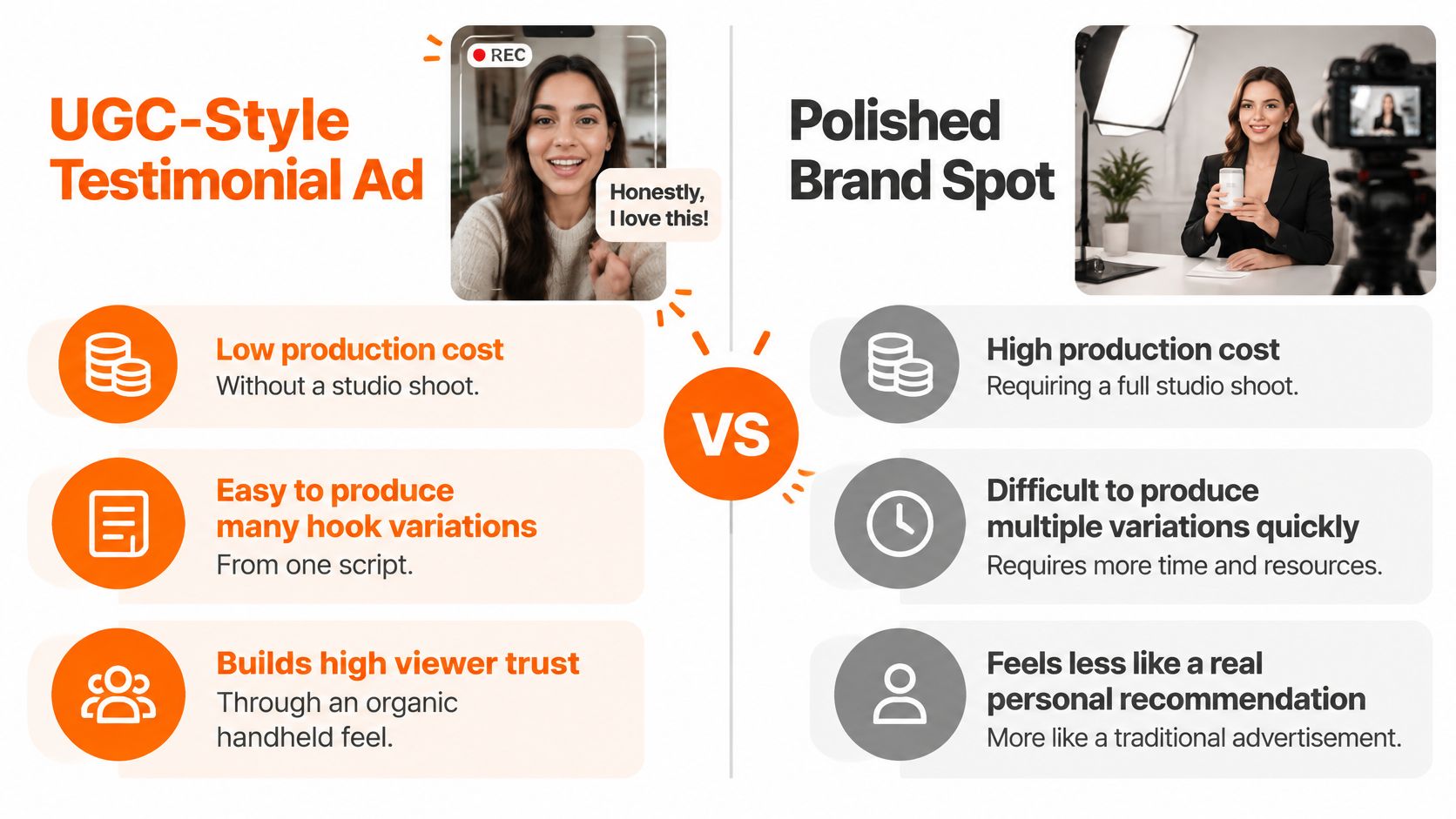
The failure mode is polish creep. Once you add studio lighting, brand voiceover, and three claims, it stops feeling like UGC and starts competing with ads that have far bigger production budgets.
<a id="2-recurring-character-mascot-series"></a>
2. Recurring Character Mascot Series
Kids brands like Cocomelon and Blippi understood something adult brands often miss. Viewers return for a character they recognize, then absorb the product because it's inside the story. A mascot series gives you that repeat-viewing engine in small episodes. Each one needs a tiny problem, a recognizable setting, and a product that appears as part of the solution rather than a sponsored interruption.
Say a small coffee brand builds a barista character who helps neighbors fix small daily messes. The drink appears in every episode, but the emotional hook is the character doing one kind, competent thing. That's easier to remember than a new discount code every week.

Here's a simple episode structure for a 2 to 5 minute story you can later cut into 30 to 45 second vertical clips. Open with the day's problem in the first 15 seconds. Let the mascot try the obvious fix and fail. Bring the product in through action, not a speech. Close with a repeatable sign-off line viewers can anticipate.
<a id="what-keeps-a-mascot-consistent"></a>
What Keeps a Mascot Consistent
Write a one-page series bible before you generate anything. Lock traits, outfit, setting rules, catchphrases, and exactly where the product is allowed to appear. ClipNova's Series mode keeps a cast of up to 8 characters across episodes with story memory, but for a small channel I'd cap the main cast at 3 to 4. More characters create more chances for visual drift and thinner storylines.
Track watch time by storyline, not just by episode number. If viewers finish problem-at-work stories but drop off during errand stories, you've found your lane.
The honest limit is patience. A mascot rarely sells on episode one. It compounds only if you publish steadily and resist redesigning the character every time an episode underperforms.
<a id="3-problem-solution-micro-story"></a>
3. Problem-Solution Micro Story
Don't open with features. Open with the mess. A problem-solution micro story shows a character hitting a familiar frustration, trying a normal fix, failing, then using your product to resolve it. The viewer recognizes their own situation before you ask them to care about your brand.

Creative quality carries real weight here. Google and Nielsen research on YouTube advertising ROI identified creative as responsible for nearly 50% of YouTube advertising ROI, and ads following the ABCD framework achieved a 30% higher sales lift than ads that did not follow the framework. That's attention, branding, connection, and direction, in that order.
Use this 60 second structure. 0 to 3 seconds, show the visible problem. 4 to 20 seconds, let the character try two familiar fixes. 21 to 45 seconds, show the product working and the visible result. 46 to 60 seconds, repeat the product name once and give one next step. Keep dialogue under 40 words so the action stays clear with sound off.
Dollar Shave Club's 2012 launch ad is still a useful reference because it paired blunt humor with a clear price point. A cleaning brand can use the same logic without copying the tone. Show the stain, show three wasted attempts, then show the cleaned surface. If your product needs more teaching than showing, read this guide to AI explainer videos before forcing it into a story.
The common failure is a miracle jump cut. If viewers don't see the process, they won't trust the result, especially for cleaning, beauty, and home products.
<a id="4-product-demo-from-a-product-photo"></a>
4. Product Demo From a Product Photo
You don't need a shoot if you have one strong product photo. This format brings a still image to life with camera movement, a simple scene, narration, and captions. It suits Amazon sellers and small brands that already invested in product photography but can't justify a crew for every variation. You can also compare approaches that turn product photos into Higgsfield videos before you settle on a workflow.
Use this example image as the kind of clean starting point that works best:

For a 20 second candle demo, structure it tightly. 0 to 4 seconds, push in on the lit product in a lived-in setting. 5 to 14 seconds, name three scent notes and one number, such as burn time in hours if you've verified it. 15 to 20 seconds, end on the product, price context if relevant, and one action. Don't narrate five benefits. Viewers won't retain them.
<a id="format-choices-that-save-rework"></a>
Format Choices That Save Rework
A social-video specification guide recommends 1080 × 1920 pixels in a 9:16 aspect ratio for vertical placements such as TikTok, Instagram Reels, and YouTube Shorts, and 1920 × 1080 pixels in a 16:9 ratio for horizontal YouTube videos. Generate 9:16 and 1:1 versions from the same idea so one concept covers Shorts and feed placements. If you're building this workflow for the first time, this overview of picture to video AI covers the image-to-finished-video process.
Watch this example before you write your voiceover, and notice how little explanatory text a simple demo needs:
<iframe width="100%" style="aspect-ratio: 16 / 9;" src="https://www.youtube.com/embed/Wrkw9HjOP4w" frameborder="0" allow="autoplay; encrypted-media" allowfullscreen></iframe>The failure mode is dishonest visual implication. Don't show steam, glow, size, or results your product can't produce. A demo earns trust by staying close to reality.
<a id="5-founder-and-origin-story-documentary"></a>
5. Founder and Origin Story Documentary
Some brands sell on trust before they sell on features. Food, wellness, local services, and handmade goods often fit that pattern. A founder origin documentary explains the specific moment that created the business, the problem that wouldn't go away, and how the product took shape through testing. Patagonia's brand films work this way. They lead with origin and mission, not a direct sales pitch.
Try a 90 second to 3 minute cut. First 10 seconds, open on a concrete failure, such as the day the first batch failed. Next third, show what the founder tried and what customers said. Final third, connect the finished product to that original problem and end with a quiet call to action. Don't interrupt the story midway with an offer.
<a id="credibility-rules-for-this-format"></a>
Credibility Rules for This Format
Use real dates and verifiable numbers where you have them, such as 3 years of testing or 200 customer samples, but only if they're true. Say a small bakery tells the story of a family recipe passed through three generations, then links to its order page. That story works because the product is the evidence. It stops working when the timeline gets vague or every hardship sounds scripted for sympathy.
In ClipNova, you can tell the story with original scenes and a saved character playing the founder instead of reusing stock footage viewers have seen elsewhere. If that approach appeals to you creatively, this piece on making your own movies goes deeper on directing original scenes without a set.
Disclose clearly when an AI character stands in for a real person. There's also a rights limit to understand. A Congressional Research Service summary of U.S. copyright law states that courts have not recognized copyright in works lacking a human author, including works created autonomously by AI systems. Commercial permission to use output and exclusive ownership of every generated element aren't the same thing, so keep your human creative direction documented.
<a id="6-kids-character-product-introduction"></a>
6. Kids Character Product Introduction
A kids product ad has two audiences at once. Children need a character they can follow in seconds. Parents need clarity, safety, and a reason to trust what they're seeing. Build for both, or the format collapses. A cartoon character can introduce a product through a short scene, a simple lesson, or a song, but the learning moment should carry the video. The product can't be the whole plot.
Cocomelon is the obvious reference because recurring characters and songs drive repeat daily viewing. A snack brand could adapt that logic with a mascot who teaches counting at a family table, with the product appearing naturally in the scene. Keep dialogue short, rhythmic, and repetitive enough for young viewers to predict the next line.
Use a 30 to 60 second structure. 0 to 5 seconds, the character greets viewers with the same opening line every time. 6 to 35 seconds, teach one tiny concept, such as counting to five. 36 to 50 seconds, place the product inside the activity. Final seconds, speak to the parent in the on-screen text or description, where platform rules require it.
<a id="why-lip-sync-and-identity-need-separate-checks"></a>
Why Lip Sync and Identity Need Separate Checks
Talking characters only work if mouth movement and face consistency both hold. A lip-sync study on generated video evaluated 32 generated video sets with 39 participants, scoring 3.923 for lip-sync accuracy and 4.128 for character-identity preservation on its rating scale. Treat those as separate quality checks in your review. Good mouth timing with a drifting face will still break trust, especially across a series.
Check COPPA in the US and equivalent rules in every target market before publishing. Review each scene manually, because AI output may need one or two regenerations. Don't target children directly where the law or platform policy expects parent-directed messaging.
<a id="7-serialized-cliffhanger-teaser"></a>
7. Serialized Cliffhanger Teaser
A cliffhanger teaser isn't a product ad in the usual sense. It's an ad for the next episode. Horror, history, documentary, and faith channels use it to turn a one-time viewer into a subscriber who comes back for resolution. That makes it one of the most useful ad video ideas for creators who monetize series viewing rather than a single checkout.
Horror and mystery YouTube channels do this constantly because the format is cheap to test and easy to judge. Either viewers click through to the full episode or they don't. A history channel could tease a letter found in an archive, withhold who wrote it, and reveal that answer early in the next episode. A horror channel can end on a sound at the door and refuse to show what's behind it.
<a id="timing-for-cold-and-warm-audiences"></a>
Timing for Cold and Warm Audiences
For cold traffic, keep the teaser near 30 seconds. 0 to 5 seconds, state the strange fact or threat. 6 to 22 seconds, add one piece of evidence. 23 to 30 seconds, cut on a question and pin the next episode link in the description and final frame. For warm audiences who already know your characters, 60 seconds gives you room for a second clue without losing urgency.
ClipNova's Series mode with story memory helps here because the payoff episode stays connected to the teaser. Your cast, setting, and unresolved plot point carry forward instead of resetting. That continuity matters more than fancy editing. If episode two looks like it belongs to a different series, viewers feel misled even when the story is good.
Payoff rule: Deliver the teaser's answer within the first 2 minutes of the full episode. Delay it longer and your comments will fill with people calling it clickbait, and they'll be right.
The failure mode is stacking mysteries. One open question creates momentum. Three unresolved questions create homework, and new viewers won't do homework for a channel they just found.
<a id="8-faith-parable-brand-ad"></a>
8. Faith Parable Brand Ad
Faith audiences don't respond well to sales language pasted onto scripture. They respond to a story that respects the source, lands emotionally, and only then points to a resource. A faith parable ad uses a familiar narrative structure, a lost item, a forgiven debt, a neighbor helped at cost, to frame a book, ministry, service, or community event without turning the message into a pitch.
Church and ministry channels already use short parable videos as weekly devotional content. A Christian bookstore could run a weekly series where each parable ends with a brief mention of a related book as a study resource. The book appears after the story resolves, not during the emotional turning point. That sequencing protects credibility.
For a 2 to 4 minute version, use calm pacing. Opening minute, establish the ordinary setting and the moral tension. Middle section, let the character make the costly or faithful choice. Closing 20 seconds, reflect briefly and mention the product or service once. Warm lighting, slower cuts, and gentle background music fit better than fast promotional editing.
<a id="language-versions-without-losing-the-message"></a>
Language Versions Without Losing the Message
This format travels well when you localize it carefully. ClipNova narration supports 18 languages, so the same characters, proof point, and story structure can reach multiple audiences. Wistia's 2025 video report found that caption use had increased 572% since 2021, which supports building captions and language versions into the plan from the start rather than adding them later.
Translation alone isn't localization. A literal rendering can flatten a parable's phrasing or make a testimonial sound unnatural. Keep caption lines short, adapt examples carefully, and have a theologically trained reviewer check every script before publishing. Publish on a fixed weekly schedule if you want the devotional habit to form. Random posting rarely builds ritual viewing.
<a id="ad-video-formats-compared"></a>
Ad Video Formats Compared
| Format | Typical Length | Best Placement | Best For | Main Limit |
|---|---|---|---|---|
| UGC-Style Testimonial Ad | 15–45 seconds | TikTok, Reels, and feed ads | Authentic product recommendations and hook testing | Can feel stiff if the script is formal |
| Recurring Character Mascot Series | 1–5 minutes per episode | YouTube and short-form clips | Building a returning audience around a brand character | Needs consistent publishing and strong story planning |
| Problem-Solution Micro Story | 45–90 seconds | YouTube pre-roll and social feeds | Showing a relatable problem and product solution | Weak storytelling wastes the setup |
| Product Demo From a Product Photo | 20–30 seconds | Product listings, Shorts, and social feeds | Showing product details without a physical shoot | Motion may look artificial with poor source photos |
| Founder and Origin Story Documentary | 90 seconds–3 minutes | Brand channels and social video | Building trust for higher-consideration purchases | Slow openings can lose viewers |
| Kids Character Product Introduction | 30–90 seconds | Family and kids content channels | Memorable product introductions for family brands | Strict advertising and age-appropriateness rules |
| Serialized Cliffhanger Teaser | 30–60 seconds | Social ads and series channels | Driving subscriptions and return visits | Needs a real episode payoff |
| Faith Parable Brand Ad | 2–4 minutes | Ministry channels and devotional series | Connecting with faith audiences through story | Requires careful theological review |
<a id="pick-one-format-test-three-hooks-then-scale"></a>
Pick One Format, Test Three Hooks, Then Scale
Don't start by making eight ads. Start by picking the one format that matches your product, your placement, and the action you want. A product with a visible before-and-after belongs in a demo or micro story. A brand built on trust belongs in a founder film. A channel built on return viewing belongs in a mascot series or cliffhanger teaser. Format fit matters more than production style.
The second decision is your test design. Most lists of ad video ideas stop at concepts, but you need a measurement plan before you generate anything. A 2025 survey of 2,500 small-business decision-makers found that only 18% felt very confident in their marketing effectiveness, and 23% said not knowing what was working was a frustration. That uncertainty is a creative process problem. If each variant changes the character, claim, proof, and CTA, you can't tell which choice moved the result.
Use controlled variation instead. Keep one product promise, one character, and one proof scene constant. Test three opening hooks against each other. Then test two CTAs on the winning hook. Judge awareness hooks by watch time and hold rate, consideration cuts by clicks or saves, and conversion cuts by completed actions. Producing endless variations isn't automatically better. Each version should answer a specific question you wrote down before generating it.
Adoption data supports building that testing habit now rather than later. Wyzowl's video marketing data reports that 91% of businesses use video as part of their marketing strategy in its 2026 dataset, and 93% of video marketers consider video important to their overall strategy. The competitive edge isn't using video anymore. It's producing distinct, testable concepts fast enough to learn which message works for which audience.
That's where consistent AI characters change the economics for a small team. Clip generators like Runway, Kling, Veo, and Hailuo make strong individual shots, but you still assemble the story. Template editors like InVideo and Pictory rely on stock footage. Faceless shorts tools like Revid, StoryShort, and Zebracat stop at shorts. Avatar tools like HeyGen and Synthesia make presenters. ClipNova makes the whole finished story, up to 5 minutes at up to 1080p, with script, scenes, voiceover, captions, and background music in one pass.
Pick one format from this list, script three hooks, and generate them with the same face and product in every version. Plans start from $19/mo with commercial rights. Make your first video and judge the results by the metric you chose before you started, not by whichever cut you personally like most.
If you're ready to turn one of these ad video ideas into a testable set of finished ads, ClipNova AI can build the full video with consistent characters, narration, captions, and music in one pass. Choose your format, lock your character and product, then generate three hook variations and let the data pick your winner.
Ready to ship your own?
Start creating viral videos with AI in under twenty minutes, no credit card required.