
You posted a video you're proud of, checked it an hour later, and it's sitting at 140 views. A week later it's at 150. The idea wasn't bad. Something in the delivery stopped it early.
That pattern is common for small accounts. An analysis of 24,283 videos from 518 creators found accounts whose typical video got fewer than 1,000 views had a median of 357 views, and 64% of their videos stayed below 500 views. So getting 500 views on TikTok isn't failure by itself. It's often just the first test audience telling you where viewers left.
Most stalls come from three places. The first two seconds didn't earn attention, the middle lost people before the payoff, or the caption gave viewers and search nothing clear to match. The seven tactics below fix those points in order, with a number to check at each step. If you're also improving short-form video campaigns across platforms, the same batch logic applies. Start here.
Table of Contents
- 1. Hook the Viewer in the First 2 Seconds
- 2. Build for Watch Time With a 60 to 90 Second Runtime
- 3. Design for Sound-Off Viewing With Captions and On-Screen Text
- 4. Turn Recurring Characters Into a Series People Follow
- 5. Write Searchable Captions and Pick Topics People Already Look For
- 6. Use Original Music and Trends With Care
- 7. Post on a Steady Schedule and Review Analytics Before the Next Batch
- How the seven TikTok tactics compare on benefit, best use, and limits
- Run One Batch, Read the Numbers, Then Repeat
<a id="1-hook-the-viewer-in-the-first-2-seconds"></a>
1. Hook the Viewer in the First 2 Seconds

State the conflict before you explain anything. A history video that opens with "Nobody recorded what happened in that room for 40 years" gives a viewer a reason to stay. An opening that starts with your channel name, a slow pan, or background gives them nothing.
The room for error is small. A peer-reviewed study of 9.2 million recommendations from 347 users found average attention stayed around 45%, while 55% of recommended videos were not watched to completion and most were skipped before halfway. If your payoff sits at second 20, many viewers never reach it.
<a id="open-on-the-decision-not-the-setup"></a>
Open on the Decision, Not the Setup
A Bible story can start when Daniel hears the king's order, then explain the background after. A kids cartoon can open with the main character already in trouble, then show how the problem started. The question comes first. The explanation earns its place second.
Write the hook first, then build the script around the promise it makes. If the hook promises a twist, the script has to deliver that twist.
Test two openings on similar topics and compare the 3-second view rate in TikTok Analytics. I wouldn't change topic, length, and hook in the same batch. You won't know what moved. For more phrasing patterns, see the Social Media Scheduler's guide to hooks. When a hook is weak, regenerate only the opening scene instead of rebuilding a video that otherwise works.
<a id="2-build-for-watch-time-with-a-60-to-90-second-runtime"></a>
2. Build for Watch Time With a 60 to 90 Second Runtime

A 75-second horror story can hold a haunting, one twist, and a final line that leaves a question open. Shorter is easier to finish. Too short, and there is no story worth replaying. For story and explainer posts, 60 to 90 seconds is the range I'd test first, with a visible turn every 10 to 15 seconds. That turn can be a new problem, a new fact, a reaction, or a scene change that raises a question.
Completion is rare enough to be a useful signal. The 9.2 million recommendation study cited earlier found most recommended videos were not watched to the end. A strong like ratio can still hide weak retention, because people who liked the opening may have left before the middle.
<a id="split-long-stories-into-parts"></a>
Split Long Stories Into Parts
A 4-minute story works better as three TikTok parts of about 80 seconds each, with part one ending on a cliffhanger. Each part needs its own mini-payoff and a reason to watch the next one. For AI-made story videos, ClipNova episodes come in 30-second, 1, 2, 3 or 5-minute lengths, and story Shorts usually run 30 to 90 seconds in one render, so matching runtime to format costs nothing extra.
- Check the drop point: Open the retention graph and note the exact second where viewers leave most.
- Cut the scene at that second: Shorten it, move it later, or remove it before you touch anything else.
- Log runtime against average watch percentage: Compare formats over 10 or more posts, not two.
Reposting a revised video only makes sense when the edit is substantially different. Otherwise, apply the lesson to the next episode.
<a id="3-design-for-sound-off-viewing-with-captions-and-on-screen-text"></a>
3. Design for Sound-Off Viewing With Captions and On-Screen Text
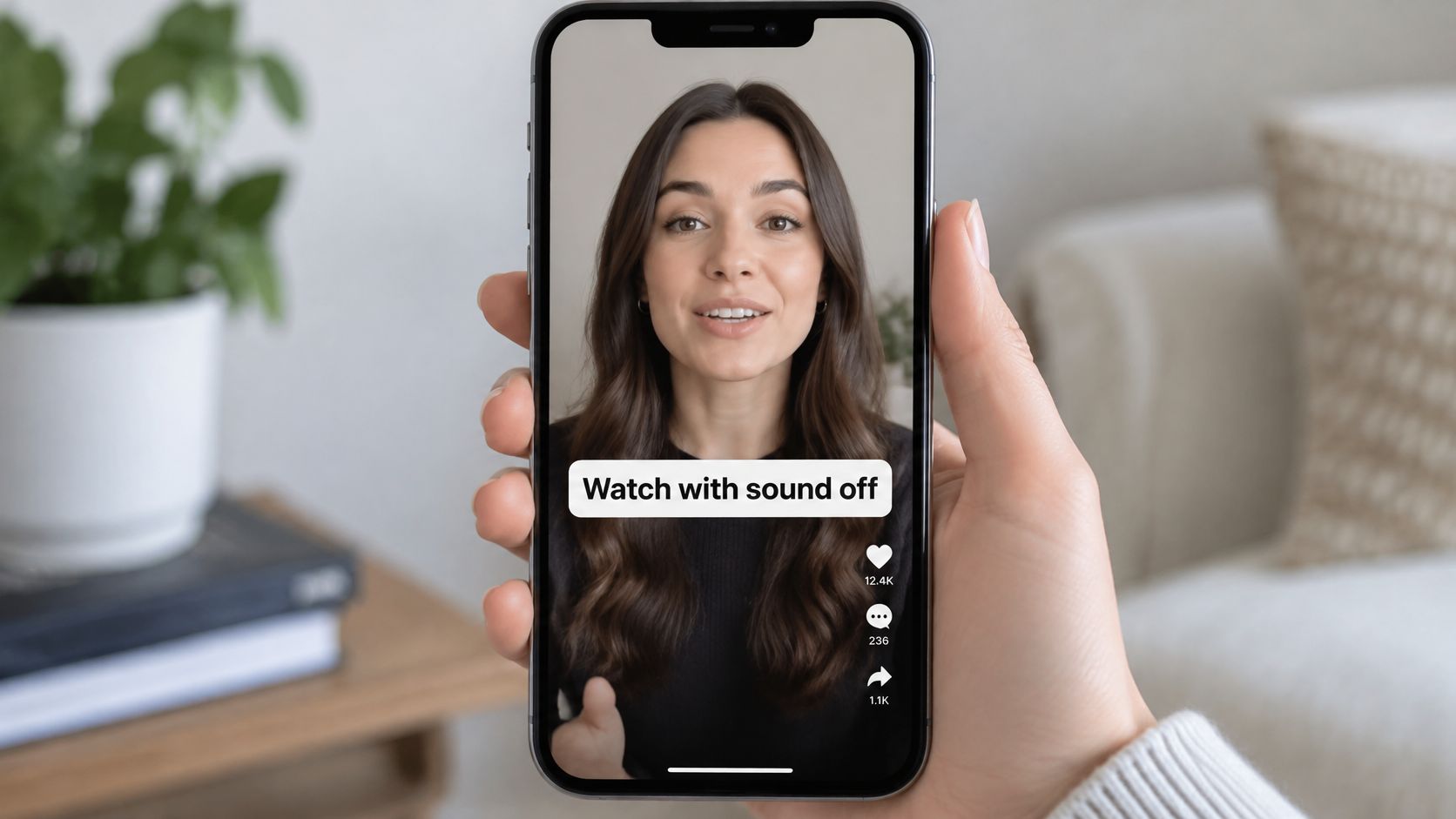
Many viewers watch in public, on a bus, or late at night with sound off. If the topic only exists in audio, they have to work to understand you. Most won't. Burned-in captions that match the narration, plus one short on-screen line stating the topic, make the video readable within a second.
Captions also protect you from a counting trap. TikTok's Creator Rewards qualified views definition excludes views with less than five seconds watched, along with paid and promoted views. A public count of 500 views on TikTok doesn't mean 500 people stayed long enough to count for rewards. Readable first frames help more of them pass that point.
<a id="make-text-do-specific-work"></a>
Make Text Do Specific Work
A history video should show the year and place in the first three seconds. A faith story can show the scripture reference on screen while the narrator reads. A kids cartoon should label dialogue with character names so younger viewers can track speakers. Each text element answers a question the viewer already has.
The short clip below shows why caption placement and timing matter before you publish, not after a post stalls.
<iframe width="100%" style="aspect-ratio: 16 / 9;" src="https://www.youtube.com/embed/t5yFQJy9ZLM" frameborder="0" allow="autoplay; encrypted-media" allowfullscreen></iframe>Keep caption lines to 6 to 8 words so they stay up long enough to read, and place them in the lower third without covering faces. Check every proper noun before posting, since speech models misspell uncommon names and places. For timing, styling, and export checks, follow this guide on how to add subtitles to a video.
<a id="4-turn-recurring-characters-into-a-series-people-follow"></a>
4. Turn Recurring Characters Into a Series People Follow
A one-off video has to win a stranger from zero. A series episode gets help from recognition. Viewers who know the hero, the narrator, or the family need less setup, and they have a reason to open your profile for the next part.
Early response predicts whether that wider push happens. An independent 500-view test study reported posts staying in initial testing averaged 418 views, while broad-distribution posts averaged 11,073 views, and during their first 500 views the broad group had an 11.58% like rate compared with 7.43% for limited posts. Familiar characters can lift that early response because returning viewers react faster and comment with context.
<a id="keep-the-cast-recognizable"></a>
Keep the Cast Recognizable
A horror anthology can keep one recurring narrator who introduces each case. A Bible series can follow one family across episodes, with a one-line recap at the start. A kids series can keep three characters, solve one small problem per episode, and end with a question for next time.
- Lock the look once: Save each main character with a clear reference image and a fixed outfit, then reuse them.
- Add a one-line recap: New viewers should follow episode four without hunting for episode one.
- Number the parts: Titles like "Part 3" and a playlist make earlier episodes easy to find.
- Start small: Two or three faces are easier to remember than a full cast on day one.
Character dialogue matters here too, which is why testing formats like a talking avatar for direct address scenes can help separate narration from on-screen speech.
<a id="5-write-searchable-captions-and-pick-topics-people-already-look-for"></a>
5. Write Searchable Captions and Pick Topics People Already Look For
People search TikTok the way they search the web. They type a question, a place, a verse, or a character name. Your caption, your on-screen text, and your spoken first sentence should all contain the phrase they'd type. "Pompeii 79 AD in 60 seconds" tells search more than "history facts part 12."
This matters more as small-account reach tightens. An analysis summarized by Xtended View's TikTok statistics found accounts with 1,000 to 5,000 followers averaged 350 views per post in 2025, down from 860 in 2024. Broad topics put you against every large channel covering the same ground. A narrow topic with existing search demand gives TikTok a clearer audience to test.
<a id="build-the-caption-from-the-search-bar"></a>
Build the Caption From the Search Bar
Type your topic into TikTok search and read the autocomplete suggestions before you write anything. Those suggestions are phrases real people use. Pick one, put it in the first line of the caption, and say it in the first spoken sentence so the captions carry it too.
Practical rule: If your caption wouldn't work as a search query, rewrite it until it does.
A fact channel can title a post "Why did the Titanic sink so fast" and answer inside 10 seconds. A faith channel can name the book and chapter, such as "Genesis 22 explained in 75 seconds." Use three to five hashtags that describe the topic. A long list of unrelated tags dilutes the signal you're trying to send.
<a id="6-use-original-music-and-trends-with-care"></a>
6. Use Original Music and Trends With Care
A trending sound can get you discovered, and it can also make a serious story feel like a meme. That's the trade-off. I'd use a trend sparingly, as a short sting in the opening or on the final beat, and let original background music carry the story. Horror, history, and documentary tones rarely survive a comedy sound pasted over them.
There's also a hard limit if you plan to pay for reach. TikTok's Promote advertising policy states only videos using original sound or sounds permitted for commercial use can be promoted. A video built on a restricted trending clip may do fine organically and still be blocked when you try to promote it.
<a id="match-volume-and-mood-to-the-narration"></a>
Match Volume and Mood to the Narration
Keep music 10 to 20 decibels below the voiceover, then lower it further if any line needs effort to hear. A history channel can keep music quiet and let silence carry the serious moments. A horror channel can run a low ambient track throughout and reserve a short stinger for the jump scare.
- Check recent activity: Open the sound page and look at how new the latest uses are. Drop a stale trend.
- Keep one series theme: The same opening music across episodes becomes a recognition cue.
- Test one against one: Post one trend version and one original-music version on similar topics, then compare average watch time.
If the trend version wins on views but loses on completion, it brought the wrong audience. That's not growth you can build on.
<a id="7-post-on-a-steady-schedule-and-review-analytics-before-the-next-batch"></a>
7. Post on a Steady Schedule and Review Analytics Before the Next Batch

One post tells you almost nothing. A batch of four on the same format tells you whether the format works. Set a cadence you can hold for a month, then read the numbers before you produce the next batch. Changing everything after a single flop wastes the only asset a small channel has, which is comparable data.
Judge engagement against your size, not a large channel. Socialinsider's 2025 TikTok benchmark post reported accounts with fewer than 5,000 followers averaged a 4.20% engagement rate by views in 2025. On 500 views on TikTok, that is about 21 combined likes, comments, and shares. Above that line, the video earned its reach. Below it, look at where viewers dropped off before you blame the topic.
<a id="review-one-batch-change-one-thing"></a>
Review One Batch, Change One Thing
A faceless history channel posting four videos a week can track which era holds the highest completion over a month. A fact channel can change only the hook on half its posts and compare 3-second view rates. Both learn something they can repeat. A channel that rewrites topic, length, voice, and hook in the same week learns nothing, because no single change can be tied to the result.
Log views at 24 hours, 48 hours, and 7 days, plus average watch time, completion, profile visits, and follows. Review every 7 days and pick one variable to change for the next batch. A schedule only works if you can keep it, and TheContentMap's guide to sustainable publishing covers how to set a cadence that survives a busy month. If production itself is the bottleneck, an automated video production workflow lets you produce a week of episodes in one session, and you can then upload the MP4 files on the schedule you set.
<a id="how-the-seven-tiktok-tactics-compare-on-benefit-best-use-and-limits"></a>
How the seven TikTok tactics compare on benefit, best use, and limits
| Item | Core Benefit | Best For | Key Limitation |
|---|---|---|---|
| Hook the viewer in the first 2 seconds | Captures attention early and encourages viewers to keep watching | Any short-form video, especially stories that can open with conflict or a strong question | A strong hook cannot make up for a story that fails to deliver |
| Build for watch time with a 60 to 90 second runtime | Balances completion potential with enough time to develop a story | Story and educational videos with one clear arc | Complex topics may need multiple parts |
| Design for sound-off viewing with captions and on-screen text | Keeps videos understandable without audio and improves accessibility | Videos with narration, key names, dates, or information to follow | Captions can obscure visuals or be hard to read if poorly placed |
| Turn recurring characters into a series people follow | Encourages recognition, repeat viewing, and interest in the next episode | Serialized stories and channels with a recurring cast | Long-running plots can be difficult for new viewers to follow |
| Write searchable captions and pick topics people already look for | Helps match videos with viewers searching for relevant topics | Evergreen history, faith, and educational content | Search visibility does not guarantee viewers will watch through |
| Use original music and trends with care | Sets the mood while letting trends support, rather than dominate, the story | Story channels seeking a consistent tone or series sound | Trends fade quickly, and music can compete with narration |
| Post on a steady schedule and review analytics before the next batch | Creates regular opportunities to learn from performance and refine content | Creators who can sustain a posting cadence and track results | Early analytics can be noisy, and no schedule guarantees views |
<a id="run-one-batch-read-the-numbers-then-repeat"></a>
Run One Batch, Read the Numbers, Then Repeat
Don't try to fix seven things on your next post. Pick two tactics, apply them to a batch of three to five videos, and compare that batch with your last one at 24 hours, 48 hours, and 7 days. Keep what moved completion or shares. Drop what only moved views while watch time fell.
That ranking order isn't guesswork. TikTok's guide to how it recommends content says that for most users, interaction signals, including time spent watching a video, are generally weighted more heavily than other factors, and it lists likes, shares, comments, follows, watching in full, and skipping among those signals. There's no public 500-view gate to pass. There's an audience sample reacting, or not reacting, to specific choices you made.
So read 500 views on TikTok as a sample size, not a verdict. Compare it with the median of your previous 10 to 20 posts. If this video beat your median with stronger completion, study its first scene and repeat that structure. If it landed far below your median, the opening is the first suspect, the drop point in the retention graph is the second, and the topic is the third.
Two workflow notes before you post the next batch. If a video promotes a product, an affiliate link, or a sponsored story, turn on TikTok's content disclosure setting at publish time. TikTok treats that as a requirement for promotional content, not a step you add after a post performs, and the obligation doesn't change because a post is small. Second, record whether you used Promote on any post in the batch. Paid and organic views look identical in the public count, and mixing them will corrupt every comparison you make afterward.
If you want story videos with consistent characters cut into 60 to 90 second parts for TikTok, you can make your first video and produce the batch as one series instead of five unrelated posts. Then let the retention graph, not the view count, decide what you make next.
ClipNova AI makes finished videos up to 5 minutes at up to 1080p with script, scenes, voiceover, captions, and music in one pass, and saved characters keep the same face and outfit across every episode. For a channel working to move past 500 views on TikTok, that means you can test a new hook or a three-part series in one batch instead of spending days on a single post. Visit ClipNova AI to build your next batch and read the numbers it gives you.
Ready to ship your own?
Start creating viral videos with AI in under twenty minutes, no credit card required.